User Comments - Fiona@ChinesePod

Fiona@ChinesePod
Posted on: Introduce Your Name Like a Native
July 24, 2015 at 3:18 AMHow about this: 我姓 艾,艾草的艾,叫尚仪,高尚的尚,礼仪的仪。
Posted on: Introduce Your Name Like a Native
July 24, 2015 at 3:14 AMHi Nick, perhaps you could try something like this. 我姓 倪,叫志坚。 人字旁的倪,意志的志,坚强的坚。意志 is willpower and 坚强 is strong, so it sounds quite nice.
As to the remembering of the name, that's up to you! ;P
Posted on: I Dropped My Phone Down The Toilet
May 29, 2015 at 10:07 AMHi Sigma145, great explanation.
Hanks in response to you question:
尴尬 is indeed awkward - "我刚刚碰到我前男友,好尴尬。" "I just bumped into my ex boyfriend, aaaaakwaaard." It's more how you FEEL.
Whereas 丢脸 has more to do with your reputation and how an action might affect how others view you. “刚刚说错话,好丢脸!“ “ I just misspoke! how embarrassing!”. So in this case, misspeaking can definitely make you feel awkward as well as embarrassed but there is more of a focus on the shame you feel as others judge you.
Hope that helps.
Fi
Posted on: I Dropped My Phone Down The Toilet
May 29, 2015 at 9:58 AMHi guys, thanks for spotting this discrepancy. There seems to be a little mix up with the scripts. Please refer to the dialogue tab for the correct version for now. I'll get the voice actors in asap to fix the problem and get back to you guys. Fi
Posted on: 见面三分情
May 29, 2015 at 9:52 AMHi Bergmaaj and MingMao, they are very similar terms and are often used interchangeably, especially when you are talking about reaching a certain target through something. Two pictures came immediately to mind so I drew the attached pic.
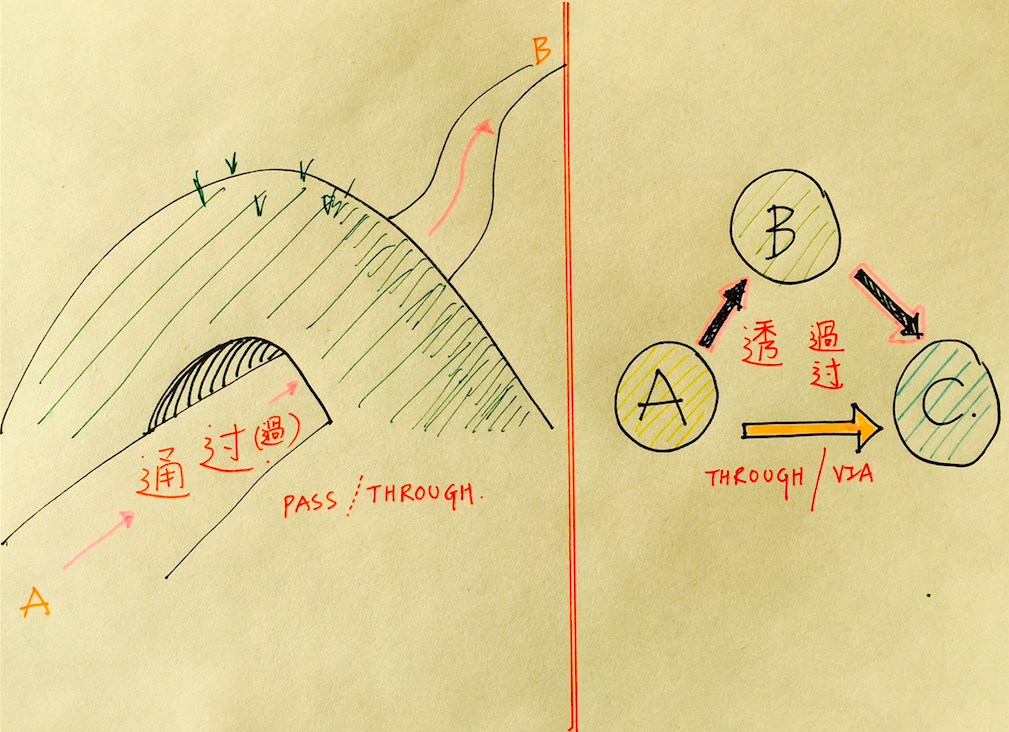 However, one of the main differences is the basic meaning of 通过。 通过 can be used in two ways. Whereas, 透过 is nearly always "through or via". Check out the example sentences that Constance put together. Hopefully that will make things more clear. If it's still not clear, I'll think of another way to explain it. Fi 通过 as "pass": "需要通过入学测试才能进入大学。"; "这条法案去年就通过了"
通过 as "through"雅虎通过天猫卖日货。
透过 as "via": A透过B认识C
Posted on: 音乐祭
May 19, 2015 at 5:09 AMHi Dong Hua Sen, with regards to the supplementary vocab "音樂季", Constance and I talk about the difference between 音樂季 and 音樂祭 at the end of the podcast. Sometime these characters can be used interchangeably but generally speaking we feel that for short music events such as the one in the dialogue today we would use "祭", and "季" for longer events that say happen over a few weeks for months. Hope that helps :)
Posted on: Who's That Over There?
April 1, 2015 at 8:37 AMThe “shui” you are hearing might be a dialectal pronunciation. Both mean the same thing but "shei2" is much more common.
Posted on: Who's That Over There?
April 1, 2015 at 8:34 AMI think that this qing wen will answer some of your questions.
In this context: If you use 不, this will mean that they never have a habit of wearing this item of clothing. And if you use 沒 this will indicate that they are not wearing the item now. So by saying 不穿裤子的人是谁 you are essentially saying that “who is that person that always doesn't wear pants”.
Posted on: That's Not Literature!
April 1, 2015 at 8:22 AM我们有提到‘三国演义‘,也有提到 ”金庸“ 的书。他是一位非常有名的武侠小说家。若果你喜欢武侠小说的话,一定要看金庸。
Posted on: Introduce Your Name Like a Native
July 24, 2015 at 3:19 AMThat's a very clear explanation with good examples. Keep with it! :)