The Economics of Iron Ore – or ‘not everything is cheap in China’
bodawei
August 10, 2010 at 04:26 AM posted in General Discussion
Rio Tinto mines iron ore in the Pilbara at cost of about US$20 per tonne, and pays freight for transporting the ore to China of between US$8 and US$10 per tonne. In this September quarter it is receiving a price of a little under US$160 per tonne. (Price falls to US$130 per tonne next quarter.)
Subtract production and freight costs from contract prices (160 – 28 or 30) = US$130 per tonne (approx.) in profit. [Rio currently produces around 230 million tonnes per year.]
Source: John Garnaut (Tuesday 10 August 2010), ‘How Lucky to sit at the peak of a boom’, The East is Red, Sydney Morning Herald.
‘The Lucky Country’ do I hear you say? Admittedly the numbers look pretty good. The arithmetic has of course stirred Chinese production, but Australia is still enjoying a ‘resources boom’. Unfortunately, the big miners can afford those expensive TV ad campaigns informing fellow citizens that the Government’s planned resource rent tax will ruin the whole economy (and not just their annual bonuses.)
suansuanru
August 25, 2010 at 09:15 AM
小区内means小区的中心,the center of the 小区。
"靠+something" means "close to" something. For example,if you have 2 chairs in your room,one is in the center of your room,while the other is close to the door,so we can call the latter "靠门的椅子".
So you may have many 卧室,but one is close to the center of your 小区, so that is "靠小区内的卧室".

bodawei
August 22, 2010 at 11:47 AM
Hi suansuanru
I am indeed happy that you have drawn a plan of my 小区 sight unseen! :)
You are absolutely right because last night my landlord sent a dozen photos of the damage in question. The whole affair has challenged my Chinese! We will have workman around for a few days soon fixing it up - I will have to learn some vocab such as: water damage, stains, mould, damp, leaks, etc. :)
But I am still wondering about the expression “靠小区内的卧室” - could the landlord have made a mistake? I don't think it is 方言 - he is a Kunming native but he always speaks standard Chinese with me.
suansuanru
August 20, 2010 at 02:58 PM
I don't really think so.
Actually,I don't know what it exactly means,just guessing it would be something like this…… 呵呵

changye
August 20, 2010 at 01:42 AM
Hi suansuanru
Good job! I believe that bodawei would be very happy with the drawing. Incidentally, I have a question. Is the phrase “靠小区内的卧室” correct/standard Chinese?
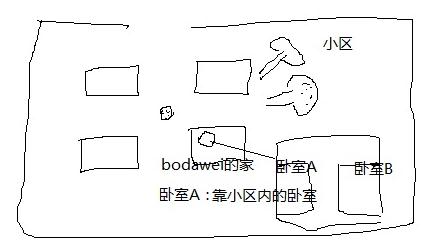
bodawei
August 18, 2010 at 08:46 AM
suansuanru - you need to check the uploading. I can't see a photo - just a kind of blurred image of the name of the site fotop.net. I wasn't sure whether this is what you want me to see. Or have you got a real photo? :)
bodawei
August 17, 2010 at 11:35 AM
Hi suansuanru
Are you recommending this site for uploading photos? I gather it works in China? (I'm in Australia at present.) Sorry if I did not catch the meaning of you post.
bodawei
August 12, 2010 at 11:06 AM
What is the meaning of this expression:
靠小区内的卧室.. ?
I have never seen 小区 used this way, to describe the geography of a building? Does it just mean 'in the vicinity of the bedroom..'?
BTW - I have resorted to editing old posts to make a post - neither posting mechanism seems to work for new posts. (And hasn't worked for me for some time now.)
bodawei
August 17, 2010 at 11:31 AM
Hi Zhenjljiang - I really liked your inventive interpretation. But I think Changye nailed it - it is almost certainly what he means, although it is a construction I have not seen before I can see how it works. I imagine 靠 as 'leans' - so the bedroom 'leans toward' the middle of the 小区。
I would like to put the landord's writing on record - once I get back to China I will be finding and posting more photos, I can do that. He writes with such care .. a lovely bloke ... Actually his wife speaks Japanese, not that that is any use at all for communicating with me! :)

zhenlijiang
August 17, 2010 at 08:59 AM
Oh 不好意思 Bodawei for letting you think the light was dawning.
So it's 靠~内 meaning "facing into"? You could also say 靠~other directional words I guess?
You had a 牌子 post on handwritten signs that I enjoyed. I guess this isn't a sign, but I'd like to see your landlord's handwriting!
bodawei
August 16, 2010 at 10:50 PM
Hi Changye
I replied yesterday, and it posted fine, but today my post has gone! Most curious.
In essence I was thanking you for making the meaning of 靠小区内的卧室 clear to me - I realise now that it refers to a bedroom which does indeed face into the 小区. This contrasts with our other two bedrooms which face the bush. (I was also thanking Zhenlijiang for her help earlier.)
changye
August 16, 2010 at 05:13 AM
Hi bodawei
I guess what your landlord wants to say is something like "the bedroom, which faces toward the center of the district" (靠小区内的卧室), although I don't know if the Chinese phrase is grammatically correct.
bodawei
August 15, 2010 at 11:11 PM
Zhenlijiang - aaah, the light is dawning - thank you so much. I am aware of and understand several applications of 靠 (even if I find it hard to use them myself) but I did not think of 'rely on the evidence'. I am sure you are right - it makes sense to me now.
And your rationalisation of 小区内的 is also feasible, even if quite strange to me. In English we would just say 'the' bedroom, not even 'the' flat, because context has already confirmed which bedroom we are talking about.
I like to study my landlord's missives because he is such a literate person I am sure it is correct, I just need to learn the expressions he uses! His hand writing is also beautiful - on a par with my daughter's. :)
zhenlijiang
August 15, 2010 at 11:45 AM
Ow, no edit function. 痕迹 is not the damage, but rather the traces left behind.
zhenlijiang
August 15, 2010 at 11:41 AM
While we wait for Suansuanru to come back--about 小区, just seeing this sentence cold I assume it means your building. I don't know why your landlord said 小区内的; I wonder if it's a way to form a good written (and to sound formal maybe?) sentence without making such (strictly speaking) inaccurate references such as 你们的.
靠痕迹 I am interpreting as "rely on the traces left (to deduce or draw conclusions)." From the stains, or whatever traces of the water damage that are apparent to the eye, what we can see is--and he lists the damage done and not done.
bodawei
August 15, 2010 at 10:58 AM
thanks Zhenlijiang for your help but I am very dim about this - I don't know what either 靠 or 小区内 means here
靠 - in the area of ??? what does 靠痕迹 mean?
小区内 - this I don't understand. He is talking about some water damage (some 痕迹) inside a flat - can you think of why he refers to 小区内? Is he just saying/meaning the bedroom in the 'flat in the housing complex'? I am not sure why it needs this context - this came at the end of extended correspondence about a flat that is well know to both of us!
zhenlijiang
August 15, 2010 at 06:47 AM
Bodawei I think 小区内的卧室有水流下来的 is one phrase specifying what 痕迹. It's 靠痕迹 blahblahblah.
bodawei
August 15, 2010 at 06:11 AM
哦谢谢,
我的房东联系我:
靠小区内的卧室有水流下来的痕迹,主要的情况是: 水影响了两面墙, 衣柜有点受潮, 卧室门暂时关不上,床头滴过一点水,
你们的衣物和被子看上去没有大问题.
多半我明白,‘’靠小区内的卧室’‘我不明白。
有人确切地告诉我句子的意思吧?
bodawei
August 12, 2010 at 01:13 PM
bump. I just wanted to try that - the first time I think that I have bumped anything with a bump.
Anybody know what this means?
suansuanru
August 20, 2010 at 01:20 AM