Zhou170902January 1, 2012
普通话怎么说:"I would like to get up early tomorrow" 和 "he would like to go home a bit late today"?
可不可以说: “我想明天早点儿起床” 和 “他想今天晚点儿回家”?
谢谢。
Pǔtōnghuà zěnme shuō: "I would like to get up early tomorow" hé "he would like to go home a bit late today"? Kěbù kěyǐ shuō: "Wǒ xiǎng míngtiān zǎodiǎn er qǐchuáng" hé "tā xiǎng jīntiān wǎndiǎn er huí jiā"? Xièxiè.


matthewrudyJune 8, 2011
I imagined this as a couple lying in bed,
but the sound of the door closing at the end ruined it a little.

timothygstoutMarch 26, 2011
One of the expansion sentences says: 我们明天要早点儿起床。The translation says, "Let's get up a bit early tomorrow."
So, can 要 yào mean "Let's" too?
watyamacallitMarch 27, 2011
Not sure, but I don't think that is translated correctly. To keep that English translation I would drop the 要 and add a 吧:
我们明天早点儿起床吧。

JasonSchMarch 28, 2011
Yeah, as watyamacallit has pointed out, the English should read, 'We have to get up...' 要 here meaning, 'must'. If there's more context, it could also be translated as 'will' and be simply, 'We will get up a bit early tomorrow'.

baha17March 24, 2011
Hi Everyone,
I live in Macau. For my personnel experience from Cantonese, I think when the girl says "真无聊" she is saying kind of guy is boring unlike she is bored. What do you think?
Baha

JohnMarch 28, 2011
baha17,
We actually had a big discussion about this before doing the lesson, and the native speakers felt that it was much more likely in a situation like this to so that she was bored rather than that the guy was boring. But both interpretations are possible.

thinkabroadMarch 24, 2011
Sounds like the woman needs to find a more energetic and interested male friend. Great lesson!
kelunMarch 21, 2011
Whats the difference in saying "you are boring" & "you are bored" ?

catherinemMarch 22, 2011
Someone is boring if he or she is not interesting to other people. For example:
"You always stay at home alone and play on the computer. You're so boring!"
Someone is bored if he or she is not interested in anything that's going on. For example:
"There's nothing to do right now and no one is here to hang out with... I'm so bored!"

xiao_liangMarch 22, 2011
Perhaps they meant in Chinese?
e.g. 你无聊了 - you are bored
你无聊了 - you are boring
I think from another lesson though, the answer was "context", right?

cinnamonfernMarch 22, 2011
Yep - it's based on context! I once asked this question - this is the answer Jenny gave me:
"无聊 and 没意思 can both mean "bored", but they can also mean "boring". To make the distinction, you can use the word "觉得”, which means "to feel".
他觉得很无聊、他觉得很没意思 clearly means "he is bored". "
Hope this helps!
kelunMarch 27, 2011
Yes, that helps. Thanks. I just didn't want to offend anyone it they were looking like they were bored and I was telling them they were boring. ha ha. Thanks
user9476March 21, 2011
Did you notice that 困 , when it means "sleepy", is written 睏 in traditional characters, with the "eye" radical ?
cjmdjyMarch 21, 2011
Right. It is not a rare phenomenon. Another example: "干" is written "乾" in traditional Chinese when it means “dry”(乾燥,干燥), and written “幹” when it means "do"(幹什麼,干什么)。

arnevanvlietMarch 18, 2011
in the dictation exercise I believe to hear at the end of one sentence '' 玩儿'' while the correct answer given is ''你无聊吗?要不要一起出去玩'' , i.e. without 儿.
Do I hear this correct?
Are 玩 and 玩儿 interchangeable?
Thanks for this lesson!

bodaweiMarch 19, 2011
You're correct, the speaker says 玩儿 but the 'correct' answer is 玩. The exercises are all linked to each other and the expansion sentences, so you can check in the multiple choice section what the answer is in the dictation section that will be deemed correct.
They are interchangeable although 玩儿 is more natural.
You have the satisfaction of knowing that you detected the 玩儿 regardless of what mark it gave you.

fulankelinMarch 18, 2011
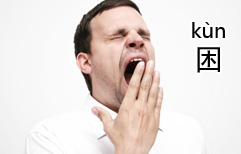
The character 困 (a tree in a box), kùn means both "sleepy" and "to trap". How do you know the difference? I suppose it is one of those you can tell by context things.

bvbeckmanMarch 18, 2011
I've never seen it as "to trap", but I know it also means "fasten together". Perhaps you are thinking of 圈套 ?

dagahMarch 18, 2011
Sorry for being off-topic from this lesson, I dont know what forum I'd put this. How to say "better safe than sorry" in chinese? Is there a chengyu or something?
dagahMarch 23, 2011
I dont think that's a good translation.. that sounds more like "be careful not to do a big mistake".
cantbelazyMarch 17, 2011
can I say " nǐ xiànzài hē kāfēi, wǎnyìdiǎn shuìdezháo ma ? "
Are the tones and everything right ?

pauleyMarch 18, 2011
your drinking coffee now ,will you be able to sleep a little later on.
is that the translation
cantbelazyMarch 18, 2011
thank you !!!!! : )
so it's 睡不着 (shuìbùzháo) for "can't sleep",
and
睡得着 (shuìdezháo) for "can sleep" ,
right ?


anonymous546627April 16, 2011
So the difference between 累 and 睏 seems to be
累 tired -- 睏 sleepy
???
If you are tired, but not want to sleep:
我很累。
If you are tired and want to go to sleep:
我很睏。
or
我又累又睏。
Am I right??
What did you notice in this lesson?
You are posting as a guest. Your reply is reviewed before it appears. Log in to post without review.