MingmaoNovember 11, 2010
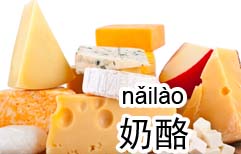
I see that there's been some brief mention of this in the comments already, but I'm still not quite clear: what is the difference between 奶酪 and 芝士? (My typing program doesn't even recognize 芝士 as a word.)

jklinnellNovember 9, 2010
Ellen, this is the correct lesson for Friday (Thursday my time), correct?
Kim
coco71October 5, 2010
An error in the expansion sentences translation: mouseover for 同学 reads correctly classmates, but the translation sentence uses coworkers.

chanelle77July 30, 2010
We just ordered Gouda cheese with this Dutch organic farmer: http://www.cheeseinchina.com who resides in Shanxi province. His products are reasonably priced and they ship (anywhere) in China and are produced in a healthy, natural way :-)

zhenlijiangJuly 29, 2010
So is 奶酪 nǎilào the most common term for cheese? My (Japanese-Chinese) dictionary tells me it's 1) a type of yoghurt; 2) cheese. The same dictionary says干酪 gānlào is cheese, and 乳酪 rǔlào is 1) a yoghurt-type lactic acid drink; 2) cheese.How frequently are these other two terms seen and understood as "cheese"?

simonpetterssonJuly 29, 2010
Down here I've never heard (or, more often, seen, as I've encountered it on menus) it referred to as anything but 芝士*. When I first arrived, I called it 干酪 and people understood me, but nobody else used it.
*Actually, not true. I've heard it referred to as "cheese", as well. As in "你们在瑞典喜不喜欢吃cheese?"
simonpetterssonJuly 29, 2010
But then again, there's a lot more sound transcription going on here than in the North, I suspect. Which is weird, because people here don't speak English. I think it's because English words are widely used in the middle of speech in HK Cantonese, both directly and in sound-transcribed forms.
There's a local semi-western restaurant with particularly weird names for the dishes. Often they make up their own transcriptions. Luckily there are pictures as well as English translations. Otherwise I'd have trouble with menu items like "法兰西多式" and "菠萝班戟".

xiaophilJuly 29, 2010
Simon
At the Subway shop I frequent in Shanghai, I hear 'cheese' most often. 奶酪 is what is written on the signs. It seems to me 奶酪 is occasionally heard, or perhaps that is only what I tell myself as I don't ever say 'cheese.' My Subway experience is total Chinese time.


changyeJuly 29, 2010
Major cheese producers in China, such as 蒙牛 and 伊利, use the name “奶酪” for their products.
http://www.21food.cn/product/detail606065.html
http://www.emengniu.com/bj/images/200908/goods_img/24_G_1250129523827.jpg
http://www.emengniu.com/bj/images/200908/goods_img/32_G_1249943947263.jpg
zhenlijiangJuly 30, 2010
Thanks everybody for all the live input straight from China. Great supplement to the lesson.
奶酪, 干酪 and 乳酪 (more frequently the first two) I'm seeing in things people have written--translated from other languages maybe--and published on the Internet, about French and Italian cheeses.
So I think I'm taking away from all this--cheese is still in the process of becoming part of people's lives in China, so we'll see in a few years, what it ends up getting called most widely?
simonpetterssonJuly 30, 2010
法兰西多式: French toast
菠萝班戟: Pineapple pancake
The transliterations probably sound better in Cantonese. They usually do.
That, by the way, is the answer to the question of so many Chinese students: "Why do the transliterations sound nothing like the original words?" It's usually because they were made in Cantonese, not Mandarin.

bababardwanJuly 30, 2010
thanks simon..that's a good tip about transliterations via Cantonese and makes sense.
zhenlijiangJuly 30, 2010
Oh haha. Yeah thank goodness for menus with pictures.
I've mentioned this before, but often Japanese pronunciations of characters will be close to Cantonese. Japanese like myself who know zero Cantonese will go to HK and see "的士" written on the cabs and immediately recognize the word "taxi", because we can read those characters as teki-shi. I guess to someone who has only learned how to read hanzi in Mandarin the association is much more of a leap, if it can be made at all. I tried to explain once, but couldn't make my teacher from Qingdao see the point (she had learned to read characters as Japanese kanji too, so you would think she would get it ...).
changyeJuly 30, 2010
的士
Mandarin .................di shi
Cantonese ...............dik si
Shanghainese ...........diek si
Middle Chinese .........diek dzi
Korean ....................chok sa
Vietnamese ..............dich si
Japanese .................teki shi / chaku dzi (漢音/呉音)
bodaweiJuly 29, 2010
Where have the posts gone? It seems that the majority have disappeared. Are they being kept safe?

go_manlyJuly 29, 2010
The rest of the comments are on page 1 (this is page 2). Unfortunately the page selector is nowhere to be seen. You have to get there by editing the URL directly.
This problem also occurs in other threads.

xiao_liangJuly 29, 2010
I've contacted tech support on this issue (for example in the lesson suggestion thread, the selector only shows pages 1-6, but the thread itself is onto page 8). Got a reply from Peter:
Hi Steve,
Thank you for informing us of this technical error on our website. I have forwarded your email to our tech team and will try to resolve this problem as soon as possible.
Thank you for your comments and we appreciate your continuing support.
Best regards,
Peter
Customer Support Representative // ChinesePod
zhenlijiangJuly 29, 2010
Thank you for volunteering your time and trouble to report the issue to tech support on our behalf, then telling us you did so XiaoLiang. The message here is duly noted ...
Would a disorder such as this one really fail to be noted by CPod within (regular workday) 24 hrs, if users did not report it? I just have to wonder this aloud.
siyiJuly 28, 2010
In Yunnan we ate a fried goat cheese made by the Bai people of Dali. It is called 乳饼 rǔbǐng.
It's Bai name is youdbap, meaning goat's milk.
From Wikipedia:
It is made by mixing heated goat's milk and a souring agent, traditionally a mixture called năiténg (奶藤; lit. 'milk cane') made from a cultivated vine.It is often served pan fried, and dipped in salt, sugar, or mala powder. It may also be stir fried with vegetables in place of tofu. Much like paneer or queso blanco it is an unaged, acid-set, non-melting farmer cheese, but with the aroma of fresh goat's milk.
Thinking of Yunnan, a wonderful part of China,
莫思怡
weibwoJuly 28, 2010
Didn't want to eat the cheese because it smelled bad. Spoken by a culture that eats stinky tofu?????
brianhzJuly 28, 2010
The only Chinese cheese i have had was in Langmusi in Gansu. It was dried crumbled stuff and had to be soaked in hot water before eating. After a few soakings it was still quite chewy but I had bought it from a local guy so was going to eat it. It didn't have much taste and the taste that it did have wasn't very good. I couldn't eat it all. I had a bottle of not so good Chinese wine to go with it.
i buy australian and new zealand cheese at carrefour in Hangzhou. It's the only good tasty cheese i can get. No soft cheeses here though. I get good parmesan brought here by people coming to visit.
zhenlijiangJuly 28, 2010
Anyone else having problems seeing all the comments here?
OK I left the page once then came back. To be more specific: I could see the first comment made here (Tal's) for a second, then when the page settled down, everything in the thread above pretzellogic's saying Yikes. A thread about cheese, and no one has mentioned Wallace and Gromit. or the first 50 or so comments, became invisible again.
* edit * OK now it's like playing the slot machine, with this page. Seems like if you can "grab" the page by clicking somewhere (I just did, wildly) before it settles down, it's possible to capture it with all comments intact. Oh and sometimes you're just lucky and there are no problems showing all comments in a normal manner ...

kimiikJuly 28, 2010
I think that this discussion was automatically divided on 2 pages :
https://chinesepod.com/lessons/smelly-cheese?page=1
https://chinesepod.com/lessons/smelly-cheese?page=2

texastochinaJuly 27, 2010
There are many delicious cheeses without getting into canned, powdered and smelly ones. I think there should be a positive view of learning about cheeses in China but remember always that you should only use it as a condiment. It is not healthy to eat too much.
Some of the best tasting are as follows:
Brie
Creamy to hard depending on the age. Be careful. Softer is milder. It is strong tasting and used often with fruit preserves on buttery french bread.
Gouda Cheese Common, flavorful. Made in Holland. Cut in thin slices and melt it over bread. Good starter cheese.
Swiss Cheese
Thin slices are best. It can be very good melted over ham.
Havarti Cheese
I think this is the best tasting.
Have with pear or sweet wine. It is not too strong.
Cheddar Cheese
Most popular in America. Good on beef. Most common.
Eat with Italian food only. Maybe too strong.
Feta Cheese
Popular in America. Used with bread or on salads in small quantities as a flavoring.Gruyere Cheese Try it with something sweet. Just a little goes a long way.
chanelle77July 30, 2010
As a fellow cheese lover, I politely disagree with you on the fact that cheese should only be used as a condiment :-).
Dutch are quite famous for cheese and eating a lot of it (and a lot of other dairy products). Being the tallest people of the world and not (that) overweight and having a relatively high life expectancy is positively related to their diet.
Diet products, too much sugar and everything packed in cans, bags, boxes it much more unhealthy than some good old natural cheese :-) I often hear people say cheese is not healthy but I think that people first need to take a look at the rest they are eating :-) So, i'd say (fresh)cheese is healthy!
chanelle77July 27, 2010
I should have written this one down when I bought Cheese fondue in China, but how does one say that in Chinese? :-)
bababardwanJuly 28, 2010
奶酪火锅:
http://www.google.com.au/images?hl=en&source=imghp&biw=1280&bih=830&q=%E5%A5%B6%E9%85%AA%E7%81%AB%E9%94%85&btnG=Search+Images&gbv=2&aq=f&aqi=&aql=&oq=&gs_rfai=

bababardwanJuly 30, 2010
yeah, and easy to remember since it's not it's own separate word but just cheese added to hot pot. It was a good question because I love fondue. Interesting to hear you've had it in China too.
Sorry folks, just realised I forgot what thread level I was on and forgot to post the English above:
奶酪火锅 nǎilàohuǒguō [cheese hotpot]
ruishiredbirdJuly 31, 2010
Well a good Fondue you have to make it with Swiss Chesse!
The Picture is good!
kimiikJuly 27, 2010
I'm surprised it wasn't mentioned before but in Asia 芝士酱 (cheese spread) seems to be widespread. Maybe because it speads easily and widely compared to dry cheese. ;o)
笑牛牌
卡夫


chanelle77July 27, 2010
I know I should hang my head in shame, but I do have the La vache qui rit in my fridge *blush* :-) Interestingly, the taste is different in China than in France / Holland.

pretzellogicJuly 27, 2010
Yikes. A thread about cheese, and no one has mentioned Wallace and Gromit.
kimiikJuly 27, 2010
Asterix in Corsica

billJuly 27, 2010
This reminds me of my first trip to France in 1990. We were visiting friends in Saint Malo and they brought out a cheese that looked and smelled like it was lost in the 垃圾箱 (lājīxiāng or garbage can) for a few weeks. Well, I too felt like excusing myself from the table. Our host then went to his wine cellar and returned with a bottle of 1971 Grand-Echezeaux.
Well, I'm definitely glad I stayed to enjoy this unbelievable combination of wine and cheese. Needless to say my wife and I have returned to France more than 40 times since then.

christofJuly 27, 2010
Jenny,
I'm glad you wrote you liked Brie, because comparing the smell of French cheese to chòudòufu ... that's not fair and I had to protest !
luoqing313July 27, 2010
oh, choudoufu is my Hunan province special product, have u been to Changsha eat the real choudoufu?
christofJuly 28, 2010
No, I can't say I have, but I tasted it in Shanghai... and ... I can't think of any French cheese that you could be able to smell from 1 block away !
kimiikJuly 28, 2010
Actually, with the right wind, you can smell french cheese from one block away. But stinky Tofu doesn't need any wind to smell from 1 block away.
It is also said that french cheese can smell like feet whereas stinky tofu smells like rotten tripe (a totally different category.)

JohnJuly 28, 2010
Christof!
Wow, it's no good to see you! Did your acute French sense of smell pick up the scent of smelly cheese in our podcast? :)

catherinemJuly 28, 2010
Haha Cristof! It has been a while. Of course your return to join the discussion of stinky cheese (and stinkier tofu). How decidedly Gallic of you ;) On the topic of French 奶酪, I have to say I'm a big fan of Camembert. (卡门贝干酪, kǎménbèi gānlào).
christofAugust 3, 2010
Hi Catherine, Hi John,
I thought you'd know by now that my main mission back in the days was to insert a watchdog in ChinesePod source code to warn me in case of major attack on French culture ! Well, the alarm went off !
(and I'm glad it gave me the opportunity to say 'Hi' to my beloved former colleagues :-) )
kimiikJuly 27, 2010
According to a british University, here is the liste of cheese with the strongest flavours :
Rang
Fromage
Origine
1
Vieux Boulogne
France, Boulogne-sur-Mer
2
Pont l'Evêque
France, Normandie
3
Camembert
France, Normandie
4
Munster
France, Alsace-Lorraine
5
Brie de Meaux
France, Meaux
6
Roquefort
France, Midi-Pyrénées
7
Reblochon
France, Savoie
8
Livarot
France, Normandie
9
Banon
France, Provence
10
Epoisses
France, Bourgogne
11
Parmesan
Italie
12
Raclette
France, Alpes françaises
13
Ossau Iraty
France, pays basque
14
Cheddar
Royaume-Uni
15
Crottin de Chavignol
France, Centre
But If you leave any of them out of the fridge for few days, it can easily be number 1.
jjinfranceJuly 27, 2010
I am so surprised to see Camembert and Reblochon on the list. For me, they are almost the lightest 起司。
kimiikJuly 27, 2010
I agree for the Reblochon, but for the Camembert I hope you tried the real one (soft and smelly) not the pasteurized and artificial "Camembert" (hard and dull.)

stellacadenteJuly 27, 2010
Of course, if you consider smell, Limburger should be on the list, although its taste is quite mild.

zhong_bideJuly 27, 2010
I haven't checked back on all the previous Qinwen's, but these complements that Chanelle77 and Zhenlijiang have been discussing are problematic for me in terms of any consistency in meaning. Maybe a Qingwen?
zhong_bideJuly 27, 2010
I have bought and eaten blocks of cheese in Beijing, but it was aweful tasteless stuff. However I love cheese, so I persevered - still better than having none at all.
Make me fat though when I have my midnight snacks.

jennyzhuJuly 27, 2010
Brie (布里/bùlǐ) and gouda (黄波/huángbō) are my favorite!
pretzelllogic36July 7, 2011
I looked this up. Bō, sometimes bāo, seems to mean shell, peel, skin,
and strip sometimes, or sheet as in sheet metal. Hope that helps. But
I wonder about the shūfá. Are the characters here for huángbō simplified Mandarin. I think they are but I'm not sure. They look different from
the ones in my dictionary which are the traditional ones.
pretzelllogic36July 8, 2011
Duìbuqǐ, dàjiā. Wǒ de dàoqiàn. The posting above from yesterday is all wrong. I looked up the wrong character. The characters in my
dictionary are very small and I didn't have my magnifying glass with me
yesterday. Today I do and I see that the bō in Jenny's huángbō means
wave or ripples or an unexpected turn of events, not at all what I wrote
yesterday.

jen_not_jennyJuly 27, 2010
Personally, I think that 芝士粉 zhīshì fěn is a singularly accurate term for this:
That doesn't deserve to be called cheese...芝士,吉士, or 奶酪。。。
JohnJuly 27, 2010
If they call it 双吉 (shuāng jí), maybe that could go even further and call it 喆 (zhé). :)
stellacadenteJuly 27, 2010
Although ironically, the pic you posted is of 100% real cheese; it's just dried. It's serviceable for weeknight pasta dinners. But the other kinds are gross beyond belief. And I can no longer eat mac & cheese from the box. I can't even be around it; the smell makes me sick. But I still love *real* mac and cheese, so I've perfected my own recipe for it. My Chinese teacher from Beijing, who's been in N. Am. for over a decade now, despises cheese, esp. mac & cheese and esp. the box kind. I wish I could have had her at least try my homemade. :-)
eupnea63355July 27, 2010
I would call that nasty stuff (Kraft Parmesan) "fermented dairy product seasoning powder." I agree, not worth of "cheese" included in it's name.

chanelle77July 27, 2010
Do not get me started on Cheese :-) 刷卡 is my first Chinese word, 卡门贝, my second :-)
xiao_liangJuly 27, 2010
Hey chanelle, 你的最好的奶酪是什么?可以在中国找吗?:-p
Nǐ de zuì hǎo de nǎilào shì shénme? Kěyǐ zài zhōngguó zhǎo ma?
chanelle77July 27, 2010
嗯, 最喜欢的是:Old Amsterdam, 可惜在南京买不下。
en, zuì xǐhuān de shì: Old Amsterdam, kěxī zài nánjīng mǎi bù xià.
JohnJuly 27, 2010
Do you know many other cheese names? It seems like a lot of times the "Chinese translation" is simply descriptive and seems inadequate to handle the wide world of cheeses. An example: grated parmesan is often just called 芝士粉 (zhīshì fěn), literally, "cheese powder."
http://item.taobao.com/auction/item_detail.htm?item_num_id=3757203249
卡门贝 (kǎménbèi), "Camembert," is a counter-example.
http://www.nciku.com/search/en/%E5%8D%A1%E9%97%A8%E8%B4%9D
JohnJuly 27, 2010
By the way, the typical verbs for this discussion are:
买得到 (mǎi de dào) for "can be bought," as in, "can you buy it in China?"
买不到 (mǎi bu dào) for "cannot be bought," as in, "you can't buy it in China."
I got extensive practice with these particular complements through my attempts (and many failures) to buy shoes my size in China.
xiao_liangJuly 27, 2010
Also, looks like a trip to Beijing might be in order!
http://www.thefreelibrary.com/Chinese+cheese+lover+tries+to+win+over+Beijing-a01611915648
xiao_liangJuly 27, 2010
Woah, and there is a Beijing Cheese Society!
http://www.grapewallofchina.com/2008/03/11/gouda-times-beijing-cheese-society-goes-%E2%80%98all-china%E2%80%99/
chanelle77July 27, 2010
Hi John, The German Bakery here uses phonetic translations or descriptive for example 巴尔马干酪 if I'm not mistaken.
Regarding the complements of 买 my Nanda teacher told me besides, the one you mention you also have 买不下 and 买不上。 I remembered it like, the latter you do not have the money to buy and the first you are unable to buy? I might have mixed up those two, need to check that...
zhenlijiangJuly 27, 2010
Hi Chanelle -不上 can be used with 买, but not I don't think for what you wish to say--that you aren't able to buy that cheese because it's not available in Nanjing. -不上 is for when some obstacle prevents some act from being completed successfully. 这个门关不上。zhège mén guānbushàng This door won't shut (stay shut, maybe). is one example. 人太多,买不上 rén tài duō, mǎibushàng There were just too many people, I couldn't get XX. is another given by my dictionary.
-不下 I'm quite sure you can't use with 买; it expresses that there's no room (in your stomach to eat [吃不下 chi1buxia4], in your suitcase to pack some article [装不下 zhuang1buxia4], for people to sit on a bus [坐不下 zuo4buxia4], etc.).
买不起 mǎibuqǐ would be "can't afford to buy".
chanelle77July 27, 2010
Thank you for your help Zhen! I might have mixed up a few, complements here for example with the 买不起。 I checked my book because I was sure there was a 买下 construction, but I might have used it wrong :-). These complements confuse me to no end. Sorry for the mix up. Anyway here is what I found:
Here is the sentence: 最后他决定买下他盼望已久的一套面积64平米两居室。(zuìhòu tā juédìng mǎixiàtā pànwàng yǐ jiǔ de yī tào miànjī liùshísì píngmǐ liǎngjūshì.)
My book says the following: 动词+下(+名词): this construction indicated the completion of an action and parting with something. Sometimes it also suggests the sustainment of a result. So I figured: finally he was able to buy his house. I turned around the construction to make it: I am unable to buy x in Nanjing.
zhenlijiangJuly 27, 2010
Ah I'm not familiar with this Verb+下 (+Noun) , but think in any case that V+下 is not the same as V+得下 dexià. (And the -得下's, the affirmatives I think we generally see less frequently than the -不下's).
BTW regarding 吃不下, besides "can't eat = no room in stomach", it also has the meaning "can't eat = have no appetite (because of illness, a broken heart etc.)".
Yes these complements are a lot of trouble (even though I like them). And there are so many that get used with 吃! But I'm very gradually becoming able I think, to get them sorted out ...
Hope you get more authoritative help on 买下!

chanelle77July 27, 2010
I think it is :-) And had no idea how to write "overjarige brokkelkaas" ! hahaha!
chanelle77July 27, 2010
Hi Zhen, to be honest I have no idea about the (subtle) differences of all the complements. Therefore, it would be nice to have examples with 吃 and 买 with every possible structure.
I learnt the 吃不下 from my ayi, I told her I was not hungry because my cat was sick and she used, 吃不下。 Although I find the complements very difficult, they do make sense and are of great use (if I will ever master them. Another difficult one for me is 出来 and 起来。
Maybe someone will come to the rescue!
JohnJuly 27, 2010
Hasn't anyone ever had any China/cheese experiences?
bababardwanJuly 27, 2010
No, but I note that McDonalds does not call their cheeseburgers 奶酪汉堡包 but rather 吉士汉堡包 with 吉士 being the word for cheese ...a transliteration.
bodaweiJuly 27, 2010
We need a Related Lesson link to Hungry Traveller: Yunnan - I believe that there were cheese related stories there. People visiting here return home with 乳饼 rubing (goats cheese) in their ports. [I threw the 'ports' in for you, John - that is how they say 'bag' in Queensland.]
ellen_counselorJuly 27, 2010
If you see 芝士zhi1shi4 / 奶酪nai4lao4 / 吉士ji2shi4 / 乳酪ru3lao4,they all refer to one thing: CHEESE.
ellen_counselorJuly 27, 2010
Many cheese looks like soap. I didn't like it at first. But now I get used to it.
pretzellogicJuly 27, 2010
I didn't mind cheese looking like soap, but I minded when it smelled or tasted like soap.
ellen_counselorJuly 27, 2010
Haha.....For some people, maybe cheese smells like hell but tastes like heaven.

oranginaJuly 27, 2010
I just have to comment on how sad it is that McDonald's has been referenced in a discussion about cheese... Not that I am blaming anyone... it is a fact of life in China. But it reminds me of when one of my friends commented that the only time in her life she ate raw vegetables was the lettuce on her McDonald's hamburger. I almost cried. This is what she thinks of raw vegetables??? No wonder she didn't join us at dinner (featuring a lovely shredded cabbage salad,) claiming she had already eaten... McDonald's cheese isn't as offensive as McDonald's lettuce however. At least it serves the purpose of gluing the bun to the meat.
If you aren't used to cheese I'd say start with a medium cheddar or a jack. Work your way up to the hard stuff... and by the hard stuff I mean the soft stuff.
I have a friend visiting from France. Well, I never met her before, but she brought chèvre, chocolate and rosé, so now she is a friend for life.
eupnea63355July 27, 2010
... it is a fact of life in China. But it reminds me of when one of my friends commented that the only time in her life she ate raw vegetables was the lettuce on her McDonald's hamburger. I almost cried. This is what she thinks of raw vegetables??? end quote
I have a Chinese acquaintance that is in her late 60's. She will not eat any raw vegetables. "The Chinese cook everything." she says. I too think this is sad. I eat as much raw plant foods as I can, including home sprouted seeds and greens blended into healthy drinks. I give her credit for making careful, thoughtful forays into many aspects of American culture, but this is the one area in which she will not venture, FOOD. She will not do raw!
chanelle77July 27, 2010
I agree with you :-)
Bit off topic but might be interesting: Just read an article in a Dutch newspaper, that because of the increasing popularity of fast food, the Weightwatchers are expanding in China. Now there is only one branch in Shanghai.
http://www.bloomberg.com/news/2010-07-27/weight-watchers-adapts-point-system-to-china-as-it-seeks-growth-ceo-says.html
http://www.telegraaf.nl/buitenland/7268806/__Chinezen_moeten_op_dieet__.html?sn=binnenland,buitenland ("Chinese must go on a diet")
Some people I know refuse to eat cheese because of fat etc, but I do believe that real products do not make you gain weight. I eat sugar, real butter and real cheeses, and have no serious weight issues. Of course I always want to loose 5, but that is just "in my head" :-)
weibwoJuly 28, 2010
We had some Yak cheese in Li Jiang on our last trip to Yunnan. The tase was fabulous not to mention Yak Yogurt. Recommend it highly.
There is a reason that the Chinese don't eat fresh vegetables and that has to do with the extensive use of night soil as fertilizer in the past. Eating raw vegetables was an easy way to get sick - gastritis.
bababardwanJuly 30, 2010
orangina,
I agree with your kanfa [way of looking at things] and indeed am refreshed to hear it particularly after recently watching Jamie Oliver's Food Revolution USA which leaves one with the impression that poor diet and a lack of basic knowledge about fruit and vegies was a particular problem there [at least in a town in West Virginia]:
http://www.jamieoliver.com/campaigns/jamies-food-revolution
I was under the impression that cheese and dairy products in general are not so common in China and thus I thought the most likely place one may encounter Cheese in China was at a place like McDonalds [ or a Pizza joint I guess]. The first word I learnt for cheese was 乳酪 [rulao] whereas here it was 奶酪 [nailao] so I was curious to see what was used at McDonalds.
go_manlyJuly 27, 2010
Amazingly, this is the first time 一些 has ever featured in an Elementary or Newbie dialog.

TalJuly 26, 2010
A couple of errors in the expansion sentences:
He gave me some books as a gift.
He went swimming with some classmates.
But thanks for the one about farting.
TalJuly 26, 2010
有一天,我的中国朋友问我:最臭的奶酪就是最贵的奶酪,为什么呢?
Yǒu yī tiān, wǒde Zhōngguó péngyou wěn wǒ: zuì chòu de nǎilào jiùshì zuì guì de nǎilào, wèishénme ne?
What did you notice in this lesson?
You are posting as a guest. Your reply is reviewed before it appears. Log in to post without review.