mrzhouMarch 28, 2012
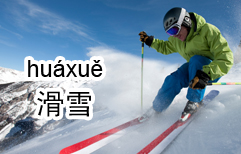
Does anyone know the Chinese word for "cross-country skiing" (a.k.a. nordic skiing)? I have been asked a couple of times whether I like to 滑雪, and I could not find out how to say "I like cross-country skiing".
Thanks!
pretzelllogic62July 1, 2011
May liǎng ge in the dialogue and last two expansions also be translated as 'both', e.g., "I thought both were about the same"?

PurrfecdizzoMay 7, 2010
I think that water skiing might be either 滑水, which is my best guess, but perhaps it may be 滑江.
hank77January 28, 2010
My question is why 別? Can I just say 沒有差?
謝謝
sometimes,Chinese also say:“沒有差”,It's OK! If you say 沒有差 whit Chinese,in normal conditions, they will understand what your mean.沒有差is a slang sometime.
But the 没有差别 is formal.
The 差=V. =differ from.actually the 别=N.=distinction; difference.

lujiaojieApril 18, 2010
差别 chābié is a noun means "difference, distinction".
As a noun, 差 chā also means "difference", but it is used in "mathematics".
So 没有差 is not good for "no difference".
As a verb, 差 chà means "be short; lack".
You can say:
差两块钱 chà liǎngkuàiqián(Two yuan short)。
差三个人 chà sānge rén (Three more people are needed. )
You can also say 不差钱 bùchà qián for "not short any money".

dunderklumpenJanuary 20, 2010
@cpod
I'd like to know how to say "After christmas I got the flu and could not go out skiing". I'm not sure where to put the wicked 了...
;-)

helencao_counselorJanuary 20, 2010
圣诞节过后我得了流感,不能出去滑雪。
sheng4dan4jie2 guo4 hou4 wo de2le liu2gan3,bu4neng2 chu1qu4 hua2xue3.
Hope that helps!
dunderklumpenJanuary 21, 2010
Hi helen,
Thanks! Can I also say "圣诞节以后我感冒了,不能出去滑雪。"? Sheng4dan4jie2 yi3hou4 wo3 gan3mao4 le, bu4neng2 chu1qu4 hua2xue3.
helencao_counselorJanuary 27, 2010
也可以的。不过用 “过后” 更好。 (bu2guo4 yong4 'guo4hou4' geng4hao3---but using 'guo4hou4 is better')
Normally, if it's a festival, we use the verb '过',which means 'to spend;to celebrate'. For example, 过新年guo4 xin1nian2---to celebrate New Year、过圣诞节guo4 sheng4dan4jie2--- to celebrate Christmas.
punter888December 14, 2009
How does one say snowkiting in China. I know the water version is 风筝滑雪。 Also, does anybody know where this is done in China if at all. To many trees in Yabuli. I am thinking of driving my kite right up the middle of downtown Harbin on the frozen Harbin River during ice festival, but fear the local authorities might not see the humour in this.

JasonSchDecember 13, 2009
@vann000
这么 can be translated as both 'so' and 'that' or 'this' when, it's indicating the degree of something. 这么 + adj.
When it's before a verb, (like 这么做) it carries a bit fo a different meaning, but is still translated the same. (Like this, like that, like so, like such)
The reason we keep it 'so' in the vocab is because to simply use 'this' would confuse it with 这个. The translations, however, can provide some contexts in which it might be translated differently.
Hope that helps.

vann0000December 12, 2009
Some signs that use the characters of danger... Can you find the characters?

svikDecember 11, 2009
vann000
I think all are proper translations. I think the issue is that the sentence structure between this sentence
你这么快,太危险了!
and an equivalent English sentence would be quite different. I think a good translation would be:
It's dangerous to go so fast!
(or that fast)
vann0000December 11, 2009
CPOD Team,
这么, when used in the sentence,
你这么快,太危险了!
means something like
"this much / this way / like this"
but, your translation for both are different...
The sentence in the dialog is translated as...
"this"
but, it is translated in the vocabulary as...
"so"
What is the proper translation for this term?

shanghai_heliosDecember 10, 2009
Yabuli has two main resorts, and a bunch of rope tow type places. Sun Mountain is good, with new modern lifts, equipment, and a lodge. Google the webpage.
The PRC national team practices at the other place, and the runs are good. It is where the World Winter University Games were held last year, the Asian Winter Games in the past, and where China wants to hold the Winter Olympics.
The train from Harbin stops at the bottom of the mountain, so getting there is easy.
The bottom of the ski areas are a bit chaotic with hundreds of people trying skiing for just a couple of hours. You can get ski or snow board lessons.
There are also tons of tourists bused in to take the lifts up to top of the mountain. More tourists than actual skiiers, which means the mountain is actually free of skiers and the runs are wide open. No lift lines. But the resorts make more money off these tourists so they had closed the top lift. Thus, you end up spending all day on the mid-mountain lift, that is, between the tourists sight-seeing at the top and the beginers at the bottom.
And yes, there are local Heilongjiang ski bums at these places.

jennyzhuDecember 10, 2009
There are some small ski resorts outside Beijing. But the most famous one in China is Yabuli/亚布力/yà bù lì in Harbin/哈尔滨。

pretzellogicDecember 10, 2009
there are a couple of places outside Lanzhou where people ski. Not quite sure if its Steamboat Springs (powder) or Killington (ice), but it's better than nothing.

bababardwanDecember 10, 2009
svik,
As soon as I knew we were to have a lesson on skiing,that was the first thing I wanted to know about.I've known heaps of Aussies go to Japan for skiing but I don't recall anyone telling me they went skiing in China.Shanhai_helios has mentioned Yabuli which wikipedia says is near Harbin and is China's largest ski resort:
https://en.wikipedia.org/wiki/Yabuli_Ski_Resort
shanghai_helios has also mentioned Wanlong which is in Hebei province.
Yeah,I'd love to hear more discussion about China's ski resorts,how they accomodate snowboarders etc ,as I'd love to combine a trip to China with a snowboarding holiday one day.Anyone with any experience of China's ski resorts?
lujiaojieDecember 10, 2009
asia2010You can say:Are you going to mop?你要去拖地吗? nǐ yào qù tuōdì ma?I done it 4 times.我已经拖了4次了。
lujiaojieDecember 10, 2009
lamartiniere,Yes, you can conclude that the verb is always 4th tone and the noun 1rst tone.差 has another pronunciation "chāi" in the word "出差/ chūchāi /business trip "I think http://www.nciku.com is a good online-dictionary.
lujiaojieDecember 10, 2009
dunderklumpen,You're right. 想 is more like "assume/imagine/ guess". Thank you for your perfect answer! 我想滑雪和滑冰差不多。(Someone tells me what skiing and ice skating is like. I draw the conclusion that they are pretty much the same. Think=assume, imagine, guess,...=想)我觉得滑雪和滑冰差不多。(I have tried skiing and ice skating. I think (by experience) they are pretty much the same. I think=my opinion is, I feel, I consider, I know,...=觉得)
asia2010December 10, 2009
I know this is off the topic, but I was wondering how you would say the following in Chinese:
Are you going to mop?
I done it 4 times.
I ask because I work in a Chinese restaurant

lamartiniereDecember 10, 2009
Thanks a lot lujiaojie. Your helpful answer lead me to the dictionary and now I realize that 差 in 差不多 is 4th tone (chàbuduō) and 差別 is first tone (chābié). Should I conclude that the verb is always 4th tone and the noun 1rst tone?
Besides, could you please recommend me a good online-dictionary (with traditional character)?
Anticipated thanks.
L.
dunderklumpenDecember 10, 2009
@jiaojie
When meaning 'to think', 想 and 觉得 are almost interchangeable.
I hope there is still a little difference. Otherwise I must relearn ;-)麻烦您给一下批改:
我想滑雪和滑冰差不多。(Someone tells me what skiing and ice skating is like. I draw the conclusion that they are pretty much the same. Think=assume, imagine, guess,...=想)
我觉得滑雪和滑冰差不多。(I have tried skiing and ice skating. I think (by experience) they are pretty much the same. I think=my opinion is, I feel, I consider, I know,...=觉得)
OK?
dunderklumpenDecember 10, 2009
@Shanghai_rocks
I once saw this road sign: 小心路滑 xiao3xin1 lu4 hua2 Careful, slippery road.

bodaweiDecember 9, 2009
@Jenny
ah, 明白了。 Yes, it is about positive and negative implications - it is only living here in China that I have recognised the expression being used with negative connotations (in the sense that I might possibly suffer from the adjective 差不多.) Thanks for your example.
You might recognise the Australian expression 'she'll be right' - carries a similar idea?
jennyzhuDecember 9, 2009
@bodawei,
差不多 means 'more or less the same', 'no great difference'. I think what you are confused by is that 差不多 can have both positive and negative implications. In your example, my interpretation is that the shopkeepers means 'ok, I'll give it to you'.Now, that's a positive result. But quite often, 差不多 implies a compromise on standards. For example, you want things to be done to a certain standard, but people who work with you say '差不多就行了', which means 'that will do, no need to be so strict'. When quality and standards are involved, 差不多 often means a compromise and being slack.
bodaweiDecember 9, 2009
I'll try my question again .. expressed another way.
In fact I'll give an example in English. You are looking at buying a T-shirt marked $110. You offer the shopkeeper $100 and they respond along the lines that 'the difference is not big.' 差不多. Do they mean (a) you're right, there is little difference, I'll give it to you for $100, or (b) you're right, there is little difference, pay the full price of $110 [you tight *******].
Do native speakers believe there are these two possible interpretations of 差不多? This slight but sometimes important ambiguity?
If so, how would you respond to seek clarification?
jennyzhuDecember 9, 2009
@scoldilocks88,
Jimijames is correct. But we use 滑旱冰/hua2 han4 bing1 and 旱冰鞋/han4 bing1 xie2 more than 轱辘鞋/gu1 lu xie2.
@jimijames,
Thank you for your help as always.
@mystic,
'Snowboarding' is 单板滑雪/dān bǎn huá xuě. 单板 means a 'singular board'. How graphic!
lujiaojieDecember 9, 2009
lamartiniere,
差别 chābié is a noun, but 差chà is a verb/ adj. so you can just say: 没有差别 for "there is no difference".
shanghai_heliosDecember 9, 2009
In addition to listening in the Alps, Chinesepod users could also listen to the lessons on the slopes here. Yabuli is fairly good.
Anybody been to Wanlong and the new Italian-invested resort next to it?

abelleDecember 9, 2009
Ni hao! How do you say "snowboard" in Chinese? My brother lives in Utah and this is his winter sport instead of skiing. He used to play ice hockey from when he was 5 to 12 years old, but likes snowboarding now. --Mystic

go_manlyDecember 9, 2009
vann0000
I too like to understand the meaning of each character in a 'word', because often that adds shades of meaning to the word (and very often it doesn't help in the least).
But, once its done, its done. I hope you don't break down every word in every sentence, including the words you've seen before. I think that would be an inhibitor of progress. The word breakdown should be done while studying new vocabulary, in order to get a feel for those words. But once you have progressed to studying sentences which use this vocabulary, you don't want to be held back by analysis of the character composition of each word.
jimijamesDecember 9, 2009
@scoldilocks88
轱辘鞋 gūluxié Roller Skates (Shoes)
轱辘鞋滑速赛 gūluxiéhuāsùsài Roller Skating Speed Race (Roller Derby)
jimijamesDecember 9, 2009
@Shanghai_rocks
Careful The Kitchen is very slippery.
小心.厨房地板是很湿滑的
xiǎoxīn. chúfángdìbǎnshìhen3shīhuáde (Careful. The kitchen floor is very slippery(due to wetness))
jimijamesDecember 9, 2009
@scoldilocks88
Roller Skating 旱冰 hànbīng
sìlúnhuábīngxié 四轮滑冰鞋 Four Wheeled Roller Skating Shoes. or 旱冰鞋 hànbīngxié Roller Skate Shoes.
vann0000December 9, 2009
I'm working the lesson. The way I do it, is deconstruct each character, research and then build up the sentence. Here is the first sentence...
rowynokeDecember 9, 2009
This lesson came at just the right time! My boyfriend wants me to help him while he learns Chinese and asked me how you said ice skating the other day for our next date! So thanks! I'm still not sure I understand the 差不多thing yet. It just confuses me a lot.
scoldilocks88December 9, 2009
How about the words for roller skating (not rollerblading but the "old" kind with four wheels: two in front and two in back); also for roller derby? I have tried to find the Chinese translations for a while, without much success.
Thanks for any help or insight!

jwhitsonDecember 9, 2009
Could someone give me a quick explanation of the difference between 想 and 觉得 when meaning 'to think?' Thanks!
dunderklumpenApril 18, 2010
Hi jwhitston
我想滑雪和滑冰差不多。(Someone tells me what skiing and ice skating is like. I draw the conclusion that they are pretty much the same. Think=assume, imagine, guess,...=想)
我觉得滑雪和滑冰差不多。(I have tried skiing and ice skating. I think (by experience) they are pretty much the same. I think=my opinion is, I feel, I consider, I know,...=觉得)
(Copied from the elementary lesson "Skiing, Not Ice Skating")

waiguorenDecember 9, 2009
@shanghai_rocks
I've seen signs in restaurants that say '滑地小心‘ which I 'spose means 'wet floor - be careful!'
As for the kitchen being very slippery, I think I'll leave that up to the experts...
lamartiniereDecember 9, 2009
If 差不多literally means ''difference NOT big'' and 差很多''difference VERY big'', there should have an expression that means "No difference". I was thinking of 沒有差, but I have found the expression is 沒有差別 (there is no difference) in the dictionary.
My question is why 別? Can I just say 沒有差?
謝謝
L.
hank77January 28, 2010
sometimes,Chinese also say:“沒有差”,It's OK! If you say 沒有差 whit Chinese,in normal conditions, they will understand what your mean.沒有差is a slang sometime.
But the 没有差别 is formal.
The 差=V. =differ from.
Actually the 别=N.=distinction; difference.

kaixin_in_tampaDecember 9, 2009
Hi, speaking of gliding and slipping, how do we describe a surface as "slippery"? E.g.,
Careful, the kitchen is very slippery.
bodaweiDecember 9, 2009
Nice lesson.
I have a problem with 差不多 - it's to do with that vagueness in Chinese. (Thanks for explaining how to refute with 差很多).
I believe that it can mean either (a) so close there is no need to dispute the difference, as well as (b) there is actually a small difference. The meanings are conveyed by way of both context and body language. 差不多 (b) is said with a note of concern, or as an admission. 差不多 (a) is said with a smile, like 'we both know the difference is not worth worrying about'. Does anyone else worry about this vagueness in meaning?
好像两个意思像一样差不多。 (It seems that the two meanings are close.) But - am I worried about how close they are, or am I suggesting 'don't worry about it'? God knows, but it is one of the funnest expressions in Chinese.
luolichengDecember 9, 2009
差很多 little
差不多 ok
PurrfecdizzoMay 7, 2010
Really? My impression from the lesson is that 差不多 indicates a big difference.

ellen_counselorDecember 9, 2009
li4wei3,
你没事吧?
Here in this sentece, "吧" indicates the tone of speculation. The girl is not sure if that man is ok, so she asked "你没事吧?“ to make sure. ^^
dunderklumpenDecember 9, 2009
Hi cpod!
Who plays the female character in today's dialogue? I was thinking about the accent.


li4wei3December 9, 2009
Great lesson as always, guys!
One question: why is there a 吧 (and not a 吗) in 你没事吧?


JohnDecember 9, 2009
And for Premium and above subscribers, the word 滑水 is also in the Vocabulary section (first word under supplementary vocab).
jennyzhuDecember 9, 2009
@misterjess,
Glad it helped. We normally do this kind of analysis in the podcast, but maybe it's even more memorable when it's in a short dialogue.
@cynthiahung,
Yes, water skiing in Chinese is 滑水/huá shuǐ. Great work!
matman1115January 15, 2016
the dialogue was................weird, creepy at the beginning, and at the end. it made me breathless! (the soundtrack)

Jess_AndersenDecember 8, 2009
Thank you, 差很多helps me fully understand 差不多。
If you could incorporate more of these examples into future lessons that would be great.
What did you notice in this lesson?
You are posting as a guest. Your reply is reviewed before it appears. Log in to post without review.