
beibaoliOctober 19, 2012
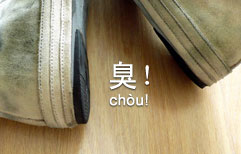
So, I'm visiting my daughter here in Suzhou and spending my days going through the local RT Mart, eavesdropping on every conversation, puzzling at all the package labels. Every day I make a shopping list and use the ChinesePod glossary to learn how to ask for what I need. Today I needed some tofu so the search of the glossary generated a bunch of sample sentences, including the last one in this lesson's expansion. Well, I had never had chou doufu so I bought it and cooked it up in my daughter's wok, to surprise her when she got home from work. Well, she was surprised alright! She knew what was on the menu the minute she walked in. I honestly assumed that ChinesePod would never lead me astray. Fortunately, I enjoy strong flavors! Someday maybe I will understand Mandarin well enough to know when something is being said tongue in cheek. For now, I will just have to be a little more careful.

bababardwanSeptember 7, 2012
Next time she could greet this guy with 你好洗脚 [hi, wash feet]...actually I just wanted to say nihao xijiao 'cos I liked the way it rhymed and had the same tones, hehe

miss kimJune 20, 2010
你好。。
would u please take a look at the pdf file i think that there is something wrong with it ..
thank u ..
kim
bheff34March 15, 2010
I'm suprised to see that no one mentioned "Hong Kong Feet". I believe it is "xiang gang jiao" in pinyin. Maybe it was written in Chinese and I just can't read it

lily_counselorNovember 13, 2009
Hi babybob
不对哦,香港脚不是臭脚哦。哈哈!
香港脚是 dermatophytosis 或者说是athlete's foot,是一种皮肤病。


helenshen_counselorNovember 12, 2009
@bodawei, miaotiao is right, you can say
谢谢你的帮助!xièxie nǐde bāngzhù Thanks for your help!
谢谢你帮我!xièxie nǐ bāng wǒ Thanks for your help!
Fat is like clothes I guess!!哈哈!

bodaweiNovember 12, 2009
miantiao
没关系,谢谢你的帮忙。 还不一定,你的意见帮助很大。
(no worries, thanks, your view helps a lot. I wasn't sure.)
miantiaoNovember 12, 2009
bodawei,
‘谢谢你的帮忙’更顺口
谢谢你帮我一点忙, 感觉别人应该帮你的忙,应该帮我的意思,所以感觉到不是帮忙,而是被逼的, 还有,意味着这别人帮你的忙一点都没用。
知道这是初级课程,我懒得写拼音和英语翻译,没时间,快要走吃饭了。
helenshen_counselorNovember 11, 2009
@bodawei, both of them are correct, but your version is much better, "脱咖啡因的",and I used to say "不含咖啡因”, bùhán kāfēiyīn
More example, Non-Fat Milk Powder, 脱脂奶粉, tuōzhǐ nǎi fěn
bodaweiNovember 11, 2009
@helen
I used to say 脱卡非因的 tuōkāfēiyīnde (decaffeinated) but I notice now that Microsoft Word has it as 除去咖啡因的 - do you know which is now more correct?
helenshen_counselorNovember 9, 2009
@vallance, "to take off", 脱掉,tuōdiào, to take slippers off, "脱掉拖鞋", tuōdiào tuōxié
You can also say "脱", 脱拖鞋,tuō tuōxié
脱袜子,tuō wàzi
脱裤子,tuō kùzi
脱衣服,tuō yīfu
hamshankNovember 9, 2009
Excellent. Thanks Calkins. I thought it might be sometihng along those lines but the main vocab section in this lesson did not supply the "to take off" hanzi.
So to "take slippers off"... it would be tuō tuōxié??

calkinsNovember 9, 2009
Hi Vallance,
They both have the same pronunciation but different characters (I can't see the supplemental vocab. so I'm not sure which characters are used).
脱鞋 tuōxié : to take off shoes拖鞋 tuōxié : slippers
So you could say:
进房子前要先脱鞋,然后再换上拖鞋。jìn fángzi qián yào xiān tuō xié,ránhòu zài huànshàng tuōxié.Take off your shoes before you come into the house, then change into slippers.
Hope this helps.
P.S. you can use 脱 tuō (to take off) for many things...like taking off clothes, socks, hats, etc.
hamshankNovember 9, 2009
The vocab for "take off you shoes" in this lesson was tuōxié and the supplimentary vocab word for "slippers" appears to be the same.
Can anyone impart some wisdom for me here? Are they supposed to be the same?
meyers66September 29, 2009
The audio review for this lesson is a bit weak, too short. The exercises seem duplicated. IOW the matching section has the same words twice.
I like the revamp on the exercises.
The exercise section in lessons could be expanded more. Teach Yourself Chinese has some good exercises.
kaixin_in_tampaJuly 8, 2009
By the way that dude snickered/chuckled, we know he is mildly proud of those stinky feet of his. I mean, no "hello" or anything, just "may I (please) take off my shoes?" Just could not wait to show them off!
^_^

abelleMay 21, 2009
My mom is from the Philippines where they always take off their shoes when entering a home. My dad is an American and he's adopted the same custom. So we don't wear shoes in our house. It sure does keep the house clean!

light487April 24, 2009
hehe.. I always just make a joke of it 我的脚是太臭了 wǒde jiǎo shì tàichòule and get a laugh.. at least then they are warned the awkward moment is covered with a bit of humour that both sides can deal with in whatever way is needed to save face for both sides. :)


adfbnnnadnfApril 21, 2009
Just letting you know CPod, this lesson does not appear in any search results.

pinkjeansApril 20, 2009
In Asian homes, it is the norm to take off one's shoes. It is expected and the host would really be aghast if someone entered without first removing his or her footwear. Now that I have moved back, I am so relieved I don't have to tell my guests to take their shoes off anymore as everyone does it automatically. In the UK, I was the one feeling 不好意思 asking people to 脱鞋。

selleckMarch 15, 2009
If anyone is looking for a language partner, and you live in or near XuJiaHui, please shoot me an email at jjselleck@gmail.com. I need to find someone to practice these ChinesePod lessons with. Some of my Chinese students at EnglishFirst, who are all adults, are also looking to find people to do a language exchange with.
briancoxMarch 15, 2009
In Chongqing, you always take off your shoes. Slippers are provided for visitors. No exceptions unless the home owner has plastic covers for you to put over your shoes.
netramblerMarch 15, 2009
There is a phrase in the dialogue that I didn't hear in the translation or the vocabulary. After the hostess says "Zhen Chou" she says "Ni ha xie tuon xie ba"??? Something like that.
What does it mean? It wasn't explained in the translation or vocabulary.

kellylMarch 14, 2009
I've got a quick newbie question. The dialog uses a single character, 鞋 xié, for shoes, but other material I have uses two characters, 鞋子 xiézi.
Are these pretty much interchangeable?

tommy2toneMarch 13, 2009
in the PDF, the dialogue uses 脱鞋, the supplementary vocabulary uses 拖鞋 for take off shoes. are both correct?
user2048March 13, 2009
bababardwan: I had the same question regarding B's last comment. My question and the dialog were edited to remove the comment. I heard it the same as you did.
urctoMarch 12, 2009
hi,changye.
对不起,请问一下,in this case,I usually say "不好意思,请问一下".
不好意思 feel ashamed (to), feel embarrassed,this is right,I did not mean it was wrong.
I am sorry I did not explan clearly.

changyeMarch 12, 2009
Hi urcto
Yeah, you are right. Actually 不好意思 is a very "versatile" (and convenient) phrase that is used to mean "ashamed/embarrassed", "I'm sorry", "excuse me", and even "thank you" in everyday conversation.
On the other hand, an expression such as "对不起,请问一下" is more formal than a 不好意思 version. I admit that maybe I'm the guy who most frequently use "对不起" in the office, hehe. 我却不好意思说“不好意思”!
pearltowerpeteMarch 12, 2009
Hi evgeniyazhu
Thanks for keeping us on our toes.
Actually, the character is correct in the vocab section. I guess this is just a weakness of this font. I agree that the "clothing radical 衣” on the left is not very clear.
urctoMarch 12, 2009
hi,changye,
对不起 I'm sorry, excuse me不好意思 feel ashamed (to), feel embarrassed
========
不好意思 is used as 'Excuse me' more often.
Ep.不好意思,请问××怎么走?Excuse me,how could I go to **,please.Here we would not say "对不起"。
不好意思,失陪了。(Excuse me.) (in Janpanese:shirrei shi ma su)

evgeniyazhuMarch 12, 2009
I'm afraid in Supplementary vocabulary the word 袜子 (wa4zi), socks, the left element of the first character is wrong.
It should be 袜子 - one more stroke in the left element.
Check http://www.nciku.com/search/all/pinyin/wa%20zi

vduncanMarch 12, 2009
user36136,
In this case, it would suffice to say 不用, meaning "no need" (to take off your shoes).
evgeniyazhuMarch 12, 2009
Very interesting lesson. And full of culture. I didn't know that you have to ask about taking off your shoes in China. In Russia you ALWAYS take off your shoes, no matter whether it's your house or somebody else's.
Thanks to CPod I can see my level of Chinese going up rapidly.

bostonphilMarch 12, 2009
dunderklumpen, missworldtraveler,
You might want to listen to this episode of Qing Wen regarding how to say "Sorry".
https://chinesepod.com/lessons/saying-sorry/discussion
changyeMarch 12, 2009
Hi missworldtraveler
对不起 I'm sorry, excuse me不好意思 feel ashamed (to), feel embarrassed
missworldtravelerMarch 12, 2009
Out of curiosity, is "buhaoyisi" and "duibuqi" interchangeable? They can both be used to mean, "I'm sorry."
bababardwanMarch 12, 2009
Is B's final comment?:
你还是穿鞋把
...you,nevertheless[on the other hand/on second thoughts], put on your shoes?
..hehe;couldn't handle the 臭
bababardwanMarch 12, 2009
light,
I love it when someone can put a good spin on things like that.I'd love to hear how "to be stinky in the winter" was put in a good light.I'd also like to know if he was having a lend of you or whether he'd convinced himself.hehe
light487March 12, 2009
I have a Chinese friend who works near my work who's name is 臭寒 Chòuhán. He explained this to me as meaning "to be stinky in the winter", and the way he explained it to me suggested that it was a good name.. :)
This is a great lesson guys: To the point, fun, useful, easy, enjoyable, interesting etc.
I always love the ones that Jenny giggles in.. ;)
mormon88March 12, 2009
I have a question about 真. What's the difference between 真 and 真的? I feel like you need the 的 if it's modifying a verb clause, but not if it's modifying an adjective. Is this correct?
Thanks.
dunderklumpenMarch 12, 2009
Hi johns,
要 yao4 (must, want, should, ...) can be used in a lot of different ways.对 dui4 (yes, correct, towards, ...)
Hi Jenny,
what's the difference between 对不起 duì bu qǐ (I'm sorry) and 不好意思 bù hǎo yì si (I'm sorry)? And how do you say "What's the difference between A and B?" in chinese?
johnsMarch 12, 2009
Some of the translations were confusing for me. Does要really mean "must"? "Want" was the only definition I am familiar with. Also,对, when my curser rolls over it is listed as "towards". Please explain. This is a fun lesson and Westerners should be aware that shoes may come off at meals or other events so leave those stinky sneakers at home.
changyeMarch 12, 2009
The character 臭 (chou4/xiu4) consists of two parts, namely 自 (zi4, oneself) and 犬 (quan3, dog). "自" is the original character of modern 鼻 (bi2, nose), and 自 later obtained an extended meaning "oneself" because a man often points a finger at his nose when meaning "myself, me".
So, 臭 originally meant "smell", but not "stinky". As you know, a dog has a sensitive sense of smell and always noses around. And a new character "嗅 (xiu4, smell)" was made by adding the mouth radical "口" and replaced 臭, but actually 闻 (wen2, smell) is more commonly used than 嗅 in modern Mandarin.

jennyzhuMarch 12, 2009
Yes, 臭 is also used metaphorically, mostly in sports as eaglew has pointed out. You can say 臭球/chou4 qiu2 to describe a bad move in ball games. But it is not frequently used to describe other things such as moveis or actors. You can use 烂/lan4/rotten to describe a wider range of things of bad quality.

eaglewMarch 11, 2009
臭,it's pungent,now.
it also can be said:my English is very "臭".(it's poor 或not strong)
还比如,一球员把球踢进自己球门,也可以说“臭脚”,
(hai bi ru ,yi qiu yuan ba qiu ti jin zi ji qiu men ,ye ke yi shuo "臭脚)
mean :bad,Should not be。
What did you notice in this lesson?
You are posting as a guest. Your reply is reviewed before it appears. Log in to post without review.