(Part 2) Which has the longest language history, China or the West?
xiaophil
August 10, 2009 at 03:30 AM posted in General Discussion
Okay, for anybody who has been following along, I have been comparing the lengths of language history between China and the West. I am taking the position that generally the West has a longer history, but it is just fun and games. If I am wrong, I am wrong. But if you think I am wrong, please tell me why (ideally in Chinese as well as English, but just English is fine too).
现在我会比较一下中国和西方的现代的写法。这是在这里的论文的继续。
Now I will compare the modern written styles of China and the West. This is a continuation of my essay here.
大多数西方语用拉丁字母表。最初的拉丁字母表早在公元前一世纪被采用,这个字母表跟现代的字母相似,不过到公元一世纪开始的古典拉丁语时,字母光少了两个现代的字母,J和H。中国什么时期开始采用汉字是可争辩的,可是楷书是公元二世纪开始采用的,可见西方的写法的年纪比中国的大至少一世纪多了。
Most Western languages use the Latin alphabet. The original Latin alphabet was adopted as early as the 7th century BCE. This alphabet is very similar to the modern alphabet; however, by the time of the Classical Latin period that started in the 1st century CE, the alphabet was only missing two letters usually found in the modern alphabet, J and W. When the Chinese started using characters is debatable, but the date for the start of the modern script is placed at the 2nd century CE. This is basically the script used in Taiwan, Hong Kong and Macau today, and in a modified form it is used in the Chinese mainland. In this way, we can see that the written form in the West predates the written form in China by at least one century.
且慢,我知道有的人认为"两千之前西方人写了拉丁语,已经停用了好久,而那时中国人写了中文,中文当然还是使用的",这是使人产生误解,直到二十世纪中国才采用像言语一样的文字,白话。因此,中国的文字和言语是不同的语言好久了。由于拉丁语从十六世纪起已经丢失了普通语地位,于是以前的中文写法继续长些。但是,除了有些文化和别的专门的功能以外,近世以来,两个大多被丢弃了,所以要争论哪个语言的历史最长的,这可能是无关的。
But wait. I can hear some people saying, "Two millennia ago, people in the West wrote Latin, which is largely in disuse today, whereas the Chinese wrote in Chinese then, and of course Chinese people still write in Chinese." This is misleading. It was not until the 20th century that a written system that closely follows oral Chinese, baihua, was adopted in China. Therefore, for many, many years written and oral Chinese were two different languages. Since Latin largely lost its lingua franca status in the 16th century, the old form of written Chinese did last longer. However, both have largely been abandoned in the modern world except in some cultural and various other specialized functions. Perhaps then, we can say when debating who has the longest language history, this is irrelevant.

changye
August 14, 2009 at 02:30 AM
Hi rjberki and orangina
The Imperial exam (科举) was basically held once every three years. One theory holds that the average age of examinees passing the exam was 36. I hear that of examinees passing the bar exam in Japan, which is the most difficult one in Japan, is 30. I guess a lot of Chinese intellecuals spent their "half a lifetime" preparing for 科举.
This toughest-in-the-world examination had both good points and bad points. Its positive aspect is that people "equally" got opportunities to socially scceed regardless of their origins, provided that they had enough money for preparation for the exam. In general, examinees were too busy studying to work for a living.
"科举" had some negative aspects, such as rote learning, cheating techniques, briberies, backdoors, and stifling creativity. These "traditions" are still beautifully preserved in the unified college entrance exam (高考) in the PRC. You can enjoy seeing state-of-the-art cheating devices every year. Even 007 would be impressed.
Korea and Vietman also introduced 科举 system, but Japan did not, fortunately. Maybe this is the reason Japanese people relatively put importance on craftsmanship, otaku-ism, and learning out of curiosity. Thankfully, Japan was not so spoiled by conservatism and dogmatism generated by Confucianism.
Ironically, Japanese literacy rate has been very high in the past several hundred years owing to its education system, even though there was no 科举 in Japan. According to the comprehensive survey carried by the US occupational army in 1948, three years after the end of the war, Japanese literacy rate was 98%.
And the USA immediately gave up the idea of abolishing Chinese characters in Japanese, which I think was a very wise decision. Good or bad, modern Japanese students study less hard than Chinese and Korean students do. Japanese youngsters are busy enjoying Manga/Anime and playing TV games and sports, hehe.

tvan
August 14, 2009 at 02:29 AM
Changye, so New York is in the Far East? Actually, that works for us Californios.

changye
August 14, 2009 at 12:50 AM
Hi Joachim
I love the map. Japan is located very close to the center of the world, which is even closer to the center than China (中华) is, hehe. Maybe the same is true in upside-down maps sold in Australia. Actually, most Japanese children don't understand why people call East Asia (and some other regions) "Far East" by seeing the maps sold in Japan.

xiaophil
August 14, 2009 at 12:30 AM
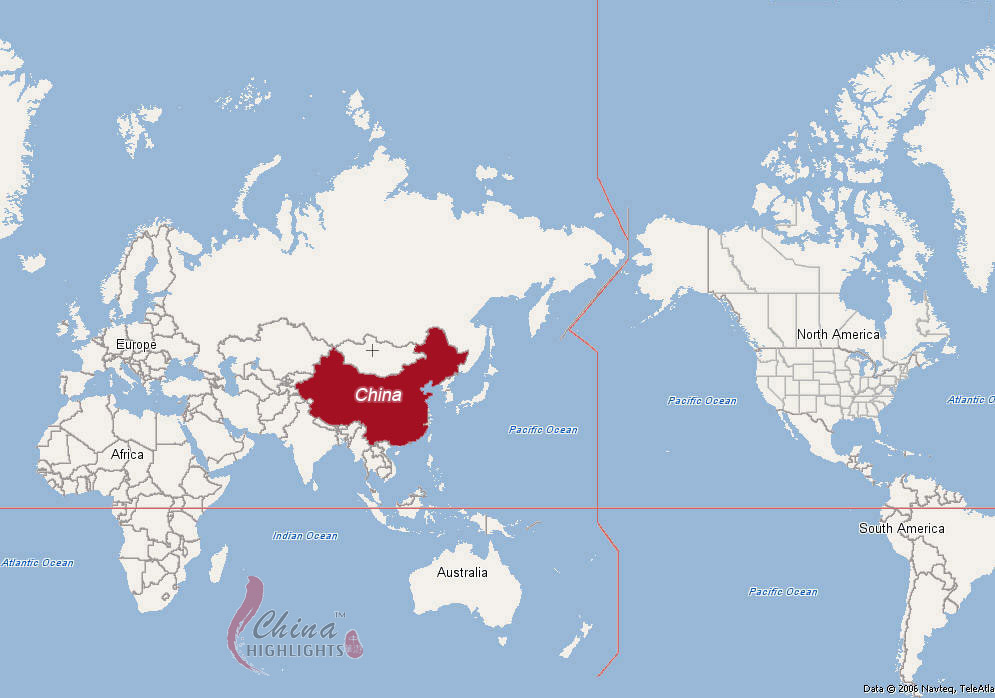
It is just as you say according to the maps I have seen here in China, after all, they are the 'Middle Kingdom'. American maps place the Americas on the left, Europe and Africa in the middle and Asia on the right. Of course on a globe, everything is both east and west.

sydcarten
August 13, 2009 at 11:57 PM
I was just thinking.
If you live in China then North and South America is the East.
xiaophil
August 13, 2009 at 11:46 PM
Hi Joachim
I assume you are pointing out that east and west are relative on a globe, right?

Joachim
August 13, 2009 at 03:02 PM
There is no thing like "The West". With China in the middle North America is to the east and Europe is to the West.
xiaophil
August 13, 2009 at 02:08 PM
RJ
Don't take my word for it, but I'm pretty sure I read about a man who failed several times, and then like you said, er... became a poet.
changye
Your capacity to pull out knowledge is outstanding. I don't even care about the debate. Just keep talking ;)
changye
August 13, 2009 at 01:19 PM
Hi xiaophil
I agree the West has rich diversity in languages, and, of course, East Asia also boasts of having rich linguistic heritages.
the West's main strong point: diversity. it would be easy then to argue that the Western language tradition is richer.
In China, as you know, there are many dialects and languages spoken by ethnic minorities. Some of them have their own characters, such as Yi scripts, Tibetan scripts, Mongolian scripts, and Dongba scripts. Dongba scripts is the only set of pictograms still used in the world today. Tibetan language/sutra are very imoprtant for a study of Buddhism.
South and North Korean people take great pride in their own characters "Hangul", which was entirely artificially invented in the 15th century. Japanese writing system is just unique. Japanese people use three different kinds of character sets, Hanzi, Hiragana, and Katakana (and even alphabets). People use Cyrillic alphabets in Mongolian People's Republic.
Besides, there were several character sets used in East Asia in the past, such as Phags-pa scripts (八思巴文) used in Yuan Dynasty, Khitan scripts (契丹文), Tangut scripts (西夏文), Manchu scripts (满文). In Vietnam (South East Asia?), people used quasi-Hanzi characters called "Chunom" (字喃), but they use Latin alphabets now. I believe East Asia has richer diversity in languages than you might think.
P/S. Korean, Mongolian, and Japanese belong to language families that are completely different from China-Tibetan language family.

RJ
August 13, 2009 at 01:16 PM
Changye
sounds like great job security for those who could afford education and were smart enough to pass the imperial exam. A lot of time and effort must have gone into studying for this exam and I heard someone say recently that this may even have held China back since no one had time to study or investigate things like science, that were not on the exam. Once you pass you would have a good job (and a great hat). It sounds like only one chance was given to pass since many who failed seem to have wandered and become poets :-) Was there only one chance?
changye
August 13, 2009 at 12:16 PM
Hi orangina
Chinese colloquiarism movement (白话文运动) began in 1910s. This movement was led by several intellectuals, including 鲁迅 (Lu Xun). Interestingly, most of them had experience of studying/living in Japan. Colloquiarism movement started about 30 years earlier in Japan than in China, and I guess it's possible that those Chinese intellectuals were, more or less, inspired by Japanese colloquial literatures.
China's national literacy rate was only 20% when the PRC was established 1949. So the rate must be much lower in ancient China. Actually, Chinese peasants couldn't afford learning Chinese characters at all in the past, and only children of high-income families learn characters and Confucian scriptures for the Imperial examination. I believe there were a lot of literate officials at local governments in ancient times.

orangina
August 13, 2009 at 06:07 AM
changye叔叔,please tell me about Chinese colloquialism movement. Also, historically how literate were common Chinese people? I would imagine to administer such a vast area at least the village cheif would need to read and write, but I have nothing to back that opinion. On the other hand, characters are so culturally significant I can imagine a very high level of literacy.
changye
August 13, 2009 at 05:46 AM
Hi orangina
Let me explain why (classical) written Chinese is so stable.
chinese has a more stable written history.
There are two main reasons, that is to say, "conservativeness of Confucianism" (儒教) and "Imperial Examination" (科举).
In the period of 春秋战国 (770 - 221 BC) in China, a lot of scholars, intelligentsia, politicians, and tacticians traveled all over China in order to get a prestigious government post, which consequently induced a development of a kind of "standard written form/style" in ancient China. Major Confucian scriptures such as "Four Books and Five Classics" (四书五经) were written and released in those days.
Later, Confucianism was promoted to the official religion/study of China in the 2th century BC. Confucianism naturally gained great momentum, and most Chinese intellectuals mainly studied and learned Confucian scriptures. "Conservativeness" and "nostalgia for the old good days" are two major characteristics of Confucianism, and these traits have long worked as "preservatives" for Chinese written language.
Furthermore, the Imperial examination (科举) started for selecting capable bureaucrats at the end of the 6th century in China, and its examinees had to memorize tons of Confucian scriptures in order to pass this super-difficult nationally-standardized examination, which have also worked as potent "preservative" for written Chinese until when the 科举 system was finally abolished in 1905, surprisingly.
In short, it has long been the most important assignment for Chinese intellectuals to memorize ancient Confucian scriptures (and write classical poems) in the past two thousand years, which didn't allow written Chinese change very much. And this is the very reason why colloquial and written Chinese are very different from each other today. In a way, written Chinese is a living fossil of language, just like Coelacanth!
P/S. Chinese colloquialism movement began only one hundred years ago.
P/S.2 Thanks to the Imperial exam, Chinese characters also didn't change much in the past. Examinees were required to write "authentic" Chinese characters in the exam. Therefore a lot of character dictionaries were edited and published for examinees, and this consequently encouraged standardization of characters and kept Chinese characters from changing their shapes.
orangina
August 13, 2009 at 05:13 AM
chanye~ I love that you explain what I am saying better than I do! thanks! :-D
changye
August 13, 2009 at 02:48 AM
Hi orangina
Usually a misspelled word is still intelligible, unlike a miswritten character.
You don't have to worry about this. It depends on how serious the misspelling is, but miswritten characters are often intelligible to a large extent. It may be said that the more complicated characters, the more intelligible when they are miswritten. Just look at Chinese characters displayed on your PC screen. You'll find some characters are, in a sense, "miswritten", or simplified due to limited resolution, especially when font size is small, but natives can read them without difficulty.
Character changes seem to be less frequent than spelling changes.
This might be true. Actually, most Chinese characters have maintained the same (or similar) appearance in the past two thousand years, except for simplified Characters introduced in the PRC and semi-simplified ones in Japan after the war.
orangina
August 13, 2009 at 02:33 AM
I wonder if 女书 can still be learned. Is there anyone left to teach it? Does anyone know of 女书 dictionarys or resources?
changye
August 13, 2009 at 01:49 AM
Hi orangina
女书 (nv3shu1) is a set of syllabic characters, just like Hiragana and Katakana in Japanese, tailored for the pronunciations of local languages. So local people, both women and men, can get the meaning of texts written with 女书 if they are read aloud. Anyway, these characters are amazing. I happened to see them in a book I bought in Japan this year, but actually, at first I couldn't easily believe it. They are only for women, and men are not allowed to learn them. Just interesting.
orangina
August 13, 2009 at 12:52 AM
changye mentioned earlier that there has been no language with a written but not a spoken form. Well, an exeption for every rule!
Nushu was a chinese script for women only. It can be argued that it was an alternative written form of the spoken language, but it's purpose was to communicate without including a big chunck of the population that spoke that language. Reading it aloud may have been more akin to translating. It seems to have been it's own thing.
Pretty interesting!
xiaophil
August 13, 2009 at 12:27 AM
canini
谢谢你的解释!真有意思。
changye
You have a point. I thought of some ways that I can argue against you, but perhaps they are futile or at least daunting. What I should be emphasizing is the West's main strong point: diversity. This of course undercuts my 'stable' argument, but it would be easy then to argue that the Western language tradition is richer. There are so many languages, and every one of them has its own written form. Anyway, I think I need to go back to studying Chinese again. Too much fun here ;)
orangina
August 12, 2009 at 09:44 PM
'Childrens' is not considered proper and is mostly used by english language learners including children... but it is standard in some rural areas. The point is the proper term was once just as wrong. Many words are that way. As far as german goes, one simplistic explanation of engilsh is that it is german with latin grammar. And anglo-saxon words, and greek, and whatever else works. The result is a very flexible and expressive language. That doesn't quite make sense.
As far as the relative longevity of the language groups, I don't know. My guess would be that western languges have a longer, but more convoluted history and that chinese has a more stable written history. After all, no spelling changes over time! Character changes seem to be less frequent than spelling changes. West vs. chinese is a weird comparison though... How about occidental vs. oriental, european vs. asian, chinese vs. english. What about northern vs. southern hemisphere? Since you can't tease english history away from the rest of european language developement, while chinese seems to have a single thread of developement I would say chinese "wins". My very arguable opinion. Everyone's history is the same length regardless, so it is all a bit of fun.

BEBC
August 12, 2009 at 08:23 PM
Crikey !
I don't know much German. Got to admit that I've never heard 'childrens' before, except maybe when a child is trying to pluralise. Is 'childrens' something from Chaucer or Middle English ? I always used to think that German was difficult, but when I actually had a look at it I realised how much of the basic vocabulary is virtually the same as that of English. Also, the word-order in a lot of german phrases reminded me of that of very old-fashioned English.
I was shocked ! I might be German !
Anyway, I'm reconciled to that now. It's not so bad. Hehe.
So, who do you think has the oldest continuous oral and written tradition ?
orangina
August 12, 2009 at 08:05 PM
user21377!
no no, I understood your egalitarian approach to language... I was just complaining about my teachers' authoritarian view (they are all great people.)
Good plan on the undies!
On an unrealted note, one of my favorite language changes is "children". Child is singular. -er is a german plural marker so childer would be plural but it has the second plural marker -en... child-r-en. Occasionally you hear childrens. Three plural markers there! I think of this whenever someone gets too high and mighty about the "rules".
Oh wait, were we supposed to be talking about chinese?
BEBC
August 12, 2009 at 06:45 PM
Orangina !
No, but they are in Scotland. Never stand under a ladder which a kilt-wearing Scotsman is climbing. At least, if you do, don't look up !
Not a pretty sight; enough to put you off your dinner.
Actually, the British spelling of those words isn't really 'correct'.....I'm not THAT chauvinistic. USA has it's own way.
'Pants' is used a lot here, but so is underpants. I almost never leave the house without a pair on. In case I get run over.
canini
August 12, 2009 at 05:54 PM
文字可上溯至甲骨文,
年代我想我就不用说了吧。
至于楷书,可以理解为一种字体写法而已。
至于文言和白话,书面语与口头语相脱离而已。
草草浏览楼主文章,仅对一部分稍作解释,如有误解,还请海涵。
orangina
August 12, 2009 at 05:34 PM
user21377! 哈哈!
I wish my grade school (grammar school?) teachers felt spelling was up to each person's whim... I remember one paper I wrote in 4th grade where I spelled the same word 3 different ways hoping one of them was correct. Got marked down for not choosing one and sticking to it. It always annoyed me to be told that reading would improve my spelling... I personally don't sound out each word as I read, and am not really concious of individual words until I come across an intruiging one. And I believe many of my egregious spelling errors were in fact correct British spellings. (Looks like I am still scarred.) Characters are so much easier! Well, maybe not. Usually a misspelled word is still intelligible, unlike a miswritten character. I still like them better...
I take it "underpants" is redundant in the Isles?
BEBC
August 12, 2009 at 01:33 PM
Hey Orangina ! (sorry for shouting)
I thought spelling was still a matter of choice in the former colonies.....
......color (colour),dialog (dialogue), analyse (analyze), theatre (theater) etc etc.
Maybe there is a surfeit of dyslexia in the States ??
Also, if the Doc ever asked me to take off my pants, I wouldn't just take off my trousers, I'd show him the old wedding-tackle too.
Who says linguistic diversity isn't alive and kicking !
changye
August 12, 2009 at 01:09 PM
Here is the conversation of the same content, but spoken in the late 18th century, which was quoted from the latest edition of 《老乞大》 published in 1795. This conversation is much easier to understand than that of "more than 600 years ago" shown in my previous posting.
(A) 大哥,你从那里来?
(B) 我从朝鲜王京来。
(A) 如今那里去?
(B) 我往北京去。
(A) 你几时在王京起身来着?
(B) 我这月初一日离了王京。
(A) 既是这月初一日离了王京,到得半个月,怎么绕到这里?
(B) 我有一个朋友落后了,所以在路上慢慢的走着等候他来,故此来的迟了。
(A) 那朋友如今赶上赶不上啊?
(B) 这个朋友就是他,昨儿个纔到来了。
(A) Mate, where did you come from?
(B) I came from Wangjing in Korea (= 朝鲜王京).
(A) Where are you going now?
(B) I'm going to Beijing
(A) When did you leave Wangjing?
(B) I left Wangjing on the first day of this month.
(A) Although you left Wangjing on the first day of this month,
it's already been half a month, why are you still here?
(B) My mate is behind me, I traveled slowly to wait him. I ‘m delayed due to that.
(A) Has that mate caught up with you?
(B) This is my mate. He finally arrived last night.
P/S. Beijing (北京) was called "大都" when China was under control of Mongolian people between the 13th and 14th centuries, and this is the reason 大都 is used in the conversation in my previous posting.
sydcarten
August 12, 2009 at 12:32 PM
yfalle is the past tense of to fall, the prefix y- denotes the OE/ME past tense
cf german past tense of fallen is gefallen, where ge- is prefixed to the verb
changye
August 12, 2009 at 12:26 PM
Here are some examples of colloquial Chinese spoken in northern China, probably in Beijing area, in the 14th century, which happen to be the same period as Chaucer. These sentences are quoted from the earliest edition of conversation textbooks titled 《老乞大》 published in ancient Korea in the 14th century. Its latest (and last) edition: was published in the late 18th century.
Probably average modern Chinese people don't have difficulty (roughly) understanding them. I believe even middle school students can easily get the outline of the conversation to a large extent. That said, "listening comprehension" is another story. Modern Chinese should have difficulty listening to the conversation if they are spoken using old sounds in the 14th century.
Maybe the same is true for Chaucer's English, which was written before Grand Vowel Shift started. Anyway, please try to read this Chinese actually spoken by northern Chinese people more than 600 hundred years ago. How much do you understand them? Which do you think is more difficult, Chaucer or this conversation? Of course, it should depend on your Chinese skills.
(A) 伴当,您从那里来?
(B) 俺从高丽王京来。
(A) 如今那里去?
(B) 俺往大都去。
(A) 您几时离了王京?
(B) 俺这月初一日离了王京。
(A) 既您这月初一日离了王京,到今半个月,怎么绕到这里?
(B) 俺有一个伴当落后了来,俺沿路上慢慢的行着等候来,为那上迟了来。
(A) 那伴当如今赶上来那不曾?
(B) 这个伴当便是,夜来才来到。
(A) Mate, where did you come from?
(B) I came from Wangjing in Korea (= 高丽王京).
(A) Where are you going now?
(B) I'm going to Beijing (= 大都)
(A) When did you leave Wangjing?
(B) I left Wangjing on the first day of this month.
(A) Although you left Wangjing on the first day of this month,
it's already been half a month, why are you still here?
(B) My mate is behind me, I traveled slowly to wait him. I ‘m delayed due to that.
(A) Has that mate caught up with you?
(B) This is my mate. He finally arrived last night.

WillBuckingham
August 12, 2009 at 11:53 AM
Chaucerpod! Now, there's an idea...
We Brits use the word "sundry" quite a bit. For example in the following sentence: "Those sundry tomatoes look good..." Oh, no. My mistake. That should read "Those sun-dried tomatoes look good..." (although both are grammatical!). Usually it is in the fixed expression "all and sundry".
Will
orangina
August 12, 2009 at 10:06 AM
I would sign up for chaucerpod! We could learn about the Great Vowel Shift of the 15th century, after which words like here, where and there no longer rhymed... and that wend is the present tense of went (same pattern as send and sent)... and that while rules of english grammar are logical once you figure out which set of rules is applied to what word, spelling had been a matter of personal choice until Samuel Johnson standardized it in the 18th century (ruining it for everyone)... so much linguistic goodness!
xiaophil
August 12, 2009 at 09:59 AM
Changye
Actually, I think a lot of Americans wouldn't know sundry. We don't use it much. I'm guessing Brits do.
changye
August 12, 2009 at 09:56 AM
Hi xiaophil
Thanks for the explanation. Gee, I should have known the word "sundry". I feel I've seen this word somewhere before.....perhaps.
xiaophil
August 12, 2009 at 09:29 AM
Changye
Yeah, I know you aren't a native speaker, but I know you can communicate well with it. That is why I was curious. Don't feel bad, though. I think this kind of translating requires in most cases native immersion.
Anyway, here are my translations of the words that you highlighted:
bifil = It happened
seson = season
Southwerk = Southwark (an area in London)
Tabard = probably just some hotel
Redy = ready
wenden = go
corage = courage
nyght = night
hostelrye = hostel/hotel for travelers
wel = well (I think it means altogether)
nyne and twenty = 29
compaignye = company, group
sondry = sundry, various
aventure = adventure (although I think he means 'peradventure' or 'by chance')
yfalle = fall (I'm less confident here, but I think he means 'become' like 'fall in love')
felaweshipe = fellowship (similar to companionship)
alle = all
wolden =went
ryde = ride (as in 骑马) wolden ryde = went riding
------------
Maybe praxis can make chaucerpod? hehe
changye
August 12, 2009 at 08:44 AM
Hi xiaophil
I was at a loss when I read the text for the first time, and I read it several times to find that some "strange" words in the text seem to resemble some modern English words. Anyway, I can't translate it exactly. I only know that the poem is about a pilgrimage to Caunterbury with friends (?). You know, I'm NOT a native speaker of English !!!
Bifil that in that seson on a day
In Southwerk at the Tabard as I lay
Redy to wenden on my pilgrymage
To Caunterbury with ful devout corage
At nyght was come into hostelrye
Wel nyne and twenty in a compaignye
Of sondry folk, by aventure yfalle
In felaweshipe, and pilgrimes were they alle
That toward Caunterbury wolden ryde
words : difficult for me to decipher
words : relatively easy for me to decipher
xiaophil
August 12, 2009 at 05:54 AM
Changye
That I'm not sure of. I am interested in language, so I guess I have an advantage. However, most of the words are very similar to their modern brothers. But I had to guess that 'wenden' means 'go'. 'Bifil' is the only word I wasn't sure of. I guessed it meant 'befall' and I was right. The more I look at it, I think I understand pretty much all of it now that bifil's meaning has been confirmed. But yeah, a high school educated average Joe, 不一定.
I'm curious. Can you understand a lot of it?
changye
August 12, 2009 at 05:18 AM
Hi xiaophil
By the way, I can understand 90% of this:
Is it also easy for "native English speakers who don't have much education such as a high school educated shopkeeper who doesn't like reading books very much" to read/understand Chaucer?
changye
August 12, 2009 at 03:41 AM
Hi xiaophil
"Which language heritage has the longest and stablest history."
You should have declared this at the very beginning. That said, thanks to this confusion about the topic of these threads, I could read many interesting comments posted by other people and had a good opportunity to think over "languages". Thanks.
xiaophil
August 12, 2009 at 02:20 AM
changye
Okay, I'll try again. I guess we could say, "Which language heritage has the longest and stablest history." Although, I obviously only scratched the surface, and I fear I haven't progressed my argument well, but I got a good discussion here. That's most important :)
By the way, I can understand 90% of this:
Bifil that in that seson on a day
In Southwerk at the Tabard as I lay
Redy to wenden on my pilgrymage
To Caunterbury with ful devout corage
At nyght was come into hostelrye
Wel nyne and twenty in a compaignye
Of sondry folk, by aventure yfalle
In felaweshipe, and pilgrimes were they alle
That toward Caunterbury wolden ryde
I have an education, but not an extraordinary one.
sydcarten
August 12, 2009 at 02:15 AM
@ changye
there is no direct evidence that pre-germanic invasion languages such as Latin, or the Brythonic (ancient celtic languages) influenced Old High German.
Survival of Brythonic celtic placenames suggest the possible survival of isolated pockets of Roman Britons.
it is believed that Latin continued to be used in some churches, without influence on the common spoken language.
Here is a curiosity for you, the ancient Brythonic languages survived in some areas in the form of a counting system used by shepherds to count sheep. This counting system survived up until the beginning of the 20th century. See the wikipedia article on Yan Tan Tethera:
http://en.wikipedia.org/wiki/Yan_Tan_Tethera
changye
August 12, 2009 at 02:03 AM
Hi sydcarten
(a) I think most modern speakers would have trouble with it.
(b) germanic tribes completely supplanted them, and I don't believe that any remaining Latin influence from that era survived the germanic invasions.
Thanks a lot. These are just what I wanted to know. About (b), is this an accepted theory in the academic world?
sydcarten
August 12, 2009 at 01:55 AM
@changye
Yes, you are right. Romans occupied Britain for about 500 years.
But I don't think they left much direct linguistic heritage. The celtic speaking Britons who became very Romanised no doubt used quite a lot of Latin in their language. But invading germanic tribes completely supplanted them, and I don't believe that any remaining Latin influence from that era survived the germanic invasions.
sydcarten
August 12, 2009 at 01:45 AM
I think most modern speakers would have trouble with it.
I have memorised the beginning of the prologue:
1: Whan that aprill with his shoures soote
2: The droghte of march hath perced to the roote,
3: And bathed every veyne in swich licour
4: Of which vertu engendred is the flour;
5: Whan zephirus eek with his sweete breeth
6: Inspired hath in every holt and heeth
7: the Tendre croppes, and the yonge sonne
8: Hath in the ram his halve cours yronne,
9: And smale foweles maken melodye,
10: That slepen al the nyght with open ye
11: (so priketh hem nature in hir corages);
12: Thanne longen folk to goon on pilgrimages,
13: And palmeres for to seken straunge strondes,
14: To ferne halwes, kowthe in sondry londes;
15: And specially from every shires ende
16: Of engelond to caunterbury they wende,
17: The hooly blisful martir for to seke,
18: That hem hath holpen whan that they were seek
The pronunciation is quite different from modern English
You can clearly see the mixture of germanic words with norman french, e.g. in hir corages - in their hearts.
Sir Gawain and the Green Knight is roughly contemporary with Chaucer, and the language is obviously closer to OHG than to Chaucer's London English:
SIÞEN þe sege and þe assaut watz sesed at Troye,
Þe bor3 brittened and brent to bronde3 and askez,
Þe tulk þat þe trammes of tresoun þer wro3t
Watz tried for his tricherie, þe trewest on erþe:
Hit watz Ennias þe athel, and his highe kynde,
Þat siþen depreced prouinces, and patrounes bicome
Welne3e of al þe wele in þe west iles.
Fro riche Romulus to Rome ricchis hym swyþe,
With gret bobbaunce þat bur3e he biges vpon fyrst,
And neuenes hit his aune nome, as hit now hat;
Tirius to Tuskan and teldes bigynnes,
Langaberde in Lumbardie lyftes vp homes,
And fer ouer þe French flod Felix Brutus
On mony bonkkes ful brode Bretayn he settez
wyth wynne,
changye
August 12, 2009 at 01:44 AM
Hi sydcarten
I heard that Latin first entered Britain about two thousand years ago when Roman conquested the island, long before German conquest happened. Am I right?
changye
August 12, 2009 at 01:36 AM
Hi sydcarten
I have a question. Are average (?) modern English native speakers have difficulty reading Chaucer (1343-1400) without learning old/middle English or German?
Bifil that in that seson on a day
In Southwerk at the Tabard as I lay
Redy to wenden on my pilgrymage
To Caunterbury with ful devout corage
At nyght was come into hostelrye
Wel nyne and twenty in a compaignye
Of sondry folk, by aventure yfalle
In felaweshipe, and pilgrimes were they alle
That toward Caunterbury wolden ryde
changye
August 12, 2009 at 01:14 AM
Hi xiaophil
Probably we are just talking about the same thing from a different standpoint. Our only difference lies in the definition of "the same language", hehe.
Incidentally, let me ask you a question again. What is the topic of this thread? Is it "what language has the longest history of retaining similar appearance"?
I'm still confused.
xiaophil
August 12, 2009 at 12:54 AM
sydcarten
You can speak German and some Chinese? I'm impressed. Hats off to you!
sydcarten
August 12, 2009 at 12:40 AM
@ xiaophil
My German is pretty good and it does help in understanding OE.
for example:
Ic nam - I took
cf Modern High German: Ich nahm (from the verb nehmen - to take)
The English verb 'to take' comes from scandinavian.
cf. Danish - Han tog sin hut = He took his hat.
sydcarten
August 12, 2009 at 12:36 AM
William the Conqueror isn't solely responsible for the influx of Latin into the English language.
Before 1066 Latin was already entering the language directly via the church.
After 1066 Latin entered the language indirectly, via Norman French.
In the 18th century, advances in science and literature spurred many writers to coin new words, and they used Latin and Classical Greek as main sources for neologisms (a greek word)
xiaophil
August 12, 2009 at 12:32 AM
changye
I get your point. However, I dare say that I would state from a technical perspective that B, C and D are different languages but part of the same language tree. To give you an analogy, we wouldn't call homo sapiens the same species as homo ergaster, now would we? But I do realize some bizarre things will happen if we follow too strictly my basic condition for declaring two languages the same, i.e. 'mutual intelligibility'.
It occured to me that answering this question might clear up any disagreement: does 中文 equal 'the language of China' or 'the languages of China'?
user21377
We may very well have to call a tie... or a 'to be continued' (as in to be continued after further discoveried come to light). haha.
sydcarten
I wonder if we can lure in henning (the German who floats around here) and see if he can understand your old English text above. That would be interesting if he could.
sydcarten
August 11, 2009 at 10:57 PM
@nitrox
English is not a direct lineal descendant from Latin, although almost 70% or our modern vocabulary has come directly or indirectly from it.
To add to your point, modern English has changed considerably since the days of Old English (pre 1066).
Here is an example:
Ic nam me to gemynde þa gewritu and þa word, þe se arcebiscop Lyfing me fram þam papan brohte of Rome, þæt ic scolde æghwær godes lof upp aræran and unriht alecgan and full frið wyrcean be ðære mihte, þe me god syllan wolde.
TRANSLATION:
I took to mind the writings and the word that the Archbishop Lyfing brought me from the Pope of Rome, that I should everywhere promote God's love, and outlaw lies, and full peace bring about by the might that God would wish to give me.
BEBC
August 11, 2009 at 07:57 PM
Nitrox,
My understanding is that chinese characters are understandable to anyone who learns them, irrespective of their language, because they convey ideas. That's why a Guangdongren can read the same meaning into text as a Beijingren, despite that fact that their 'dialects' are as different as English and French.....they vocalise the characters in different ways, but the meaning is the same. In fact, I have read that at one time the chinese writing system was suggested as a universal writing system to the United Nations (by a westerner), because anyone who learns the ideas which the characters convey, and the characters themselves, is able to read the text, no matter what his language is. That's why it's not possible to identify the dialect of the person who writes the text simply from the text itself.
So you're right. A modern chinese person would be able to understand ancient text......provided that the meaning of the characters has not changed, and that the same character system is used.
By the way, English is not a Romance (Latin based) language. It is a Germanic language which has a lot of Romance vocabulary ( due to that naughty William the Conquerer ).

nitrox
August 11, 2009 at 07:10 PM
Wouldn't a chinese person understand ancient chinese easier based on the fact that the chinese writing system is completely different from an alphabet (based on meaning instead of sound) ? Probably ancient latin sounds as different to modern english as modern oral chinese to chinese 2500 years ago.
The oral languages probably all change similarly over time, the corresponding written forms however are more resistant to change, if they are not based on sound...
BEBC
August 11, 2009 at 04:29 PM
Changye,
I think that Greek is the west's most likely challenger to the antiquity of spoken and written chinese, but I'm not sure that Greek 'beats' Chinese. The language of Linear B is known to be an archaic form of Greek, but the Linear B script itself is totally unlike the greek alphabet, which was devised independently of Linear B two or three hundred years after the fall of the Mycenaean kingdoms. During the intervening 'Dark Age' the ability to write was lost in Greece, and the greeks had to start afresh. I'm also not sure of the date assigned to the earliest examples of Linear B. I've come across the dates 1500BC and 1400BC; there seems to be dispute here.
On the other hand, the oracle bone inscriptions are indisputably on the continuum of development of chinese characters, and are dated to roughly the same period as Linear B. Western archaeology has about 150 years of history of intensive study of Classical and Middle Eastern sites....compared to that, chinese archaeology has only just begun in earnest, so who knows what future finds in China will reveal ? At one time western scholars viewed the Shang dynasty as legendary only; what if evidence for the Xia is discovered and dated ?
Although it is probably true to say that the actual vocalisation of the oracle bone inscription cannot be known...(who knows what dialect was used by the inscribers ?) .....it seems sensible to assume that it was an early form of chinese.
Lets call it a tie ! :-)
changye
August 11, 2009 at 12:34 PM
Hi xiaophi
It seems you confuse the concept of "different languages" with that of "different stages of development of a language". Old/middle Chinese are merely early stages of development of Chinese. They are also Chinese language regardless of whether modern Chinese people can easily read them or not.
(A) You English
(B) Me at age 30 modern Chinese
(C) Me at age 15 middle Chinese
(D) Me at age 5 old Chinese
(E) My cousin Cantonese
You and me are two different people. Everybody can easily tell you from me. On the other hand, probably some of my friends can't tell who (C)/(D) are, in spite of the fact that both (C) and (D) are certainly (young) ME. (E) cousin doesn't look alike (B) Me, but (E) cousin is of course a member of my family too.
changye
August 11, 2009 at 11:06 AM
Hi user21377
Chinese can date back only 3,300 years. Oracle bone scripts, the earliest known Chinese characters, appeared around 1,300 BC, after Shang dynasty (商朝,殷商) relocated to today's Anyang (安阳) (perhaps) to avert damage from flooding of Yellow River.
It's evident that modern Chinese (based on northern dialects) is the legitimate "offspring/successor" of an ancient Chinese written (and probably spoken) in Shang dynasty. Chinese has at least 3,300 years of history. The same is very true for Chinese characters.
I agree with you. Greek has a longer history than Chinese, as of today, to the best of our knowledge
BEBC
August 11, 2009 at 08:35 AM
Xiaophil,
Haha !
I'd still go for Greek.
I suppose the answer partly depends on how you define "The West". Most people wouldn't include the Middle East as part of the West, in which case discussion about Sumerian is redundant. Do we define "The West" geographically as Europe ? Within Europe do we exclude those languages which do not take centre-stage (eg Greek)? Do we define "The West" culturally, to include North America, Australia etc ? Do we emphasise only the English-speaking part of the West, or that which uses English as the Lingua Franca ?
It is true that Greek (not Latin) is no longer the Lingua Franca which it was in Classical times, but Greece laid the foundations of modern western society even more than Rome ( through Rome).
I suggest that if the sentence:
"No modern language is as old as Chinese. Even Chinese primary students can read a Tang poem."
raised your hackles, and the question is: "Which has the longest language history, China or the West?"
In the West we have Greece.
I rest my case :-)
xiaophil
August 11, 2009 at 06:56 AM
Hi Changye
Yeah, I know what you mean. Your examples make a good point. It seems defining languages is tough. This page talks about this exact problem.
I would like to point out you said, "Some are easy to read." That poem is quite simple. Seems like an exception to the rule. So if some poems are easy to read, this means all writings from the period can automatically be included as being the same language as modern Chinese even though Chinese people need special training to understand most of them? Perhaps the answer is yes. But I have trouble accepting that anything written or said is a part of the same Chinese language just because it was derived from some written or spoken tradition in China. When do we draw the line? I do feel like I might have started climbing a slippery slope, though.
changye
August 11, 2009 at 06:01 AM
Hi xiaophil
Looks like you'd like to make the problem even more complicated. I see no point in your remark below:
I feel that if a written language cannot in general be understood by someone unfamiliar with that written language's system when spoken out loud, then they are not the same language.
I think most Chinese people have difficulty understanding the text below only by listening to it.
士为知己者死,女为悦己者容;子期死,伯牙叹曰:从此天下,更无知音。窃为今日衲子之叹也!佛徒教世人,诸恶莫作,众善奉行,以布施为第一波罗蜜。今日社会上行慈善者,施财施物,施衣施食,救济贫穷困苦者,皆受佛教教化而来。不受佛教因果之教化,而肯行布施者未之有也。曾见新学者,见他人以一铜币与乞者, 犹谓与之不当,况肯自将财物施人乎?今之不信佛教者,责佛徒不行慈善,其不知佛教之慈善,行之早矣,天下之慈善多是佛教产生。不过是直接教人自行布施,救 济贫苦,买放生命。不同其他,集施者之财物,行自己之慈善耳。
This text was written by a modern Chinese author at the end of 20th century. Actually, this kind of old-style Chinese is still often used in modern China. Do you think it's not Chinese? I don't think so. It's only a matter of difference in writing style.
On the other hand, there are some "easy to read" texts written with oracle bone scripts more than 3,000 years ago. Here are some examples. Do you think they are NOT Chinese? I don't think so. Modern Chinese people can easily read and understand them.
王来 King comes.
子死 A child dies.
我往河 I go to a river.
王获白鹿 King got a white dear.
xiaophil
August 11, 2009 at 05:20 AM
Hi changye (no problem.)
I am going to make one final short essay regarding this topic and it will focus on oral languages. I don't want to reveal too much as then there won't be a reason to write it.
But you are right. I am treating oral and written languages differently, and I would argue that is legitimate. One reason is simply because they are easier to compare this way. Another has to do with how this topic started in my head. That Chinese expert said something like, "No modern language is as old as Chinese. Even Chinese primary students can read a Tang poem." Obviously, Tang poetry is written, so I focused on that aspect of language.
Just to add a little more. I feel that if a written language cannot in general be understood by someone unfamiliar with that written language's system when spoken out loud, then they are not the same language. They may be related, but since they are not both mutually intelligible to those who are unfamiliar with one but not the other, how can they be the same language? I know people, possibly you, will disagree, but this is the way I look at it. Possibly because this is the way languages were, as far as I know, perceived in the West. Written Latin is similar to Spoken Latin; written English is similar to spoken English and so on. Therefore, I disagree with the Chinese expert when he says Tang poetry is the same language. It is no different than Westerners learning Latin, i.e. we wouldn't call Latin the same language as the one we use at home. This doesn't mean that Tang poetry doesn't share heritage with modern Mandarin, though. They are clearly part of the same historical lineage.
Anyway, I wish I could have told all this in my essay(s), but since the purpose was also to write Chinese, perhaps it was a bit much to get everything correct and clear.
changye
August 11, 2009 at 05:17 AM
Hi xiaophil
Sorry, I should have posted this comment here, but no in the first thread of this theme.
Hi xiaophil
Spoken forms and written forms in a language are two sides of the same coin, even if they are very different in some ways from each other. In any languages, written and spoken forms are, more or less, different. More importantly, there has been no language that only has a written form, although there have been a lot of languages that don't have written forms/characters.
Unfortunately, almost all the historical records are, of course, recorded in written languages. Even Chinese 白话小说 (novels written in colloquial Chinese, appeared about a thousand years ago) don't exactly represent actual spoken Chinese in those days. In short, you have no choice but to discuss this kind of issue mainly based on written languages, but not based on spoken ones.
xiaophil
August 11, 2009 at 01:21 AM
user21377
Thanks for sharing about the Greek language. I did know that modern Greeks had some ability to read old texts, but I had no idea how extensive their ability was.
As for the impact of Greek on the West, yes, that has been enormous. Anybody that has some interest in the Roman Empire knows that educated Romans went out of their way to get a Greek education. Later on the Empire divided into two divisions. The Western half spoke Latin Vulgar and a multitude of other languages. Pretty much the Eastern half was homogenous Greek. Thus, the Greeks did to their conquerors what the Chinese always did to theirs-conquered them culturally.
I thought it was best to emphasize Latin in this case because it basically was for close to 2000 years (give or take a several hundred years) the lingua franca of the West. After that, French, a derivative of Latin Vulgar, became the standard, and of course after that, English, a language loaded with Norman and Latin words (okay, a bunch of Greek words too, but less so) became the de facto international standard. Furthermore, a good many languages in the West are Latin Vulgar derived. Greek on the other hand, sadly, was isolated due to the Ottoman Empire, and thus its influence waned outside of its sphere. Another problem is that the division of the Church into the Roman Catholic Church and the Eastern Orthodox Church pretty much ensured that Latin would always trump Greek in the West due to physical proximity.
So basically, Latin, while not necessarily the oldest and richest language, is strategically the best one overall to bolster my argument by showing that she has been a consistent and powerful thread in Western history.
You are right. Creating parameters would be the right thing to do. I think I am too biased, though. I would just set the conditions to favor my aim. Hahaha.
But this is just fun ;).
BEBC
August 10, 2009 at 05:35 PM
Xiaophil,
It may be that trying to discover which language started first is impossible to determine. Language is constantly changing. You first have to define the parameters within which we can identify a language as being "such and such" a language..... at what stage of development does a language cease to be of one 'variety' and begin to be another.
For example, how far back does English go ? At what point was it not English ? 1000 years ago English was a dialect of German....Old English has much more in common with modern German than with modern English, so can we say that English and German are the same or different languages ? (rhetorical question).
Scholars are agreed that English, German, most European languages, Persian and ancient Indian are of the 'Indo European' language family; that these languages developed from a common 'Root Language'. Chinese is said to be of the 'Sino-Tibetan' language family, which is distinct from Indo European. So is our task, reductio ad absurdam, to identify which of these two language families arose first ? It is complicated by the possibility that all world-languages ultimately arose from a single primeval "Proto-Language".
First I think it is necessary to define the limits of what we are to recognise as a single language.
I know it's just a bit of fun really :-)
aprilwhite
August 10, 2009 at 03:37 PM
"Therefore, for many, many years written and oral Chinese were two different languages."
Yes, I've heard the same argument regarding Sumerian writing, ie that it may have been very different from the way they actually spoke and that this is why people speak of Sumerian as a language isolate.
xiaophil
August 10, 2009 at 02:04 PM
Yeah, my objective isn't clear. Mostly because I haven't had the time to do this properly. Anyway, I'm trying to hit multiple aspects of Western and Chinese language, i.e. which one started first, which one consolidated into a stable literary/written tradition first and which one has had the longest, most stable oral tradition. Right now I am on the written part. The next and last installment will look into the oral languages of China and the West.
user21377 pretty much has it.
Oops, more later. Got to go.
BEBC
August 10, 2009 at 01:44 PM
Excellent points, Changye.
I'm a bit confused about this myself....the discussion itself seems of a much more general nature than the topic. That's okay, though.
I think the topic is about the language which has the oldest continuous ATTESTED history, and which has changed the least over time.
Not sure, though.
changye
August 10, 2009 at 12:49 PM
Hi xiaophil
I have two questions. Firstly, what is the topic of this thread? Is it "what language has the longest history? ", or "what character set has the longest history of retaining same shapes?" I'm a little confused now. Secondly, is it important to consider spoken and written forms separately when talking about which language (or character set?) has the longest history?
BEBC
August 10, 2009 at 10:37 AM
Again, I'd like to suggest that Greek has the oldest attested pedigree of all modern european languages, showing a more or less continuous development over about 3500 years (since linear B was deciphered). Of course, the written form is more recent, but predates Roman script. It would be fascinating to compare the ability of a modern chinese to comprehend ancient chinese language and texts with a modern greek speaker's ability to do the same with his own language.
Here are a few quotes from native greek-speakers which I found on the internet:
Ancient Greek is quite intelligible by a modern greek-speaking person, but there are different levels of difficulty. For example, the Koine (common greek language after 300 BC) is very easy for me to understand. The new Testament that is originally written in the Koine language can be easily understood by the majority of modern greeks. So can the ancient greek tragedies and comedies which are written in attic greek (500-400 BC), but they are a little more difficult. However the original texts of Homer's works (800-700 BC) are not so easy to understand. In the past these texts used to be taught in the high school (my parents had been taught them). Nowadays the translated in new greek texts are prefered, because of the difficulty of Homer's idiom (he used ionic greek with aeolic greek elements). Even older texts (before 1100 BC) in Linear B scriptures (which use the syllabical system) are partially understandable, only if someone is used to that system of scripture
So, to sum up, I would say that modern day greeks won't have much trouble to read something in Koine and Byzantine Greek since it's very close grammatically and lexilogically to the modern language. When ancient (mostly Attican) language comes into consideration then most of greeks won't get it immediately but will have to think a little or even ask someone's help in order to understand a phrase. Nevertheless a greek would probably get the meaning out of a carved script (for example on ancient statues, pottery or columns in a museum) but won't usually try to do it since carved text doesn't have spaces and it will take quite a lot of time to separate the words and then find the meaning...
I'm Greek so of course I speak modern Greek! Obviously the fact that greeks are taught ancient greek at school influences their ability to understand, but I think that the final sentence in the last quote is salient....."...it's just very old-fashioned..." . The language of Chaucer is recognisably English, and we can understand some Chaucer without schooling, but would need an extended course of study to fully understand Middle English.
I do understand most ancient Greek as I read plays and some things in it and definitely could keep a conversation with someone who speaks ancient!
Ancient Greek is also taught here in schools so many Greeks could also speak some ancient Greek if they'd had to!
In overall it still has many similarities it's just very old fashioned, maybe in some ways you could compare it to modern American English to Shakespearean or Medieval English! :)
xiaophil
August 10, 2009 at 09:09 AM
miantiao
我跟你同意,说实话我觉得所有的观点都有点willy-nilly。
我最喜欢的拉丁语俗话是tempus fugit,是因为这个有点误导,像脏话一样,不过真正的意思根本没设么坏意思。

miantiao
August 10, 2009 at 05:41 AM
我倾向同意pete的观点. 楷书我觉得是现代中文的起源。讲的有道理,不过像他说的一样,总会有人抱着另一个看法,那也不是错,只是要看从什么样的因素来算。有人会,说甲骨文就算是中文的起源,还有人会说大篆或者小篆才算是。我倒不过认为因为楷书是一直被采用,而除了被简化意外,没通过大改革,所以从这点可以表达起自己的观点。
我对拉丁语不大熟悉,除了in vino veritas意外,都不认识、都看不懂。

pearltowerpete
August 10, 2009 at 04:53 AM
Hi xiaophil,
First, Latin is a wonderful language with a rich body of literature. If you ever get the chance to study it, I strongly recommend jumping on it.
Second, Chinese did change quite a bit over the centuries. Serious students of classical Chinese may have dozens of dictionaries, each for specific eras and genres. In my own limited experience, documents from, for example, the Song are markedly different from, say, Han texts.
Even within classical Latin there was evolution. A famous quote about the poet Vergil states that like his contemporary Augustus, who found Rome a city of bricks and left it a city of marble, the author of the Aeneid found Latin a crude language and left it majestic and grand. An exaggeration, of course ;-)
And I'm not the only one who loves Vergil.
xiaophil
August 10, 2009 at 04:07 AM
Pete
I was hoping you would chime in. Actually, Yeah, I read about that. I'm not so sure language evolution kills my argument, but it certainly is no friend of it. I'm wondering if you know how much the style of written Chinese evolved between the 2nd century until the early 20th century? Possibly not much as I know Chinese were often hell-bent on maintaining form. Anyway, I didn't see a clear answer during my brief research period.
Changye
Please tell me. To tell you the truth, one problem could be I didn't represent myself well. Because of time limitations, I wasn't able to polish this.
Henning
To tell you the truth, I'm a little jelous of you because I wish I could've studied Latin. I know, a strange regret.

henning
August 10, 2009 at 04:02 AM
When my Latin teacher in 10th grade eventually gave up all hopes that we will ever get a grip (we were his worst class ever he claimed), he started handing out medieval Latin texts.
That was quite fun, as it was Latin vocab - but completely with German grammar (logic, sentence structure etc.). So you just took out the dictionary and did a word-by-word translation. Imagine: Reading Chinese that way. We would all be fluent in no time.
pearltowerpete
August 10, 2009 at 03:49 AM
Hi xiaophil,
Medieval Latin is actually quite different from the classical Latin of the Caesars. I'm not sure about the relative differences between Classical Chinese and modern/classical latin and medieval, but they are significant. It's a little bit of an oversimplification for us to think of Latin as "continuous" all through Ancient Rome through the Renaissance.
changye
August 10, 2009 at 03:44 AM
Hi xiaophil
Sorry, I feel there's somthing strange/funny about your argument, although I can't explain that properly now. I'll further look into your claim later.
changye
August 14, 2009 at 02:48 AMHi tvan
Very right! Let's call them "Far Eastern Establishment" from now on.