We'll always make sure you know exactly what the lesson is about. You will easily understand whether it is relevant for you.
中国通
Great Hosts
Here at ChinesePod, all our lessons are presented in an entertaining manner by our great hosts. You'll find language learners, teachers, and even professors sharing their insights, ideas, and teaching methods in our video and audio lessons.
Brief Lesson Summaries
A brief introduction of the lesson will always tell you what this lesson is about and what language level is the intended target. If you're interested in the subject, but might not be able to understand it in full, fear not; we have transcripts of lesson dialogues vocabulary so you can follow along.
Our lessons contain natural communication in Chinese in video and audio format. We have have lessons focused on video or a podcast format and our lessons have transcripts of Lesson Dialogues, Important Vocabulary, Expanded Materials for a deep dive into the lesson topic and Exercises focused on testing your retention.
Detailed Vocabulary
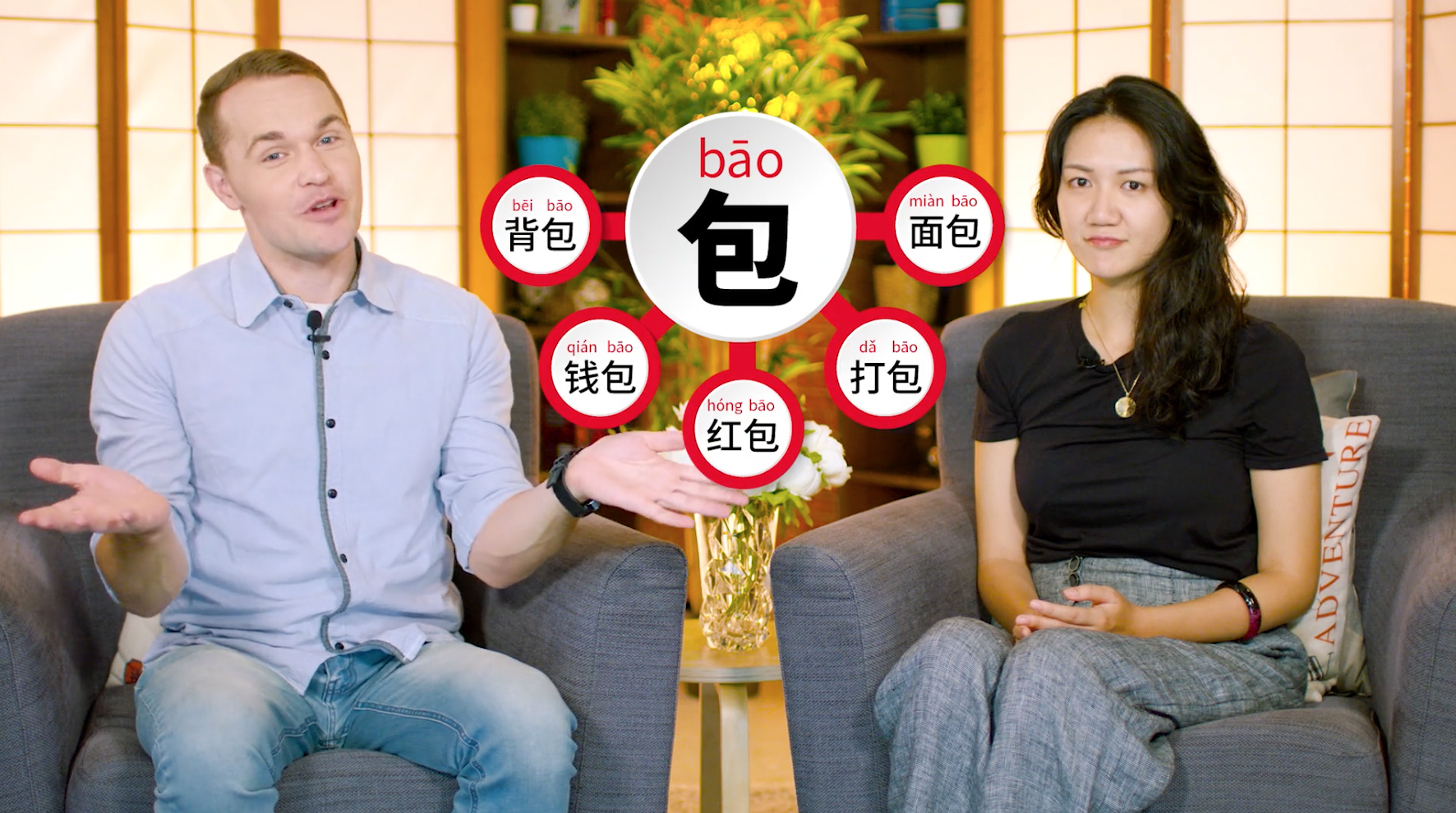
Each lesson has it's unique vocabulary and will provide you with definitions and recordings so you can practice the pronunciation. You will also be able to grasp the core material of a lesson at a glance. Here we're showing you the Simplified Chinese version.
Our guest here today is an American. However, we won't be using English to communicate and we won't be using an interpreter - we'll be using pure Chinese. OK, first let's let our foreign friend introduce himself.
I'm an American. My Chinese name is He Sizhe. I came to China right after graduating from university. At first, I went to a small city and taught English while studying Chinese. I've been to many different places and I also studied kung-fu at a Shaolin temple for 6 months. I'm really interested in Lao-Tzu and Taoism. I understand a bit about the unspoken rules of Chinese culture. For example, you have to talk business at the dinner table...
这个老外中文真好。还知道道教和老子。
zhè ge lǎowài Zhōngwén zhēn hǎo。hái zhīdào Dàojiào hé Lǎozǐ。
This foreigner's Chinese really is good. He's even familiar with Taoism and Lao-Tzu.
These days, more and more foreigners understand Chinese. When you're out in public and around foreigners, by all means, don't talk about them, otherwise they may understand you and maybe even reply.
Natural Dialogues
Each lesson is centered around a natural dialogue with key vocabulary directly prepared and translated for your use. You can also listen to each sentence as an individual recording to improve your listening and comprehension skills.
Try It For Free
ChinesePod is 100% Free to Try. Create an account today and get started!
The term "Old China hand" in English usage refers to historians and authors in the pre-1949 era such as Edgar Snow (Red Star Over China). These were people who had lived in China extensively, spoke fluently, interacted extensively with the Nationalists and Communists and whose commentary on China was particularly influential especially for those living outside. For example, American foreign service representatives David Barrett and John Service are remembered as those who influenced U.S. policy during that time. Pearl S. Buck who lived in the same village as Chou Enlai could be said to be an "Old China Hand." Perhaps this has an entirely different meaning from 中国通 nowadays.
S
smallville
你们在博客里说潜规则是那些人们不明确地去告诉别人,人人却都已经知道的“秘密”规则。但是,如果你不是在中国长大的,那么你怎样去了解在中国的所有潜规则?难不成通过trial and error?
G
guolan
suattrini,大部分是trial and error. 我已经住在中国十年多了,其中六年和一位中国的朋友住在一起。 我很深知道我永远不会全部明白中国的文化。和中国朋友一起住是最好的学习潜规则的方法,但是这个过程需要你愿意天天做错!如果你有一天你发现你没有做错、说错,意思就是你那天坐在沙发上,不去哪儿!在中国,外国人去外面,我们难免做错、说错。每次你发现对方的反应有点儿奇怪,或者他突然变成特别礼貌,你快去问你的一个比较近的中国的朋友!因为,问题是这样,你肯定做错,但是你经常就没办法知道你做错了,因为没有人想告诉你。典型的中国人不喜欢看他的对方不舒服,所以会故意去盖你的错误,让你舒服一点儿。你需要一个很近的中国朋友,一个愿意看你不舒服的朋友,才可以开始学习潜规则。
This is really a cultural difference. I personally find this 恭维 annoying (Maybe I am too Americanized) but it takes some reality adjustment to realize my Chinese counterpart is not being insincere or disingenuous.
Is this really an American? Or a Chinese person pretending to be an American?
G
giannis
I can't type in Chinese on this computer, so sorry. But I wanted to say that when I was in China/Taiwan in 1999/2000, people would be shocked that someone non-Chinese could speak Chinese or use chopsticks etc. (mostly in Beijing, not as much in Taiwan or south China). People would either compliment you profusely or refuse to even comprehend the reality of what was going on. Once, I was at a restaurant with a Korean friend who spoke NO Chinese, but everytime I would speak, the waiter would answer her, not me! He wouldn't even look at me. It was weird because my Korean friend never uttered a word. I found this inability to grasp reality to be extremely strange. Now, as this lesson says, I imagine many more foreigners speak Chinese, so it's not as big of a deal. But I don't know. Is it?
G
giannis
@malilaoshi: Even better than a friend is a boyfriend or girlfriend. :-)
I wasn´t criticizing, just making fun of myself. In fact I am also happy if vocabulary from older lessons is repeated or just if the amount of new vocabulary isn´t overwhelming.
What I most like from these advanced level lessons is, that the words are all explained in Chinese and that a lot of cultural peculiarities shine through the teachers attitude towards some vocabulary and situations.
O
ouxiansheng
谢谢!
T
tgif
My feelings exactly.
B
bababardwan
I guess this might be a case of overanalysing, but I'm wondering about how 搞不好 evolved to mean "perhaps/otherwise". I can't help but wonder if came from "do no good" in one thing, then perhaps we could try this, or otherwise [if that's no good] we could go for this shenme shenme. I can see it being used in that way, wondering if I'm right, and if so, whether it still retains a sense of that in the way it is currently used?
J
John
Bababardwan,
It's similar to 说不定 in structure and usage, if that helps any.
搞不好 has a meaning similar to "maybe," and it's normally followed by something bad. So it's almost like, "if you're unlucky, maybe...," or "in a worst-case scenario...."
I wouldn't actually translate it that way, but I think that can give you a better feel for the phrase and how it probably evolved.
B
bababardwan
Only just seen this reply now. Thanks John. Yeah, that's really helpful to get a feel for it. I think I was thinking the "bad" thing was preceding it, but you're explanation of the "bad" thing after it has put me on the right track. The rest of the explanation is really helpful too...I know what you mean by comparing it's structure and usage to 说不定。 I feel I understand it well now...great teaching :)
J
John
不客气!
B
bababardwan
哈哈,“鸡蛋里挑骨头”。。真的是中文特色的,经典
..the image it conjures up is that someone finds [chooses to take issue with] a little bone inside their egg [presumably indicating it's a fertilized egg??] and is wimpy enough to complain about it, when they should just get on and eat it? ..stop nitpicking? I'm I reading this the right way? If so, firstly you'd have to wonder how common that is...surely it would at least be worthy of comment if you found a bone in your egg. Secondly I wonder how many westerners would soldier on unperturbed, would consider it nitpicking of someone to take issue with eating it....I think this could well be a cultural difference. But hangon...maybe I've got the wrong take on this completely. Can someone set me straight on the origin of this expression?
G
guolan
bababardwan,我以为这说法的意思和fertilized egg没有关系,说法里面的鸡蛋不是fertilized。 那样,鸡蛋不能有骨头,所以如果一个人能在鸡蛋里找到骨头,他们也可以在什么完美的情况都找到什么让他们不满意的。他们算是特别挑剔。
Maybe it's like, "My coach could find something to be unsatisfied about in my basketball playing even if I were Jordan," or, "My boss would find something unsatisfactory in this report even if it were absolutely without error."
B
bababardwan
yes, I think you're right about the meaning of the phrase. They could find something that wasn't there. Makes sense. I was just wondering about the origin of the expression. Perhaps it was a tiny shard of shell and they were blowing it up into a bone...making a mountain out of a molehill.
3:00 谢谢你的确认
3:05 oh, I thought there was something between 主持人 and 说的
3:25..sorry, my question wasn't clear. I had 杂质 in my transcript, but I wasn't meaning to ask what followed "别的其他的"...I was trying to ask what 别的其他的 means. It seems redundant to me to say 其他 after 别的 and I was wondering if it had meaning or significance, or if it is just what we all do sometimes when we reinforce something by putting it another way..I suppose especially teachers may do this for the sake of giving their students the best chance of catching on. Is that what's going on here?
the first line in the expansion has 同乡 defined as "together" in the rollover. Can it mean that? The sentence translation has what I'd understand of it....folk from the same village,etc.
B
bababardwan
I can't help but be curious about this word from the expansion:
耳光..meaning slap on the face.
Is this like a clip on the ear and then the person is seeing stars [=light]?
or maybe when the hand is slapping the face, and the only things not covered by the slapping hand is the ears on the side sticking out in the light?
ok, 3rd shot at it. After the slap the ears go red [=light up]
final shot. the slapping hand was like a sudden ray of light zipping past the ears unexpectedly before striking the face.
..any other theories?
B
bodawei
The 现代汉语词典says: 用手打在耳朵附近的部位叫打耳光 (hitting in the vicinity of the ear is called '打耳光')。Doesn't answer your question really, does it? :) Dictionaries actually give two meanings to 耳光, one 'slapping the face' and the other 'hitting or boxing the ear'. I 'like' the idea of seeing stars. The sentence in 现代汉语词典 is a reminder of a different culture:
事实给了造谣的人一记响亮耳光。
B
bababardwan
haha, I love that example sentence.。。。造谣的人...I love the whole 的人 concept really...just throw anything in front of it. Also the 一记..haha.
ok, so ears are ears here. A clip over the ears..or a boxing of the ears. This 一记 gives me another idea for a theory on the meaning hear 【oops I meant "here"]. After this ren is clipped over the ears, he jiu sees the light [think Blues Brothers ] Bingo, and with that I'm gonna say I see the light [不管是不是对的,呵呵】
B
bodawei
Ha ha glad you liked it. Not sure I got it loud and clear either, I thought along the lines of 'rumour mongers get a clip over the ears 'loud and clear' to remember'.
耳光 I think of a slap on the cheek (耳 also means 'flanking') that leaves your face 光 (shining ) red.
L
lujiaojie
8:05 就是最终给你赶上了
8:40 XZ 就是你看一样东西,你只能看到它的表面。
L
lujiaojie
10:10 并不是特别难,关键呢
B
bababardwan
8:05 谢谢。。我刚才再听一遍,就能听得清
8:40 谢谢。我可以听
B
bababardwan
10:10。。谢谢确认”关键“。 我还听不见那个”是“。。”并不是“的是。。我的听力明显差
B
bababardwan
我不太清楚这个意思: “问住”,很有画面感我觉得
being stumped very much has the feeling of a picture frame....is this because the person suddenly doesn't say or do much that it looks a bit like a still life...[well not vegies and fruit and the like] but like the frame has kind of freeze framed them? ..is this what we're getting at here?
Z
zhenlijiang
Baba because David follows that up with 很形象的啊--vivid, graphic, easy to visualize--I'm guessing it means that you can easily visualize an image of the expression (I think they're talking here about ~住, and this leads to your next question below). Let's see what our teachers say.
B
bababardwan
oh, hang on, I've just noticed jiaojie's explanation above:
意思是听到“问住”这个词,就好像眼前出现了这样的画面
...I'm still not 100% 清楚 on this, but it's given me another idea of what it might mean. You're asked a question and instead of "getting the picture"[=coming up with the answer] all you can visualise/call to mind is the frame around the picture. You can't get the picture, only an empty frame. Is that it?
B
bababardwan
10:46 骄杰: “记住”呢,还有这个只是停在你的脑子里了
..if this is correct, this 记住 then I'm a little unclear how this can be the same as 问住..being stumped. I thought 记住 meant to remember. Any chance we verify what's going on here?
Z
zhenlijiang
I think David asked if there were any other examples of V+住, where this word "to stay" serves as (what I think is) a resultative complement to form these expressions. There really aren't many others Jiaojie said, but you could say 记住 is more or less the same use. Not that 问住 and 记住 mean the same.
B
bababardwan
16:28: 徐洲:...其实别人好像很【yue?/越语一去】说这个中国通的
B
bababardwan
oh, deng yi xia, I forgot toianw had corrected this in the following 30s slot 【the sentence overlapped the border of two slots] of our transcription effort,but we still need some clarification:
16:28: 徐洲:...其实别人好像很愿意【去】说这个中国通的
 G

 K
 T
 C
 B
 L
 O
 B
 J
 T
 H
 Z
 F
 E