We'll always make sure you know exactly what the lesson is about. You will easily understand whether it is relevant for you.
普通人的慈善
Great Hosts
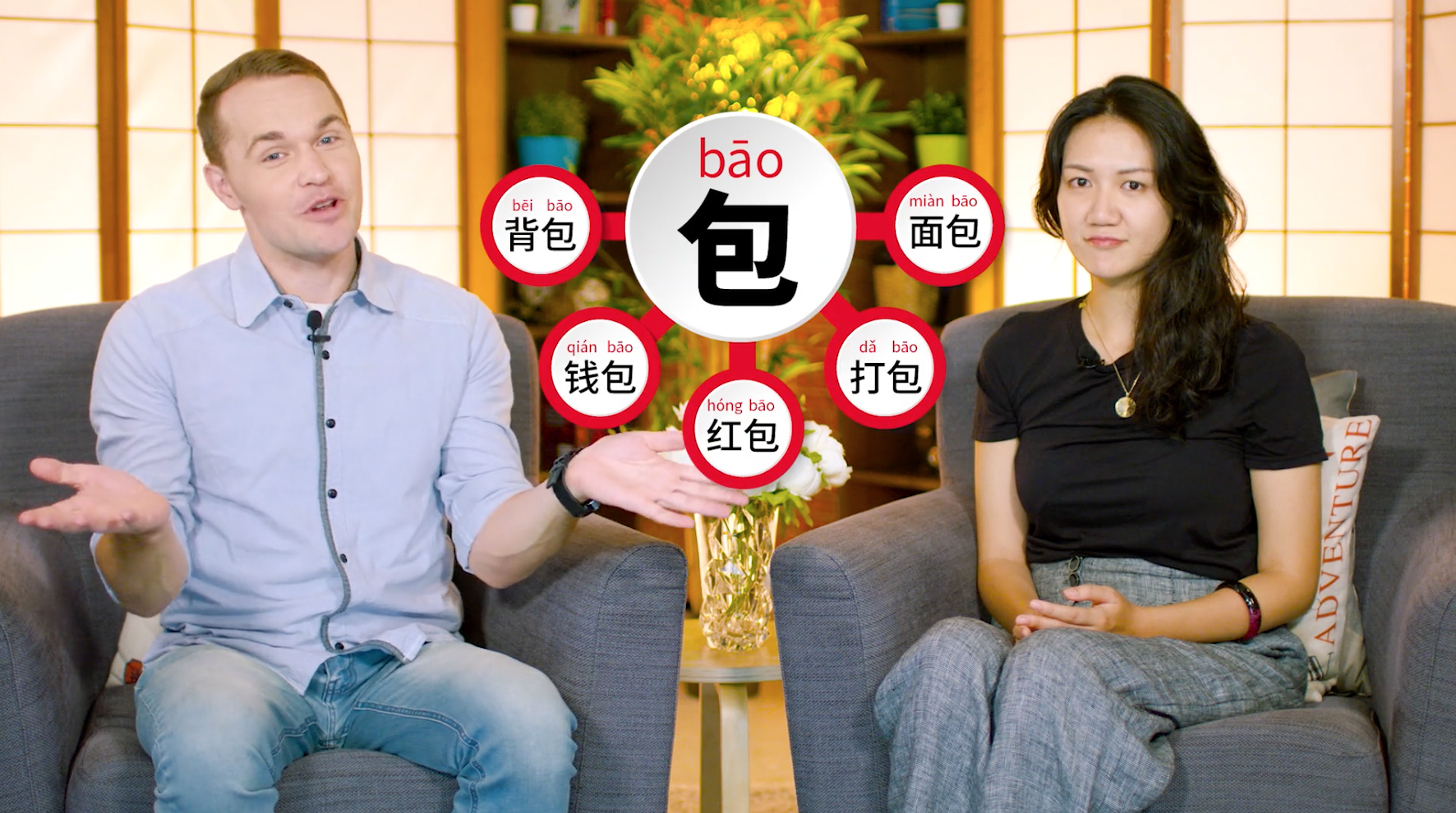
Here at ChinesePod, all our lessons are presented in an entertaining manner by our great hosts. You'll find language learners, teachers, and even professors sharing their insights, ideas, and teaching methods in our video and audio lessons.
Brief Lesson Summaries
A brief introduction of the lesson will always tell you what this lesson is about and what language level is the intended target. If you're interested in the subject, but might not be able to understand it in full, fear not; we have transcripts of lesson dialogues vocabulary so you can follow along.
Our lessons contain natural communication in Chinese in video and audio format. We have have lessons focused on video or a podcast format and our lessons have transcripts of Lesson Dialogues, Important Vocabulary, Expanded Materials for a deep dive into the lesson topic and Exercises focused on testing your retention.
Detailed Vocabulary
Each lesson has it's unique vocabulary and will provide you with definitions and recordings so you can practice the pronunciation. You will also be able to grasp the core material of a lesson at a glance. Here we're showing you the Simplified Chinese version.
Hey, look at the title of this article ''Charity is a Habit." I think it would be better to call it ''Charity is a habit for the wealthy."
谁说慈善是有钱人的专利?慈善就是善良的举动,愿意帮助别人。像这次地震,多少人都捐了款,这就是慈善。
shéi shuō císhàn shì yǒuqiánrén de zhuānlì?císhàn jiùshì shànliáng de jǔdòng,yuànyì bāngzhù biérén。xiàng zhècì dìzhèn,duōshao rén dōu juān le kuǎn,zhè jiùshì císhàn。
Who says the rich have a monopoly on charity? Charity means generous acts, and wanting to helping others. Think of the recent earthquake. How many people made donations-- that's charity.
dànshì nǎ jiā méitǐ bǎ zhège jiào císhàn?zhǐyǒu páichǎng dà,yǒu míngxīng、míngrén,dàbǐ juānkuǎn de cái jiào císhàn。hái yǒurén shuō jièdìng yǒuqiánrén de biāozhǔn jiùshì zuò císhàn。zǒngzhī,nà jiùshì ge mínglìchǎng。
But did any media outlets call it charity? Only big occasions with stars and huge donations get called charity. Then there are some people who say that the defining standard for the wealthy is charity. In sum, it's a forum for wealth and fame.
那是他们歪曲了慈善的含义。慈是慈悲,善是善良,最重要的是有这样的心。
nàshì tāmen wāiqū le císhàn de hányì。cí shì cíbēi,shàn shì shànliáng,zuì zhòngyào de shì yǒu zhèyàng de xīn。
They've distorted the implications of charity. The most important thing is to have a heart filled with mercy and goodness.
Natural Dialogues
Each lesson is centered around a natural dialogue with key vocabulary directly prepared and translated for your use. You can also listen to each sentence as an individual recording to improve your listening and comprehension skills.
Try It For Free
ChinesePod is 100% Free to Try. Create an account today and get started!
Hi bababardwan
嫣然 yan1ran2, the daughter of my favorite singer 王菲 Faye Wong was born with a 兔唇 tu4chun2, a hare-lip. She has had multiple surgeries to fix it. She and her husband (Grr..don't even get me started on this slimeball) 李亚鹏 started a charitable foundation for other little kids. It's called the 嫣然天使基金 yan1ran2 tian1shi3 ji1jin1.
There are also some bad apples. There have been some recent depressing stories about misuse of funds in the 希望学校 xi1wang4xue2xiao4 Hope Schools project that builds schools in depressed areas.
C
changye
平时善于偷税漏税的名人或者大企业也有时愿意捐款,我总觉得有点不可思议啊!
U
uoyevol
they want to show to the public and build a good fame
慈悲
慈means clemency,leniency,mercy
悲means symphathy,compassion
慈悲combines the meaning of 慈 and 悲
this word is usually referred to the Buddha
U
uoyevol
everybody can be a Buddha, the Buddha is used to be a common people, after he experienced the extremely tough times and overcame many obstacles, then he can be a Buddha,
so the Buddha is clement and symphathatic to the common people, because he understand their hardship.
W
wchan
后语:
嗨!Sunix同学
你要说:"一块钱" 也可以
F
furong
很有兴趣的课程! 谢谢你们。
我想问老师们:在中国环境保护的慈善机构多不多?他们受欢迎吗?
It seems to me that environmental issues are more widely discussed in China than they used to, but still not as high on the agenda as necessary.
P
pearltowerpete
Hi furong
NGOs of all types are not nearly as widespread here as in many places. This could be due to the fact that the CCP started out as an NGO and knows how much they can influence events.
Especially when many of the worst polluters have powerful friends in the local governments, Chinese envirnomental protection is not terribly robust. However, I can think of a few activists off the top of my head-- a guy who tried to protest the pollution of 太湖 , and a group that monitors water pollution in Western China. I respect these activists' willingness to act when others ignore the problems. If there is any hope for a livable China in the next fifty years, we will have them to thank for it.
There has been an excellent series in the NY Times called Choking on Growth (with articles translated into Chinese, and with MP3s!). The Washington Monthly and Atlantic Monthly have offered much more optimistic coverage of this vital issue.
L
leeht
Hi Pete,
Your comments to have more podcasts with Buddhism related topics (as it interests you) raises some concern in me. I hope subjects chosen to be aired on ChinesePod will be based on what is relevant and helpful to the poddies.
P
pearltowerpete
Hi leeht
There is no danger that ChinesePod will start preaching the dharma. The topics have always been and always will be based on the poddies' needs and requests.
But there is no denying that Buddhism has had a profound influence on the development of Chinese society and philosophy. In today's largely atheistic and materialistic society it's easy to overlook how important Buddhism was, not long ago.
Just as you can't fully understand the rich American intellectual tradition without knowing about Jonathan Edwards, William Jennings Bryan and Reinhold Niebuhr, your understanding of Chinese philosophy will be incomplete without Guanyin, Xuanzang, and so on.
The vast majority of our lessons are completely non-religious. And when Buddhism or any other philosophy is discussed, it is with the intent of informing and explaining, not of converting.
Hi barto,
That's a nice parody. Let me post its original text for other poddies.
孔子曰,生而知之者,上也,学而知之者,次也,困而学之又其次也,困而不学,民斯为下矣。
Confucius said,Those born with knowledge rank high. Those who acruire knowledge through learning rank next. Those who learn when in difficulty rank next. Those who do not learn even when in difficulty rank lowest among the people.
On the other hand, Confucius also said,
子曰,我非生而知之者,好古敏以求之者也。
Confucius said,I was not born knowledgeable, I am devoted to antiquity and am quick to seek knowledge.
T
tgif
PearlTowerPete:
You really had me head scratching with the translation of: 名利场 as "the area of wealth and fame."
Jeopardy question: which is Hollywood ;-)
How about "Vanity Fair" as a translation?
P
pearltowerpete
Hi tgif
I actually translated the phrase as "the arena of wealth and fame." The idea was to capture the feeling of competition or one-up-manship.
I rejected "Vanity Fair" because it brings to mind the Thackeray novel, which might be confusing.
P
penggeng
Hello, everyone! I am an associate professor of the GUCAS of Chinese, and you can find more detailed information about me with http://www.mscas.ac.cn/mba/teach/?mem=39). Now, I am a visiting scholar of the University of Texas-Austin, USA. I am glad that there are so many people like to study Chinese and willing to provide practice on online with msn: penggeng2006@hotmail.com, or with face-in-face.
Looking forward to meet you.
K
kuaizihaizi
In the dialogue where A says: "大笔捐款的才叫慈善" would it be accurate to translate 大笔 as writ large? How else can you use 大笔?
K
kuaizihaizi
Another question! As I understand it 包装 is being used metaphorically in the dialogue. Can I use 包装 to describe the shaping of other images? For instance, can I say that a politican's image has 被包装?
P
pearltowerpete
Hi kuaihaizi
笔 is a measure word for sums of money.
So in this case, a good translation of 只有排场大,有明星、名人,大笔捐款的才叫慈善 would be something like "Only big occasions with stars and huge donations get called charity."
And 包装, in addition to referring to packaging of tangible goods, can definitely refer to a person. Many singers, for example, are considered to have been "packaged" to appeal to a mass audience.
L
lujiaojie
It means someone who is 乐善好施 stands on a high moral ground in some regards.
一些词汇:
怜悯 lián mǐn to have pity for; to commiserate
慈悲 cí bēi mercy
豪华 háo huá luxurious
纯真 chún zhēn pure; innocent; sincere
隆重 lóng zhònggrand red-carpet event; ceremonious; solemn
施舍 shī shě give alms
境界 jìng jiè boundary; state of mind
用心 yòng xīn diligently
退稅 tuì shuì a tax rebate; a tax refund
募捐 mù juān to solicit contributions; fundraising
回馈 huí kuì to give back; feedback
捐助 juān zhù offer; contribution; donation
偏重 piān zhòngto lay particular stress on; to be biased
喜好 xǐ hào to be fond of; to like; to love
活菩萨 Huó Pú Sà a living Buddha; fig. compassionate person; saint
应付过去 yìng fù guò qù manage with
Replying to
Posting as a guest. Comments are reviewed before they appear. Log in to post right away.
 B

 C
 P
 C
 M
 J
 A
 W
 F
 T
 J
 L
 T
 K
 F
 V