We'll always make sure you know exactly what the lesson is about. You will easily understand whether it is relevant for you.
长征
Great Hosts
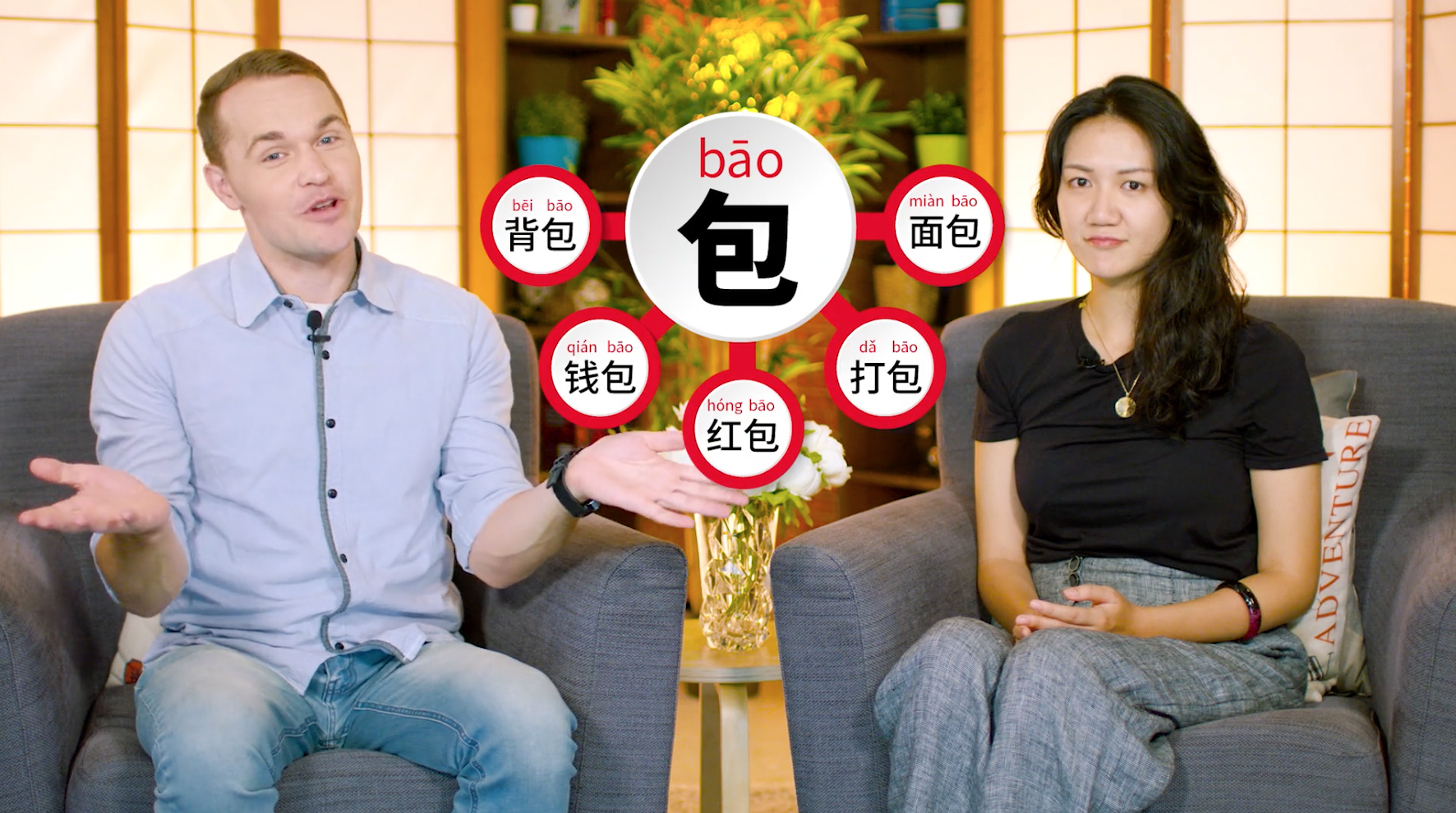
Here at ChinesePod, all our lessons are presented in an entertaining manner by our great hosts. You'll find language learners, teachers, and even professors sharing their insights, ideas, and teaching methods in our video and audio lessons.
Brief Lesson Summaries
A brief introduction of the lesson will always tell you what this lesson is about and what language level is the intended target. If you're interested in the subject, but might not be able to understand it in full, fear not; we have transcripts of lesson dialogues vocabulary so you can follow along.
Our lessons contain natural communication in Chinese in video and audio format. We have have lessons focused on video or a podcast format and our lessons have transcripts of Lesson Dialogues, Important Vocabulary, Expanded Materials for a deep dive into the lesson topic and Exercises focused on testing your retention.
Detailed Vocabulary
Each lesson has it's unique vocabulary and will provide you with definitions and recordings so you can practice the pronunciation. You will also be able to grasp the core material of a lesson at a glance. Here we're showing you the Simplified Chinese version.
Dad, that ''Long March Walk" during the National Day Week that you signed up for-- it couldn't be 8,000 miles (12,874 km), could it? If it were me, it would be too much to walk that route even once in my life!
wǒ yīzhí xiǎng wánzhěng de zǒu yī biàn,tǐhuì yīxià nǐ yéye dāngnián chī guò de kǔ。nǐ yéye yǐqián cháng gēn wǒ shuō tā hé zhànyǒu men yīqǐ pá xuěshān,guò cǎodì,chī shùpí de gùshi,nà zhǒng jiānkù wǒmen shì nányǐ xiǎngxiàng de dào de!
I've always wanted to walk it all the way, and experience the bitterness that your Grandfather tasted during those years. Your grandfather often used to tell me about climbing snowy mountains, crossing grassy fields, and eating bark with his war-time buddies. It's hard for us to imagine that kind of bitter struggle.
hépíng niándài de rén,xiàng nǐmen,shì gǎnshòu bùdào nà duàn hóngsè suìyuè lǐ,dàjiā wéile yī ge gòngchǎnzhǔyì lǐxiǎng,shì kěyǐ bùxiè fèndòu nǎizhì xiànchū shēngmìng de!
People like you, from an age of peace, can't get a sense of those revolutionary times. People were willing to struggle, even to the point giving their own lives, for the ideal of Communism!
Natural Dialogues
Each lesson is centered around a natural dialogue with key vocabulary directly prepared and translated for your use. You can also listen to each sentence as an individual recording to improve your listening and comprehension skills.
Try It For Free
ChinesePod is 100% Free to Try. Create an account today and get started!
Using a leading online translater this is what I have determined...
“painstakingly, thinks Long March 25,000; Is tired, thinks that revolutionizes the seniors.”Crawls the snowy mountain, the lawn, to eat the bark ......In the red years, the senior supports them by the firm faith to pass through that endless Long March road, moves toward the final victory. Peace age's we are very perhaps difficult to imagine such condition and the fervor, but mentions “the Long March”, that spirit makes one have profound respect. Actually does Red Army Long March have what kind of significance? Let us listen to today's high-level Chinese together!
This just goes to show me that knowing the characters is not sufficient to really understanding written Chinese.
P
pearltowerpete
Hi amesburygeorge
Just as the proliferation of 星巴克 Starbucks has actually helped drive people looking for real coffee to their local java shops, the massive advances in online translation have also helped the market for human translators.
We make our share of mistakes, and we need time, but there is still a big gap between the best online translation and the quality we can provide.
P
pchenery
Here's my rough translation:
Recalling the tiring, painstaking Long March of the 25,000; recalling the political revolution of an older generation, who climbed snow-capped mountains, passed through meadows and who ate tree bark. Looking inside the revolutionary years of the older generation, there was a firm belief and conviction, they marched free and unrestrained on a very long and endless trip towards final victory. In an age of peace, we probably find it difficult to imagine those kinds of conditions and passion, but mention the Long March, and that kind of spirit causes profound respect. Actually, what is the significance of the Long March of the Red Army ? Let's listen together to today's Advanced Lesson.
P
Purrfecdizzo
Well, that makes much more sense.
J
jennyzhu
At this level, the challenge is more about the subtle nuance of the language. 比如, “苦不苦,想想长征二万五;累不累,想想革命老前辈。”语气是比较调侃的,意思是你觉得自己苦,再苦也比不上长征苦;你觉得自己累,再累也没有革命老前辈累。
语言的感觉是比较抽象的。我回想自己学英语的时候,看美国sitcom,就算大致懂得意思,也不觉得好笑。后来接触更多的英语,才培养出语感。我们chinesepod会帮助大家继续进步的。
P
Purrfecdizzo
Well, one day, I hope to be able to listen to an advanced level podcast and understand what is being said.
M
mark
虽然这是高级课程, 但是我会用英文叙述我的感觉。I was already an adult when China and the US normalized relations. So, I grew up thinking the long march was a terrible event. To hear it described admiringly requires some mental adjustment. I thank Chinesepod very much for giving me an opportunity to see something from a new perspective.
C
changye
一般来讲,革命家只有进行革命的时候才能辉煌。
P
pearltowerpete
changye 大哥说的很对。 我们有一句话叫 “革命把自己的孩子们吃掉。”
要进一步了解很多人对革命的怀疑,poddies 可以听一听 "Won't Get Fooled Again" by The Who.
最经典的歌词(我自己翻成中文了):
认识一下新的老板。跟以前的老板一模一样。
P
Purrfecdizzo
Do I need to buy a keyboard with 70,000 characters on it in order to type in chinese letters? Im joking about the 70,000 keys, but it is hard to imagine typing all the variations of the chinese characters with a keyboard with such few keys like I use for the roman alphabet.
G
goulnik
amesburygeorge, all you need is 5 keys actually. on my smartphone, I use the (amazing) A4 手机输入法 (input method for PPC), and in 笔画 mode, 一丨丿丶 and 乙 are enough to specify all characters.
There are many other modes too such as pinyin, and there, 8 keys is all you need, basically like when you write text messages on a cellphone numeric keypad. You need several strokes, but with predictive input it's actually quite fast
G
goulnik
while I agree with pearltowerpete and jennyzhu, I would think there are more elaborate translation tools available. They may not be online and free, and some may be specific to language pairs, I'd be surprised that there isn't ...
anyway, there is no doubt these don't compete with human translators. I never use these tools myself for Chinese, but when you need to get the gist of say, an email exchange that started in German, that's quite handy.
P
pearltowerpete
Hi goulniky
One extremely powerful tool is TRADOS, a software program that "remembers" the previous translations of you (and the people in your team, if you share a database.) It takes a lot of the tedium out of translating documents, especially those with a lot of similarities like contracts, deeds, etc. It lets the translator focus more on the fun, ever-changing stuff.
But it is not a translation software per se. It's only as smart as the people using it.
Hi changye
我同意你的观念。盲目得追求“乌托邦”特别危险。全世界历史上几亿人为了各种各样的意识形态付出了最昂贵的代价,自己的生命?
也许poddies 知道我特别喜欢摇滚音乐。The Beatles 的一首歌表达我对revolution 的一些想法...
But when you talk about destruction Don't you know that you can count me out....
Interesting vocabulary and expansion in this lesson. I especially like lessons about history, language and culture etc. Though the content is quite remarkable and pretty upsetting for many people in this lesson, I believe.
T
his lesson really exaggerates and glorifies the long march. I mean, take for example the distance of the long march which is claimed to have been 12 000 km, while it probably was something like the half, 6000 km. It is quite obvious Mao and the CCP distorted and tried to glorify the long march including its battles to justify their terror. The so called "heroic" battle at the Lunding bridge has later been investigated by historians and even been proved that it was virtually invented and never took place, all for their on purpose apparently.
And as for changye's and wchan's discussion, yes to me it is in fact very offensive claiming Mao to be a "superstar". (anyway what is that supposed to mean!?) Mao was a bloody dictator, a raving lunatic just as Hitler and Stalin; mass murderers. Hitler tried to exterminate the Jewish people, but Mao on the other hand was completely indifferent concerning the suffering and death of the very same people he belonged to. Mao is probably responsible for as much as 30-72 million people’s death - most of them in peace time. “草菅人命” is a quite good description of Mao. Mao is often claimed to have done 70% right and 30% wrong by the CCP, which is sheer nonsense. Consider applying the same way of reasoning concerning Hitler and Stalin etc. Rather than being a national hero or “star” he was a butcher and tormentor of his own people.
wchan, you can definitely have different opinions about Mao and his intentions or ulterior motives but the result of his ideas have been and remains catastrophic. It is a fact, China is under brutal dictatorship. It is ridiculous to claim anything different; the Chinese are not masters in their own house. Realize the situation, China remains under dictatorship, just as during the emperors’ eras.
Chinese culture and politics are completely different aspects; this is not an offense on Chinese identity, culture or national pride. And lastly, it does not matter what kind of ideology a regime claims to represent if it acts like, for example the CCP; viciously. Call this rightist propaganda or whatever you want, that is not the intention or any political view I support. I think Chinese pod ought to give nuanced and fact based descriptions of this kind of historical event or clearly state where the information comes from.
Thank you,
Best whishes
C
changye
夸大事实就是胜利者的特权。
C
changye
In Chinese history, especially after the era of Tang dynasty (唐朝, 618-907), the official history book of a dynasty has been traditionally edited by the next dynasty that took over the previous one. In short, a victorious dynasty writes the authentic history book on a vanquished dynasty, and this automatically means that there are sometimes exaggerated, distorted or fabricated facts in those state-sponsored historiographies for the purpose of enhancing legitimacy of victors.
For example, 元史 (the history of Yuan dynasty) was written by 明朝 (Ming dynasy), and 明史 was by 清朝 (Qing dynasty), but interestingly, there is still no official history book of 清朝 in the PRC. I hear that it’s going to be probably published in several years. I understand the reason why it takes so long to write the history of 清朝. I guess that there are a lot of politically delicate issues in it, which need to be "favorably interpreted" for the PRC government.
P/S. Republic of China (Taiwan) already published 清史, but the PRC doesn’t authorize it.
P/S.2 Who will write the history of the CCP, haha?
H
hugorestall
钦佩共匪?长征的“成功”让他们剥夺人民的权利,压迫老百性。
P
pearltowerpete
Hi huguorestall
在国民党的领导下,中国并不是什么人间天堂。战争经常是这样的,双方都不怎么样。对了,我们一般说老百姓.
Confucius said, war doesn't determine who's right. It determines who's left ;-)
M
mprobertson
Totally with michael78 on this one. Further, I make the recommendation to do a series of lessons on the CCP's political campaigns, too: 延安整風,三反,五反,百花,大躍進,文革,四清,六四,迫害法輪功,等等等等。 There's so many books that give real histories on these matters, including the Long March etc.
Finally, I would very possibly subscribe if you did a 文言 section. The advanced classes still seem to be the vernacular. But who does not deeply yearn to understand the language of the Masters?
T
tingyun
I don't think a 文言 section would be a good idea - its terribly unsuited for audio learning. I'd strongly recomend Paul Rouzer's book: it's used at Harvard by the 1st year students, and is a great introduction. It's called "A New Practical Primer of Literary Chinese." Here is the amazon link http://www.amazon.com/Practical-Literary-Chinese-Harvard-Monographs/dp/067402270X/ref=sr_1_1?ie=UTF8&s=books&qid=1294455443&sr=8-1
Cpod has an amazingly talented staff, but teaching 文言 is really a matter best left for carefully researched books written by experts. Trying to do it through Cpod would be 圆凿方枘 (Round hole, square peg).
班廷筠
B
bodawei
Thanks for that mate. I think I would like to dabble in this. Will it help me read newspapers?
BTW I love how this site allows conversations with the ghosts.
T
tingyun
Hi Bodawei,
I imagine it would indirectly prove helpful (and certainly fun) - but if newspapers are your goal, it would probably be more direct and quick to just study modern formal written language - 书面语. While it has its roots in 文言, modern 书面语 only imported a small portion of 文言, so most of what you learn from 文言 will not apply (probably the only benefit is you'll learn some new characters, and get a clearer understanding of some others).
The modern language classes here at Harvard have their own texts created by the staff, and the level 4 texts focus exclusively on teaching modern 书面语. Here's a link a place where you can order the level 4, 1st semester text - http://chinasprout.com/shop/BLO092 . Its called "Comprehensive Chinese: Advanced Reading I"
It doesn't have the charm of Cpod, but its probably the best source for learning modern written Chinese. They select great articles, and do a great job on grammar explanations. Work through the series and newspapers will be no problem. They specifically focus on giving you exposure to all styles - from the almost narrative kind of reporting present in some news stories, to the 'popular economics' kind of argument, to the more editorial argument kind...
Or just go the 文言 route - I think reading Mengzi is more fun than a newspaper. ;)
B
bodawei
Thanks so much for that - I kind of suspected that 书面语 would be the way to go. I will also have a talk to my tutor about it - he works in the media and has a good feel for my reading abiliy; I'll see if he can help me through one or the other books you suggest.
I agree that newspapers are not much fun - I have been directed to 'life style' magazines; and they are a little more interesting than they sound. But I would like to understand more about the different styles.
Mengzi apparently said: 'words close, meaning far' - do you know which characters he used in this quote?
T
tingyun
Hi Bodawei,
My first guess was 言近意远 - which was lucky in that it is a chengyu derived from a song dynasty rephrasing of the quote you mentioned, so it led me to it. 《孟子·尽心下》:“言近而指远者,善言也。”, though 指 is interpreted as and replaced by 旨 to form the standard version of the modern Chengyu 言近旨远
Anyway, I think a better English translation would be 'accessible (simple) language, deep meaning'. Though of course if you wanted to translate Mengzi's quote, rather than just the chengyu that emerged from it, it would be something like 'Those who use accessible (simple) language to convey deep meaning, are good at speaking.' If you'd like to get a feel for how to read it yourself, in “言近而指远者,善言也。” the pattern is one of 'to be' (like the modern A 是 B sentence pattern means 'A is B') - here we have the pattern A者,B也 which means 'A is B', 言 is a verb meaning 'to speak', 指 is 旨 which has the meaning 意 , and the rest is as you would except from modern Chinese.
B
bodawei
Mate, you are good. :)
This reminds me that chengyu (like English idioms) can be frequently misinterpreted and mis-used. I imagine in Chinese almost as much as they are in English.
The chengyu that I used above, in English, could be interpreted in a number of ways I think (I thought it meant that it is difficult to get to the real meaning of words), whereas the Mengzi quote (as you translate it) is something that cannot easily be mis-interpreted. And it conveys something much deeper than I had originally thought.
Thanks again for your time and effort on this.

 P