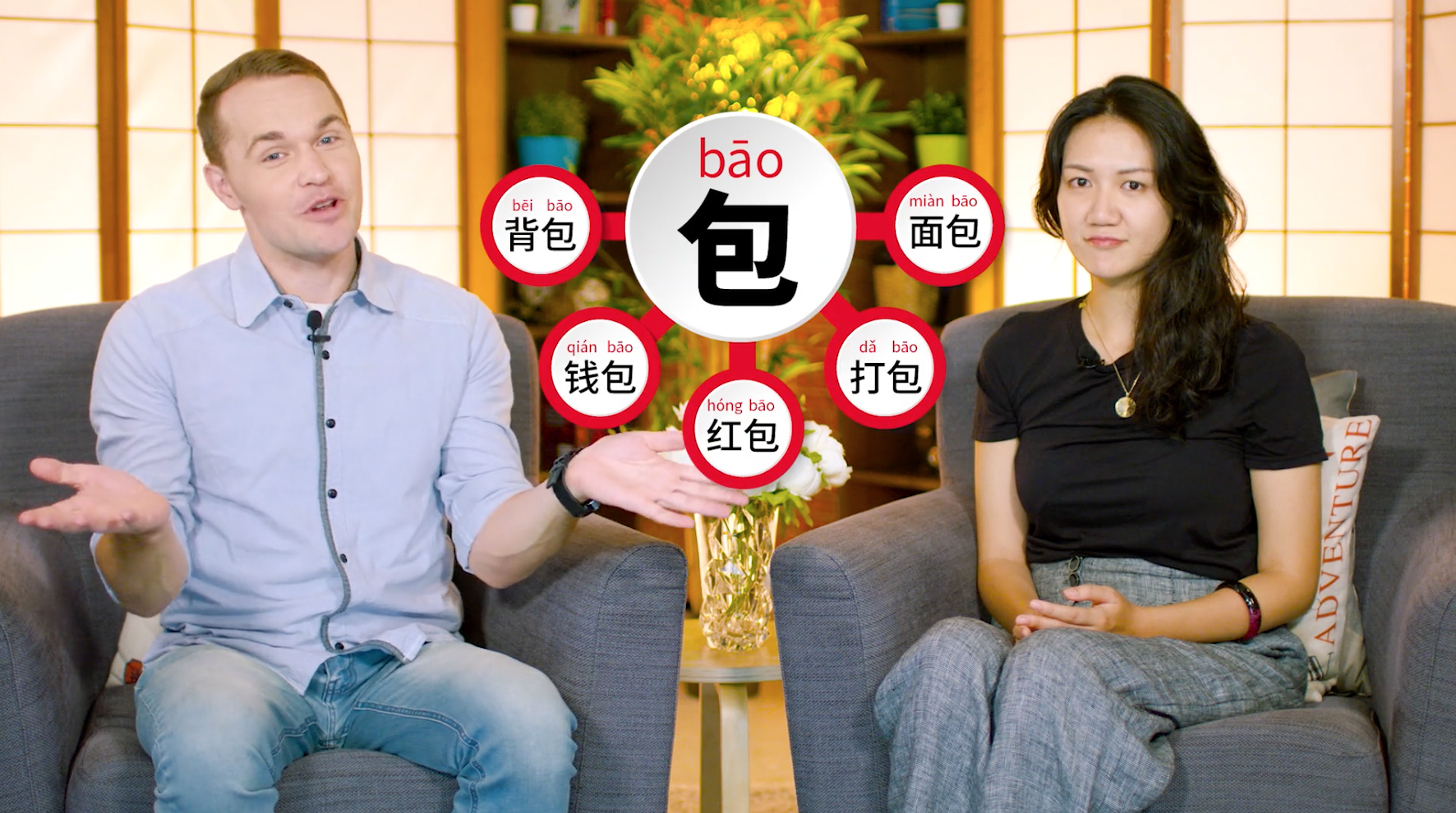
Relevant Content
We'll always make sure you know exactly what the lesson is about. You will easily understand whether it is relevant for you.

Who is that?

Great Hosts
Here at ChinesePod, all our lessons are presented in an entertaining manner by our great hosts. You'll find language learners, teachers, and even professors sharing their insights, ideas, and teaching methods in our video and audio lessons.
Brief Lesson Summaries
A brief introduction of the lesson will always tell you what this lesson is about and what language level is the intended target. If you're interested in the subject, but might not be able to understand it in full, fear not; we have transcripts of lesson dialogues vocabulary so you can follow along.
IN THIS LESSON
ID: 0913 Newbie
You may not be strutting on the catwalk, but your significant other is working it tonight! With this lesson, you can let everyone in the room know, hey... she's with me! And you'll do it in Mandarin Chinese.
Awesome Materials
Our lessons contain natural communication in Chinese in video and audio format. We have have lessons focused on video or a podcast format and our lessons have transcripts of Lesson Dialogues, Important Vocabulary, Expanded Materials for a deep dive into the lesson topic and Exercises focused on testing your retention.
Detailed Vocabulary
Each lesson has it's unique vocabulary and will provide you with definitions and recordings so you can practice the pronunciation. You will also be able to grasp the core material of a lesson at a glance. Here we're showing you the Simplified Chinese version.
SIMPLIFIED PINYIN ENGLISH  
那 nà that
是 shì to be
谁 shéi who
她 tā she
那个女孩儿是谁?
nà ge nǚháir shì shéi?
Who is that girl?
她吗?
tā ma?
Her?
对。真漂亮!
duì。zhēn piàoliang!
Yes. She's really beautiful!
她是我女朋友。
tā shì wǒ nǚpéngyou。
She is my girlfriend.
Natural Dialogues
Each lesson is centered around a natural dialogue with key vocabulary directly prepared and translated for your use. You can also listen to each sentence as an individual recording to improve your listening and comprehension skills.
Try It For Free
ChinesePod is 100% Free to Try. Create an account today and get started!

Comments (50)

Discuss in the forum
michele
thanks John, everything works fine now, but I have to say that I even did'nt realized there was something wrong... I would like to say something that may appears odd said from an user, or a customer who pays for a service... did you ever think there should be some right, for you all of the CP staff, both academic, technical, or of any sort else, to have some little weekly... rest, like most of the people in word usually have. I know, I know... modern life, fear for other possible business competitors, the will to do more and more, and better and better.... that's all true, but I have to say that, sometimes, I feel a little worried about you... After all, this is not an hospital, or an electric generator station, or even a blast furnace! isnt'it? I remember the old times of CP when on saturday there was no lessons, but Aric's Saturdays'show, and on sunday nothing at all... well, this seemed to me quite normal, even useful for everyone, for you and for me too. Yes, I'm wondering if what I'm saying now has something to do with the fact that, wrongly, I'd like to follow too much levels and too much lessons. In this perspective, a little break in this (precious, beautiful and rich, I reckon..) waterfall of lerning material would not be somehow.... healthy? Perhaps, sometimes, less could be better. OK guys, don't take this too much seriously, only if you like it tell me what you think about. At any rate, it's clear, it is useful to warn you about some malfunction, and I've already done,  nevertheless, on sunday, I feel somewhat empathetic with you, that must rush to fix some bug under pressing request... ciao Michele.

changye
Here is a well-known Chinese saying 女大十八变 (nv3 da4 shi2 ba1 bian4), which means “As a girl grows, her appearance and personality undergo a significant change.” Some people say 十八 suggests “to change eighteen times”, and others say “to change until eighteen years old.” Anyway, its basic connotation is the same, which usually hints “a girl becomes beautiful when she grows up.” Do you think so? And as far as my female dog concerns, I must say this saying contains a truth. She has become very chubby (and pretty) with growth and is still changing..........
michele
hi changye, do you think is there any chance to get some hint for the best possible translation, looking at the order of the five charcters? I'm thinking about  大十八变 . I'm wondering why 大 and 变 ,that is "the big change" has to be splitted, separated by 十八.  Does this  sequence  could be read as the will of constructing a single strong chunk, like "is to be expected  a big change when eighteen years old is reached"? or even better, "it's great the change that happens on the eighteen years" In other words, how would you express this concept in currently spoken Chinese? At any case I don't mean here to destroy the beutiful liquid uncertainty of a Chinese saying, in order to get an improbable definitive translatione!    
K
kesirui
Did China always have the words " 女朋友 (nǚ péng yǒu)" and "男朋友 (nán péng yǒu)" or was that added later as a result of western exposure?
changye
Hi michele, I really love your analysis on 大(十八)变!I couldn’t come up with this idea. It’s very interesting. Actually, some Chinese words often separate, for example, the word 结婚 (jie2 hun1, marry) changes this way;结了三次婚 (married three times). And in this case, the verb 结婚 has the structure “结 (V) + 婚 (O)”. How about 大变 (da4 bian4)?I’m afraid this word doesn’t have “V + O” structure. Probably it is translated as “change drastically” and its structure is “adverb (大) + verb (变)”. As far as I know, this type of Chinese verbs don’t separate like 结婚, perhaps. Let me try to translate 女大十八变 into modern Chinese. 女孩子长到十八岁就变漂亮。女孩子长大时有十八次的变化。 I believe that a lot of Chinese people would agree with your translation "is to be expected a big change when eighteen years old is reached". Anyway, there seems to be still no accepted interpretation for this famous saying in China.
michele
thanks a lot changye, your reply introduces more interesting stuff about the splitting in two parts of a two character word. I  also guess that, even though this seems not to  be a particularly tricky one, a saying, not perfectly following all the current grammar rules, perhaps has some good poetical, phonetic purpose; it's always acceptable a poetic licence!
suburbanite
Q: did anybody else have difficulty with the pronounciation in the last half of the dialog? (zhen v. jin and tiao v. piao) I thought that made the lesson a little more challenging from a listening perspective. A good challenge none the less.
W
wenshaTim
I think that when there is a posting of a technical error, that posting should be removed after the error is  fixed. After all, the goal is the study of the language, not of the gliches.
shanyisheng
Since e have the new CP layout I do not see chinese characters any more . Just:  ä¸€åœºçªå¦‚å…¶æ¥çš„åœ°éœ‡å¤ºåŽ»äº†å¤šå°‘äººçš„ç”Ÿå‘½ï¼Œæ‘§æ¯äº†å¤šå°‘ä¸ªå¹¸ç¦å®¶åº ï¼Œæ¯ç äº†å¤šå°‘å¹¢å»ºç­‘ï¼Œç‰µåŠ¨äº†å¤šå°‘äººçš„å¿ƒï¼ç¤¾ä¼šå„ç•Œï¼Œå›½å†…å›½å¤–éƒ½å‘ç¾åŒºä¼¸å‡ºäº†æ•‘æ´ä¹‹æ‰‹ï¼Œå›½å®¶é¢†å¯¼ä¹Ÿäº²ä¸´ç¾åŒºï¼Œç»„ç»‡æ•‘æ´ã€‚ä»Šå¤©æˆ‘ä»¬èŠ‚é€‰äº†ä¸€æ®µæ¸©å®¶å®æ€»ç†çš„è§†é¢‘ï¼Œçœ‹çœ‹å¬å¬è¿™ä½å¹´é€¾èŠ±ç”²çš„è€äººï¼Œæ€Žä¹ˆç»™ç¾æ°‘å’Œå®˜å…µé¼“åŠ²ï¼Œç»™å¤§å®¶å‹‡æ°”å’Œä¿¡å¿ƒã€‚ Who has this same problem ? Its only in Safari, not in Firefox.
M
moniqueferreras02
elow, i'm a newbie, i find the language quite easy to understand, but some of the pronounciations are hard to do and even the characters itself, i don't know where to start studying about it...
shanyisheng
In the expansion lessons there is the girl saying 是  in a strange way with the i  of 七  (qi). Up to now it was pronounced "uh", so: "shuh". how come ? Shanghai dialect ?
jimoya
I always learn so much from Changye´s posts!! Thank you Changye! Does any one knows the answer to  kesirui´s question? it´s something i´ve been wondering since i learned those words.
B
bababean
You guys are fantastic.  I say this as a language professional teaching in China.  I will be recommending this website to all my colleagues and plan to upgrade shortly. Thanks especially to Jenny and Ken.  It is evident you have done your work in contructing a pedagogically sound and fun system for people like me to acquire language. Love and Peace to All! John :-)      
frognotinawell
Is there any difference in usage between 真的 and 真? In today's lesson it's zhen1: 真漂亮; at other times zhen1 de: 我真的很热. Is there a rule, or is it purely a matter of personal preference?
cjhawk7
shanyisheng I don't think its a dialect issue. For some reason I think it just changes slightly with the context. The only time I stray away from pronouncing shi4 as "sher" or "suh" (southern dialect) instead of "shuh" is when asking who someone is. So to me it would be ni3 shi4 "shuh" shei2. And in most other contexts would use ni3 shi4 "sher" or "suh" mei3gou2ren2. Don't know if that makes any sense, and there is probably a better explaination, but just throwing it out there.
dagah
How do you know whether 女孩儿 (nü3 hair2) or 女儿 (nü3 er2) is reffered to a girl or a daughter? it means both right?
H
houban
Why does he say Wo nǚpéngyǒu and not Wode nǚpéngyǒu?
A
almajors
The de 的 is implied in some statements such as wo mama 我妈妈, wo pengyou 我朋友, and the such. wo+subject 我+主语 (zhu3yu3) implies the 的 in cases such as this. Sorry, I'm not sure how to explain beyond this.
RJ
the possesive "de" (的) can be omitted when the possesor is represented by a personal pronoun and the possesed is a personal noun such as one's parents. This is roughly the rule. RJ
johnb
shanyisheng, About your character display problem, can you check what character encoding Safari is using? Click "View" then "Text Encoding" and see what is checked. It should be either "Default" or "UTF-8." If it's neither of those (or if it's Default and it's still not working) trying changing the encoding to "UTF-8" and see if that clears things up. Firefox is rather smarter about guessing the right character encoding and encounters these problems much less frequently than Safari. HTH!
S
sophie20461
hi change and michele in my opinion, "女大十八变“ here"大” its means "grow up" not a adj for "变“  if you want to translate it by literality you can say"女孩子长大到十八岁的时会改变“ but the free translation is "女孩子(长到)十八岁后会改变很多” or “女孩子十八岁后会改变很多” we alway omit the "长到”
clay
shanyisheng, in the expansions, the voice was not that of a girl from Shanghai, she is from Anhui, the northwest part of china.  I went through and reviewed some sentences, and didnt find one in particular that seemed off.  Can you tell me what sentence in particular you found odd?  
michele
hi sophie, so, if I got the sense, 女大十八变 it could be read as 女 a girl (when has become great, that is, grow up) 大 great (up to) 十八 eighteen (years old), 变 changes. But in that case, where do you find a character suggesting your final 很多? I mean, that if you use 大 for the meaning of growing up, then, seemingly, you should have nothing remaining about the changes entity, great, small or what ever... More, I'd say, that in your free translation you pick up some of the current meaning of 大 to transfer it to the "change" chunk, in fact you say "very much" 很多. What do you think about it? thanks a lot for your kind attention! 再见,Michele.
R
razz
ma  nam  is  greg  bradley   i  wud  lic  tu  toc  chinese    and    mit   frens   tuw   day   and  pen pals   kk  luflos  
R
razz
rat  bac x
badge
Hi moniqueferreras, I'm a newbie as well.  Someone on CP recommended Reading & Writing Chinese: Simplified Character Edition by William McNaughton.  It has helped me a lot with character recognition. As for the pronunciation, I am in the same boat.  I am going to be getting together with some Chinese students in my area to see if that helps.  
mayor_bombolini
shanyisheng says 1 day ago In the expansion lessons there is the girl saying 是  in a strange way with the i  of 七  (qi). Up to now it was pronounced "uh", so: "shuh". how come ? Shanghai dialect ? shanyisheng, I'm guessin your getting caught up with the combination of 是什 (shi4shen2) and/or 是上 (shi4shang4). The shi4 sounds standard to my ears, but I can imagine you might be picking up a different sound given the second "sh" sound. Maybe try practice saying the sentence a few times, then listen to the expansion.    
shanyisheng
johnb, I changed to Firefox for CP. The comical  i sound in shi is in the first and fourth sentence of the dialogue. Normally i hear it pronounced shuh4, but here it is the i of 7 (qi) How come ?
shanyisheng
Now some "logistic" problem. CP tells me that I am currently studying 81 lessons among which there are a few advanced ones and some media - which I always skip. I never go further than intermediate level lessons (with great pleasure !) If I look at them and I press "remove" at all the ones I never studied. But CP know better obviously and I cannot get them from my personal record....strrrange !
S
sophie20461
hi michele "很多“ in this sentence is "补语”,so when we abbreviate this sentence,we omit it.    
siciliazhang
Anyone, can you help me ? why I can't save the "full lesson (radio quality)" now ? In the past I just clicked it, and then we can saved it, but now I click it and then I can listen it in the computer right now ?
S
susananna
Thanks alot Ken n Jenny, i'm a newbie here and have alot to learn from others. I want to write chinese too, the simples but don't know how and where to begin. can someone help?  
S
susananna
siciliazhang, right click and save as so you can save the file. good luck.
siciliazhang
susananna, if you use the computer, first you have to set the computer. this one for windows XP.  open :Control Panel/Regional and Language Option/Language Supplemental Language support, thick Install files for asian language (sometimes you need the windows XP CD installer) text services and input language, click details choose settings, click add In Add Input Language/Input language choose Chinese PRC.  For Keyboard layout/IME choose Chinese(Simplified) - US keyboard (depend on your keyboard) you can find the button on the task bar, bottom right, you can see "EN" for english and "CH" for chinese, you can swicth. you can use this language in most of the program (the compatible one for this option ) for example in this discussion, for the chinese you click "CH"  你好苏珊娜! , "EN" Hello susananna! The input for this is hanyu pinyin, you know this, right? the chinese romanization, type and then you can choose the character. I hope this can help you. good luck
H
horsiebabe
Could you say '你是真漂亮'  or would '你真漂亮' be more correct? This is probably really basic, but when I was doing the exercises I just noticed #7 MC had answer C as 是 and I was wondering if that would be incorrect to use it in that sencence. Thanks a bunch!
I
imbm
Hi horsiebabe 你真漂亮 is more correct. actually Chinese people don't say 你是真漂亮'
C
chini23
:)
E
elroch
A rather delayed footnote to imbm's comment above: One thing that causes confusion sometimes is that Chinese words are often only partially equivalent to their translations in English. The English verb "to be" has two quite separate meanings. The first is that "A is a B" implies that A is an example of the type of thing B (eg "I am a teacher"). This is the meaning that translates to 是 in Chinese (eg 我是老师). The second meaning of the verb "to be" in English is that the subject has a characteristic (eg "He is tall"). This is not a meaning that 是 shares at all.
ideotek
Yea, I realized that's going to take a little getting used to. It was just starting to get suspicious. Thanks for saying it!
J
jkilborn
Hi,   Does anyone know, why does Jennie pronounce the "nà" of "nà ge" as 'nay', where the dialogue reader says 'nah'?
calkins
Hi jkilborn, 那 (when used before a measure word) can be pronounced either nà or nèi depending on the region it's spoken.  I believe it's more of a southern dialect, but maybe someone else can confirm that. 这 can also be pronounced zhè or zhèi depending on the dialect.  Again, only when spoken before a measure word, like 这个 zhèige. I hope zhèige helps!
ideotek
Anybody know how to get a mac to produce the characters for nuhair (girlfriend) in pinyin? It doesn't seem to give me the correct ones. I had to cut and paste in the exercises so I wouldn't lose the point! :) Thanks.
calkins
You should be able to type nvhaier to get 女孩兒 (make sure you type 'v' not 'u'). But I think 女孩兒 just means "girl". Girlfriend would be 女朋友 nvpengyou or 女友 nvyou.
ideotek
Yes, I was looking for "girl" but girlfriend came out. Happens sometimes to me. So let's try it: together nvhair gets me 女孩日 - last character is wrong. separately: nv hai r 女 亥 日 AHA! for nü I type nv and that 'r' on the end is actually 'er'! 女孩儿 I guess this must be a newbie thing. Thanks for the help!
stephenfox
Hi, I have a couple of questions. :-) (1) Do you have to use "ge" after " Nǎ" to form "that" and why? (2) In written pinyin whi is "5" often written after "nǔhair2"? (3) What is the pinyin for "cute"? The expansion seemed to be missing this. Thanks!
JasonSch
Hi Stephen, 1) Nope! I'm assuming you mean 'nà', right? Nà means 'that', and 'gè' is a measure word for many things. So, literally nàgè means 'that thing'. You can also just say 'nà', however, for 'that'. 2) The 5 is for the neutral tone, or the tone that isn't really a tone. So, 女孩儿 is nǚháier, the 5 being for the 儿 er. 3) The pinyin for cute is kěài. We just added it, thanks.
stephenfox
Thanks! One small additional question! why is the 5 written after the word in this case given i have not seen it written after any other words and i assume the lack of any tone mark indicates the 5th tone.
JasonSch
No problem. As far as tone marks go, the neutral tone isn't marked. So, although I included it as I typed, when I hit the 'convert to tone marks button below', the 5 was left out. If you write the tones with numbers, you can write, nv3hai2er5. (or leave it out)
8
8890909
What is the difference between zhen and hen?
B
BrianWatson132
Loved hearing the RuPaul song...