Relevant Content
We'll always make sure you know exactly what the lesson is about. You will easily understand whether it is relevant for you.

What Type of Man do You Like?

Great Hosts
Here at ChinesePod, all our lessons are presented in an entertaining manner by our great hosts. You'll find language learners, teachers, and even professors sharing their insights, ideas, and teaching methods in our video and audio lessons.
Brief Lesson Summaries
A brief introduction of the lesson will always tell you what this lesson is about and what language level is the intended target. If you're interested in the subject, but might not be able to understand it in full, fear not; we have transcripts of lesson dialogues vocabulary so you can follow along.
IN THIS LESSON
ID: 1233 Elementary
In today's lesson, you'll learn to use Chinese to talk about your taste in men. Do you like bad boys? Do you like high rollers? In today's podcast, you'll learn the Mandarin you need to talk about what kind of gentleman makes your heart go pitter-pat.
Awesome Materials
Our lessons contain natural communication in Chinese in video and audio format. We have have lessons focused on video or a podcast format and our lessons have transcripts of Lesson Dialogues, Important Vocabulary, Expanded Materials for a deep dive into the lesson topic and Exercises focused on testing your retention.
Detailed Vocabulary
Each lesson has it's unique vocabulary and will provide you with definitions and recordings so you can practice the pronunciation. You will also be able to grasp the core material of a lesson at a glance. Here we're showing you the Simplified Chinese version.
SIMPLIFIED PINYIN ENGLISH  
喜欢 xǐhuan to like
什么样 shénmeyàng what kind of
男人 nánrén man
当然 dāngrán of course
你喜欢什么样的男人?
nǐ xǐhuan shénmeyàng de nánrén?
What kind of man do you like?
当然是帅哥咯!很高,很帅!
dāngrán shì shuàigē lo!hěn gāo,hěn shuài!
Handsome guys, of course! Tall and handsome!
还有呢?
háiyǒu ne?
What else?
还要有一点儿酷的。
hái yào yǒu yīdiǎnr kù de。
They should also be kind of cool!
Natural Dialogues
Each lesson is centered around a natural dialogue with key vocabulary directly prepared and translated for your use. You can also listen to each sentence as an individual recording to improve your listening and comprehension skills.
Try It For Free
ChinesePod is 100% Free to Try. Create an account today and get started!

Comments (59)

Discuss in the forum
kimiik
Pitter-pat ? I thought it came from Peter Pan but no that was just pitter-patter. ;o)
Tal
kimiik, looks like pete's eclectic taste in music extends to Erin McCarley.
jennyzhu
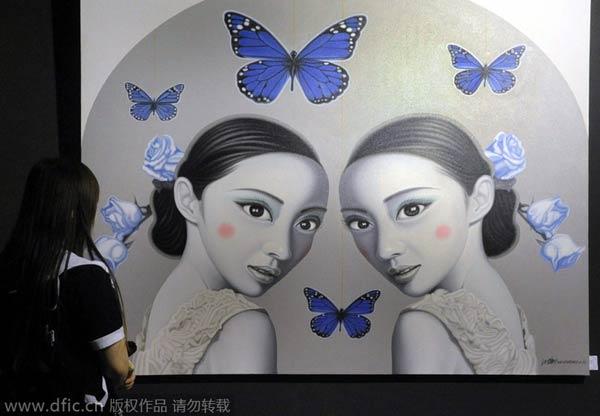
In the past 2 or 3 years in China, what's considered as 帅/shuai4/handsome has moved from a man's man to a much more androgynous look (yes, that's a man...)  
tommy2tone
Jenny, has the standard for 美女 also changed?
jennyzhu
@tommy2tone, While the Zhang Ziyi type will have lasting appeal, standards for female beauty have also changed to accept a much more androgynous look. (Yes, this is a woman...)
pearltowerpete
Hi tommy2tone, This is just anecdotal, but I'd say we're seeing more androgynous women around as well. The most famous example is the Supergirl, 李宇春. She got made fun of but I've seen plenty who look like her. Hi tal, Yeah my taste generally runs more toward Kenny Rogers and Pink Floyd, but we needed to shake it up a bit.
M
machenghan
I'm sure this is a stupid comment, but in the expansion 穿 is translated when you click on the "save word" option as "to cross" -- which I know is one meaning of 穿 but surely it's not the meaning here....? it's "to wear" I had also never come across 咯 before. My dictionary says it functions like 了.... is that right?
M
machenghan
by the way, has there ever been a lesson on getting a haircut? Stuff like telling them to not cut it too short, or to cut it shorter, or whatever.....? I get scared about going for a haircut, for more reasons than one....
jennyzhu
@machenghan, No comment is stupid especially given that we did make a mistake with the annotation of 穿/chuan1. You are right. It should be 'to wear' in the context of the sentence. We have corrected it. Thank you for pointing it out.  咯/lo is a modal particle which helps define a tone of voice rather than grammartical function. It makes one sound vivacious and light hearted. It can't be fully equited to 了 which does perform a few important grammartical purposes. Although in some aspects 咯 is similar to 了, i.e. when they are both used in the end of a sentence, it can't substitute 了 entirely. We have 2 lessons on hair cut, one elementary 'hair cuts' and an intermediate 'getting your hair done' .  
P
pretzelllogic62
Couldn't one say here "You're so cool wearing this piece of clothing"?
M
machenghan
Thank you Jenny, but the link to the elementary lesson doesn't work, and I have searched "hair" and found the "getting your hair done" lesson, but it didn't find the "hair cuts"....
bodawei
Is it really the case that 帅 cannot be used in relation to women in China? .. 帅女?? (Okay, I am making that up.)  I thought that with the discussion of trends to adrogeny above this might be acceptable now.  The term 'handsome woman' has long been acceptable in the West; I remember when I was a boy the term was common. I am not sure if this term 'handsome woman' came in with the adrogenous look, or if it is much older.  In the West the adrogenous look was around in the 1930s for example, and possibly earlier periods of history. 
baolinna27
大家好! I have a question for this lesson, why 长 is used in the sentence 他女朋友长什么样? I know 长 as "long" like in 长城 but not as "look alike" or something like that. I am a little confused. 0.o Thanks!   Note. Last year when I was in Beijing every day I was so astonished for the male look...sometimes was very hard to find out the gender. In Japan they call them "vegetarian men" because they don´t have the aggressive look anymore. 
jennyzhu
@machenghan, Try this one 'haircuts'. Also a tip on search, after you type in a keyword, select 'glossary' rather than 'lesson'. You will see a list of relevant sentences and related lessons. The search results are better.
bababardwan
So can 穿穿 chuan1 chuan1 mean a cross dresser then,or was this just a Freudian slip from someone like the translator at CPod[我开玩笑。。j/k]? If so,better watch those verb reduplications.
M
machenghan
Thanks Jenny, I got it.
M
maeann_ramirez
In the expansion sentence 他女朋友长什么样? (Tā nǚpéngyou zhăng shénmeyàng?) What does his girlfriend look like? I thought it would have been 他女朋友长得什么样. Could someone explain?
pearltowerpete
Hi desluo949 Good question. The verb + 得 construction requires an adverb afterward. 他长得怎么样 is literally asking "how does he look" as opposed to 长什么样 which could more literally be "what does he look like?" In practice, the two are very similar.
M
maeann_ramirez
Thanks Pete. Perhaps you should answer luolina27's question on the same sentence. I would jump in, but I can't remember the term for these types of characters.
jennyzhu
@desluo949, While '他女朋友长什么样' means 'what does his girlfriend look like', in Chinese it means 'exactly how does his girlfriend look like, i.e. what do her features look like'. So strictly speaking, the answer should describe her physical attributes. While 长得 is followed by a complement, e.g. 长得很漂亮,长得很帅。And the most accurate way of asking the question is 她长得怎么样?/'How' does she look like if you will. But in daily conversation, the line gets a bit blurry. The sample sentence 他女朋友长什么样 is the most common and colloquail way of saying 'what does his girlfriend look like?' Stick with that and you will be fine.
pearltowerpete
Hi luolina27 Great question. 长 is a 多音字,a character with multiple readings. It can mean "long," as 长城 the Great Wall, as you suggested. But here, it is pronounced zhang3, and refers to appearance, growing. There are quite a few such characters with multiple readings in Chinese. A few examples are 干 gan1 "dry", vs. 干 gan4 "to do." The word 解 jie3 as in 解放 "to liberate” can also be a surname, in which case it is pronounced xie4.
bodawei
@luolina27 I think the meaning here is more along the lines of 'grow', in the sense of 'grown' to be like... It is a commonly used verb when describing how people appear.  Note that this is zhang, not chang - it is one of those characters with tow pronunciations. There are many more competent people to answer your question than me but I don't like seeing a question going ananswered; perhaps someone will come to our aid if I have it wrong?
bodawei
whoops Pete, you beat me - glad to see you are on the ball. 
pearltowerpete
Hi bodawei, You are indeed correct. Thank you for taking the time to help a fellow poddie. Please note that 长 zhang3 refers not only to one's appearance but also to rate of growth, or the act of growing. In Chinese you can say 庄稼长得快 the crops are growing quickly as well as 他长得很帅 he's really handsome. English would use very different verbs to illustrate these ideas.
bodawei
Thanks Pete. That reminds me of the other verb to grow, 种 zhong4 - can 种 be substituted for 长 in the above sentence?  庄稼种得快和庄稼长得快,都可以说吗?  The two sentences meaning 'The crops are growing quickly' - are both sentences correct?
helenshen_counselor
@bodawei, "The crops are growing quickly", "庄稼长得快", you can not say "庄稼种得快", “种" means to "sow", 播种,bōzhòng
suxiaoya
正好, 明天是中国的情人节!zheng4 hao3, ming2tian1 shi4 zhong1guo2 de qing1ren2jie1Perfect timing; tomorrow is Chinese Valentine's Day! Can I say that or is there a better way? Sticking with the subject, this timely article in China Daily includes a quote from my flatmate on the dating scene for foreigners in Shanghai. Amusing!
changye
Hi suxiaoya 明天正好是中国情人节“七夕”。明天农历七月七号就是中国情人节“七夕”。 Thanks for reminding me! I had forgotten about that.
suxiaoya
Thanks for the corrections (as ever), Changye. I didn't realise the festival was called "七夕", but I'm pleased to discover that there is tradition behind it. Celebrating two "Valentine's" days in one year would seem a little excessive otherwise!
dunderklumpen
I'm still a bit confused about those sentence-ending particles... 好困啊! Hao3 kun4 a! I'm so sleepy!  小鱼爱吃什么呀? Xiao3yu2 ai4 chi1 shen2me ya? What does the little fish like to eat? 当然是帅哥咯!Dang1ran2 shi4 shuai4ge1 lo! Handsome guys of course! Do those particles have different meanings or are they chosen because they fit smoothly into the flow of the sentence?(E.g. I don't think shen2me a have the same flow as shen2me ya. Likewise, shuai4ge1 lo flows better than shuai4ge1 ya, e and lo sounding more similar to each other than e and ya.)  
D
dancan
@Suxiaoya Very interesting article and I wasnt aware of 2 Valentines  either, thanks for the link
matt_c
长 zhǎng can also mean the chief/head as in 校长 xiàozhǎng,院长 yuànzhǎng,省长 shěngzhǎng,市长 shìzhǎng,队长 duìzhǎng,班长 bānzhǎng and so on.
bodawei
@shenyajin 种" means to "sow", 播种,bōzhòng Thanks for that; I can see how it can't be used in reference to 'rate of growth'. But are you saying that 种 can only be used collocated with 播?  I can remember using it on its own,in reference to trees, and not being corrected before.  Do you mean that it can only be used in reference to seeds?  I'll be more specific: are you saying that it cannot be used in a translation of 'there are trees growing on the hills'?
inland
Is you yi dian a collocation? 有一点儿酷的 and 她有一点儿胖 while I would have guesed, ta1 shi4 yi1 dian4 peng4 Is it always Subject 有一点儿 adjective?
dunderklumpen
Hi inland, nciku has some information on yidian: 有一点 [yǒuyìdiǎn] 1. a touch of;a little   The typing tool in www.mdbg.com also recognizes 有一点儿: "a bit/ a little". If I got things right, 有一点儿 and 有一点 is exactly the same thing. It's just that people from the northern part of China like to add an extra 儿. Chinese doesn't need a 是 shi4 in front of the adjective. The simplest sentence structure may be subject+adjective: 他胖 Ta1 pang4 He is fat. In swedish and english we must use "is" to make the sentence correct, but that is not needed in chinese. However, subject+是+noun is correct, e.g. 他是中国人 ta1 shi4 zhong1guo2ren2 He is Chinese.
helenshen_counselor
@bodawei, in this situation, 'there are trees growing on the hills', we'll say "山上种着树”, shān shang zhòng zhe shù. “The crops are growing quickly”,庄稼长得快. You can not say 庄稼种得快, which means The peasants sowed quickly. And "种" can be used alone, and in reference to other stuff eg, "种花” flowers ,“种草" grass, "种菜" vegetables, "种树" trees.  
bodawei
@shenyajin 啊,明白了。 我记得那个句子‘山上种着树‘。 多谢。 可以说: 树上种着花?植物上种着花?(there are flowers on the trees/ growing on the plant) 土地上种草?(there is grass on the ground)  菜园里种着菜?(there are veteables in the garden)      
helenshen_counselor
@bodawei, "种" is a verb, and only human can "种" something( "we" are the Subject ), so you can not say "树上种着花?植物上种着花?" the flowers are not planted by the tree, they are the product of nature. You can say these: 土地上种草?(there is grass on the ground)  菜园里种着菜?(there are veteables in the garden)  Because we can plant grass and vegetables in the garden. In these sentences, "长" is the word. You can say " 树开花了”,“这个植物开花了”. There is nothing grammatically wrong with the sentences, just ways of expression.
bodawei
Thanks Shenyajin for patiently explaining those points.  You point to interesting cultural distinctions - as a native English speaker I would not have guessed at the difference between the role of the human species in propogating grass, trees and flowers.  I will have to go and practice some of that - there are so many flowers, plants, trees, grass etc. here in KM! Reminds me that in my first day in Hangzhou a couple of years ago I learnt to say .. 他把树砍倒了。 (He chopped a tree down).  We were looking at a 樟树 zhang1shu4 (Camphor Laurel) which is Hangzhou's tree but classified as a pest in Australia.  
dunderklumpen
Shenyajin 可不可以麻烦你帮一下^_^ I'm still confused about those particles used in the end of some sentences. Please have a look at my post from yesterday. 谢谢。
U
user26513
  What is the meaning sense of the word 酷? I am thinking it could be like 隨便. At the same time i<m not sure if it could mean laid back or fashionable etc.
helenshen_counselor
@dunderklumpen, we do have lessons of Qinwen on these particles, FYI 咯and啦,啊and呀,嘛,吧,呢  
connie
Hi inland "ta1 shi4 yi1 dian4 pang4." It's not correct. The structure is, Subject + 有一点儿+ adjective. So you can say, 这个有一点儿贵。Zhège yǒu yīdiǎnr guì. 今天有一点儿冷。Jīntiān yǒu yīdiǎnr lěng. For more information, you can check this Qingwen show.  
kaixin_in_tampa
Thank you Connie and Shenyajin. Here are examples of 咯, used in this lesson: https://chinesepod.com/resources/glossary/entry/咯
dunderklumpen
Shenyajin thanks ^-^ Those QW's are great!
baha17
hi everyone, I'm a bit confused with the term of 房间里还有谁? For instance if I want to ask who is at your home? 你家里还有谁? Do I need to ask like that? Thanks for the help Have a good day Baha
baha17
sorry for the double entry  
B
bambootaste
yeah u can ask like that 你家里还有谁? or 家里还有其他人么?or 就你一个在家么?
B
bambootaste
they are the same meaning.
jennyzhu
@baha17, 房间 means 'room', so 房间里还有谁 means 'who else is in the room?' 家 means 'home', therefore 家里还有谁 means 'what other family members do you have?'If you want to ask who is at your home (as in right now instead of how many family members), then you can say '谁在你家?'
salvador
Nice lesson!
baha17
Thank you for the answers. In that case,房间里还有谁,something like is there anyone still in the room(asuming the room should have been empty kind of thing). thanks  
derricks
Hi i recently picked up the word  搭讪 da1shan4, but having difficultly finding it in the chinese pod dictionary? is there something i should be searching for to add it to my flash cards? :)  thanks!  
Asegal
good lesson
Y
yuanyun
我也不知道,怎样的男生叫帅了... :-(
go_manly
In the Expansion sentence: 他女朋友长什么样? (Tā nǚpéngyou zhăng shénmeyàng?)  What does his girlfriend look like? shouldn't that be 长得 (zhǎngde)?
connie
If you want to use 长得 (zhǎng de), the sentence should be, 他女朋友长得怎么样?Tā nǚpéngyou zhǎng de zěnmeyàng?
go_manly
I've been trying to sort out your answer in my mind. Does the following make any sense: 他长什么样? His look is what type? 他长得怎么样? He looks how? Does the 长 sort of act like a noun in the first example?
suansuanru
here are my oppions. 长 is a verb in the first example. It means "grow",it like "长"in“成长”cheng2zhang3、“长大”zhang3da4。 when asked 他长什么样 ,the answer will focus on "what does he look like",while answering"他长得怎么样",the answer may focus on "is he handsome,tall,healthy?"