
989409063May 16, 2020
Fiona is a great teacher, Gwilym and her are a nice team. This was a good lesson to review stuff ive already learn.

EmilyRoseinMunichApril 28, 2017
Thanks for another great lesson. :) Does one alsouse dā(搭) with a taxi (出租车) and with the subway (地铁)? But with a bicycle (自行车) one should use qí(骑) - is that right? Thanks!


applejan9May 18, 2016
in the expansion sentence "这道菜怎么做" the character 道 is explained as a measure word for questions. I have not come across this particular measure word before or its use. Could you please explain when and how to use it.

Gwilym-ChinesePodMay 18, 2016
dào has many meanings, most of them being a classifier of long thin things (rivers etc), or for things in the shape of a line. It's also a MW for questions in an exam, courses in a meal, and steps in a process. In this case, it is a meal measure word.

podsterMay 18, 2016
I learned something new today. Thanks for that. Previously on ChinesePod I learned another measure word for meals, as in 一顿饭。Is 顿 interchangeable with 道 in this usage?
There are other nouns that seem to take multiple measure words, such as the words for dog or ship. I believe that the measure words in these cases refines the meaning slightly, but I'm not sure about this. Might be a good topic for a Qing Wen, if you haven't covered this already.

karmanhoJune 1, 2016
道 and 頓 is not interchangeable. We can only say 一道菜 and 一頓飯。Sorry that my Chinese keyboard is not the simplified version. Only the traditional version.

wenluojiaMay 17, 2016
Great lesson.
Small detail, I think during the dialogues, the second time Fiona says 第三遍, and the third time 第二遍. :)
dorothycowlingMay 21, 2016
It's great having the dialogue playing three times in the dialogue mp3 file!
emmaleesonMay 17, 2016
Another great lesson! I have a few feedback comments on changes to the video format though.
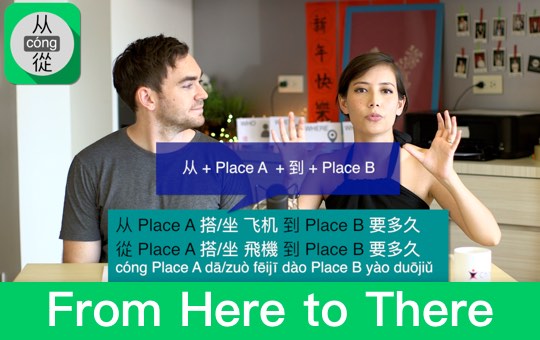
I can see why you chose to include it, but there is too much information in the text boxes - I can't work out what i'm supposed to be reading quick enough before its gone (perhaps traditional and simplified characters could be presented in different colours so its easy to quickly see which one you want to read?). Also personally i find it unhelpful having the english translations in the first dialogue as it takes away the opportunity to try and figure out as much as you can of what is being said on your own first. Being able to piece together meaning on the basis of the words you do know and the context of the sentence is a really important skill to develop.
I loved the slowed down dialogue however, and would love to see that in all new videos.
Gwilym-ChinesePodMay 17, 2016
Thanks for the feedback. I'll remove the English from the first time dialogue next time and see if I can make the simp/trad/pinyin easier to distinguish.
Gwilym-ChinesePodMay 17, 2016
I've done some minor editing tweaks and re-uploaded it. The small changes should be available in the next 30mins or so;
Changes:
Removed English from 1st dialogue listen.
Added ENG to 2nd dialogue listen
Highlighted SIMP CHINESE in Grey


antonkochkovJune 14, 2016
Well, slowing down somehow is making the speech not so clear to understand. At least on my opinion.
And one more suggestion Gwilym: it would be awesome to add bookmarks (like chapter marks in youtube videos) to the dialogues, if this particular video player allows that.
What did you notice in this lesson?
You are posting as a guest. Your reply is reviewed before it appears. Log in to post without review.