
thecomakidJuly 20, 2014
Hi, I’ve got a couple of questions about the verb 寄 and how it’s used with 去 in the sentence: 报告会直接寄去单位吗?I looked up some example sentences, but unless there’s a specific object like a letter or parcel, “it” seems to be implied. So would it be correct to say:我会直接寄去你。I’ll send it directly to you. Or would I need to include 它 ? If so, where would it go?The 去 part - is it correct that the object is being sent away from the sender. I’f I wanted something set to me, would I use 来?你会直接寄来我吗?Can you send it directly to me?Finally, I wanted to try writing these sentences in the past. Can you please clarify where to put 了 and 过? Are they necessary, given I’ve used 已经 which puts it in the past?They’ve already sent it to you. 他们已经寄去你过。She’s already sent it to me. 她已经寄来我了。
thecomakidJuly 20, 2014
Can 留 be used for large things, or is it just for small things like post-it notes and figurative things like information and phone numbers? Can I also use 留 to say things like: 请把行李留在前台旁边。Please leave your luggage next to the reception desk?你可以在桌子上留我一些钱吗?Can you leave me some money on the table?我在冰箱里留你的晚饭了。I’ve left your dinner in the fridge.

futuresailorJuly 4, 2014
Shanell good on you: right at the end of the lesson you call out the discriminatory atttitude towards people who carry certain diseases. "Gongzuo hen laolei" not a sufficient excuse.

babyeggplantJuly 4, 2014
Unfortunately, I think there's a lot of fear and misunderstanding about certain diseases and how they are spread. I have done quite a bit of volunteer work here with orphans and I remember a certain baby that was Hep b positive. The nannies were terrified to even touch the child. Hopefully over time and with better education, attitudes will start to change.
tomdrury103July 29, 2014
I think "gongzuo hen laolei" can be a reason not to pick someone who will struggle under such a work environment due to health reasons. The recruitment process should be blind to the illness, but not blind to the ability of the person to do the job. In the West a fear of discrimination against health impaired employees just leads to discrimination against healthy employees. If you have to let go one employee, which one is more likely to result in a lawsuit?

xiaopaulJuly 2, 2014
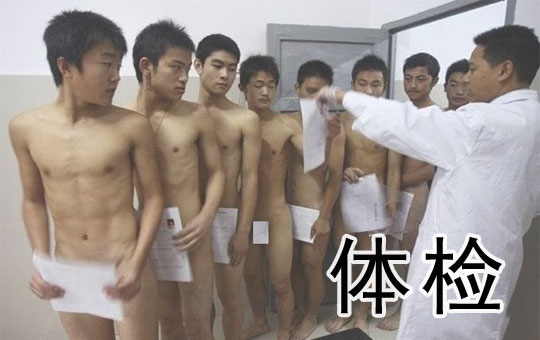
Extraordinary lesson picture, I think. (Any similar one with girls? ... they also serve in the army ... )
Why does soldier #4 get a second sheet of paper? He already has got one, a little one?

mikeinewshotJuly 3, 2014
"I thought that the comments section was created for comments related to the subject. "
touché
:-)

DavidXuzhouJuly 3, 2014
haha..., I think I could answer that. Yes, we P.S.ed the picture a little bit for the reason you've already known.


jerryrockJuly 2, 2014
Within the dialog the characters验血 have an indicated pinyin of yànxiě. Should this not be yànxuè? Yellow bridge, the online dictionary and my wife, tell me that yànxuè is correct.
jerryrockJuly 2, 2014
I heard the lesson now and get the pronunciation as David prefers it - language grows and evolves which is why it is interesting.
babyeggplantJuly 2, 2014
Interesting indeed! For me, this is one of the trickier parts of Chinese. There are so many words that are commonly pronounced differently than what you will find in the dictionary. I usually learn and use the most common pronunciation (even if it's "wrong") but I still try to be aware of the official pronunciation.

WaerdeJuly 2, 2014
Xuè is the official pronunciation (according to my dictionary http://www.mdbg.net/chindict/chindict.php?page=worddict&wdrst=0&wdqb=%E8%A1%80), but here on chinesepod xiě is mostly used. It's probrably very common in Shanghai.

gallienusJuly 1, 2014
Shanell, it's pro-NUN-ciation, not pro-NOUN-ciation. This is a regular patten in English: renounce, renunciation; announce, annuncation; pronounce, pronunciation.

Right-WingnutJuly 2, 2014
Yes, she doesn't know how to pronunciate "pronunciation".
(I can also hardly wait for Prince William to be coronated)
gallienusJuly 1, 2014
Once again, Shanell, it's pro-NUN-ciation, not pro-NOUN-ciation.
xiaopaulJuly 2, 2014
AGAIN, as along as the Chinese pronunciation is correct I'm 100% satisfied, because that's why I'm here! And they do a great job.
I thought that the comments section was created for comments related to the subject. Tiny mistakes (if mistakes at all) in English or American or Australian or Irish or Welsh or ... pronunciation or grammar interest me like a hole in the head. Isn't there any English/American online language school to check the pro-NUN-ciation?
Woops, and now I left the same kind of very useful comment :-((

AussieNickJuly 3, 2014
I've noticed many people (both in England and Australia where I now live) pronounce it pro-NOUN-ciation. I'd guess doing so gives them a feeling of cognitive ease (it feels 'right', whereas the correct form seems incongruous compared to what you would expect). Languages are constantly evolving things after all, and if enough people believe it's correct then it becomes correct.
Anyway, regardless of whether it is a mistake it's certainly not something most people would call you out on (gallienus being the .0001%).
gallienusJuly 1, 2014
Once again, Shanell, it's pro-NUN-ciation, not pro-NOUN-ciation.

markJuly 1, 2014
I have never pronounced it "pro-NUN-ciation", nor does anyone among my circle of friends and relatives pronounce it that way. There is probably some regional variation. Actually, that way sounds like the upper class twit variant. So, I'd be kind of embarrassed to say it like that. 就是我个人的想法。
adam_p_laxJuly 1, 2014
I would say "pro-nun-ciation" but I think Shanell has an American midwestern accent so it wouldn't surprise me that she said "pro-NOUN-ciation."
Just like in Chinese, there are a number of variants in English pronunciation based on country/region within a country.
markJuly 2, 2014
My own accent mostly influenced by Northern California, with some mid-western under currents, like r's are barely pronounced. So, no end of people mistake my name for "Mike".
mikeinewshotJuly 2, 2014
In England it is very definitely pronunciation.
Are you saying you also spell the word pronunciation as pronounciation?
Right-WingnutJuly 2, 2014
I've NEVER heard anyone say "pronounciation".
Sounds like something that would be said by someone who also says "Hey yous".
babyeggplantJuly 2, 2014
Thank you so much for correcting my pronunciation of pronunciation. I'm now curious about the regional variances across the states. I don't think it's uncommon to pronounce it as I do where I'm from (Las Vegas area).

si1teng2July 2, 2014
It's not a regional accent, but a common mispronunciation among speakers of English (I've heard it in both England and America, and not varying by region), reasonably extrapolated from the verb "pronounce".
Of course, what exactly constitutes 'correctness' is a complex linguistic issue. But it would count as a dialect variation only if 'most' competent speakers of that dialect have considered it to be correct for a 'long enough' period of time. According to this criterion, most competent speakers of standard English (American, Canadian, British, and Australian) consider Shanell's pronunciation to be incorrect (a quick perusal of any good dictionary will verify this).

veronique21July 1, 2014
There's a typo in the first line of the PDF (pinyin). Not very important but if it can be fixed it will be better. Thanks.
hanpihhwaJuly 1, 2014
兵役? (military service?)
DavidXuzhouJuly 1, 2014
I'm not sure of our advanced lesson 入伍当兵 (https://chinesepod.com/lessons/%E5%85%A5%E4%BC%8D%E5%BD%93%E5%85%B5)meets your requirments, but 'military' is still a good topic for future lessons.
veronique21July 1, 2014
I've had a look on the PDF and, yes, it seems to be a very interesting lesson. I generally don't study advanced lessons, that's why I did not notice this lesson.
DavidXuzhouJuly 1, 2014
According to today's lesson photo, did anyone guess out what kind of 体检 was going on?

What did you notice in this lesson?
You are posting as a guest. Your reply is reviewed before it appears. Log in to post without review.