
buzzingbeeApril 8, 2014
还是和或者有什么不一样? I understand 还是 is best used for choice, like A 还是 B. When is it better to use 或者?

verazhang100April 8, 2014
听听这个吧 https://chinesepod.com/lessons/%E8%BF%98%E6%98%AF-haishi-or-%E6%88%96%E8%80%85-huozhe
rickybarthMarch 31, 2014
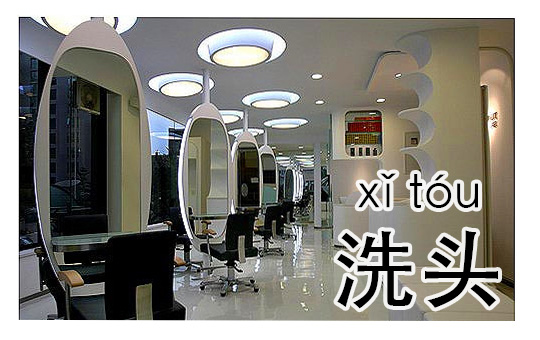
is 洗头 and 头发 the same? They have the same definition in the 'vocab' section.


antony73February 11, 2014
My first visit to a hair salon here, I ended up with dyed hair. All I wanted was a simple wash and cut. The owner was insitant on showing me the different colours to choose from, but I simply replied 不要不要 over and over. The next thing he's putting cups over my ears and painting my hair. Great!
The good thing was though that everyone loved it. Men do like getting their hair coloured here. My father-in-law at 65 still loves getting some colour put in. Without colour, the children would refer to me as 爷爷. As a 40 year old with white hair, it doesn't go down well with me. So it didn't turn out all that bad.
I guess I'm in the club now.
gloria_counselorFebruary 10, 2014
duo1jiu3……yi2ci4 can be "how often do you/I do something". But ci4 as a measure word, can be replaced for other measure words, like tang4(for trips)
ni3 duo1jiu3 qu4 yi2tang4 bei3jing1.
duo1jiu3 can also be how long or how much time.
E.g. ni3duo1jiu3 neng2 zuo4wan2 gong1zuo4.
How much time does it take to finish work.

veronique21February 10, 2014
I'm quite confused with these sentences... What would be the answer for each of them ?
gloria_counselorFebruary 12, 2014
ni3 duo1jiu3 qu4 yi2tang4 bei3jing1.
means how often do you go to beijing.
ni3duo1jiu3 neng2 zuo4wan2 gong1zuo4.
means How much time does it take to finish work.
xandelylFebruary 8, 2014
Can anyone help me to clarify the follwoing sentence? : " ni3 duo1jiu3 xi3 yi1ci4 tou2 ? . It is translated as " how often do you wash your hair ? " . Is the "duo1jiu3 ... yi1ci4 " a set frase for " often" ? . Tanks

tony.cpodFebruary 6, 2014
I notice in the Elementary lesson 'Shampoo and Cut' (21/10/2013) that 'haircut' is 理发 while in this lesson it is 箭法.
Do you mind explaining the difference between the two terms and how we would know which one is appropriate to use in which context? For example, is one slightly more formal?
tony.cpodFebruary 6, 2014
Sorry that should have been 剪发 above, not 箭法. It seems the comments section here no longer allows edits to be made after a post :(

ejrungeFebruary 5, 2014
Safer to go to the hole in the wall place that just cuts hair. Next thing you know, they will be up-selling you on some 其他的服务,and you will be leaving with a gold VIP card!! How do you think they pay for that fancy store and all the staff. ...and yes, it takes someone a long time to use up 500 RMB credit when haircuts are only 15 RMB.
user12174February 5, 2014
So how do you know if the hair wash will include the massage? Do all 干洗 include massage? I go just for the mini massage but more and more they only do the washing without massage. How can I know if a salon throws in the free mini massage or not? Sometimes when I've asked about 按摩 I've been led to a massage room for a regular (and not free) massage.
What did you notice in this lesson?
You are posting as a guest. Your reply is reviewed before it appears. Log in to post without review.