8890909August 23, 2019
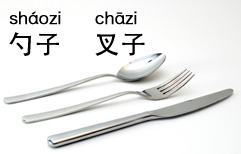
In this lesson, they use sháozi for spoon, but in other places, I usually hear tāng chí. Is there any difference?
Diana17September 19, 2017
In this lesson, they use sháozi for spoon, but in other places, I usually hear tāng chí. Will people understand both? Or does it depend on the area you're in?

tony.cpodJune 11, 2013
This might sound like a silly question, but if the waitress had not asked what else he needed (to which he simply said "糖"), how would he have asked for some sugar using a full sentence?

southamptongirlApril 26, 2012
I too agree with Jacob. I've been at the elementary/intermediate level for a long time now. It's a huge step.
jacobApril 18, 2012
*sigh* elementary is so slow and boring, i tune out during the explanations in english, but intermediate is annoyingly difficult. 怎麼辦.

carolinedpApril 5, 2012
Good lesson, thanks. I think an important cultural point was missed here. In English, it would be very rude to say, "Waiter / Waitress, give me a fork...etc." We would almost always start our sentence with "Please..." or "May I have..." or "Could you please give me...?" In Chinese, it is not rude to say (quite directly) "Give me a fork." I think this difference causes native English speakers to overdo with the 请 (qing) / please. Understanding this difference is important, I believe. Anyone want to weigh in?
jacobApril 18, 2012
Can't believe you could have a lesson on this without addressing if and/or when you need the polite words.
jeffcrowe8March 29, 2012
I've heard people use the measure word "gen" with spoon. Are there situations where that would be correct? --JC

jennyzhuMarch 30, 2012
It's a dialect thing. In Shanghainese, we use both "把"(bǎ) and "根"(gēn) for spoons. But it's only "把"(bǎ) in Mandarin.

geiwotangbaMarch 29, 2012
你们改善了复习录音,没有英文翻译。 加油!
user19325March 29, 2012
Hi,
Kind of a demanding customer, and a very understanding 服务员。
Like minghuiguangbodiantai, it seems my audio review also has been upgraded to only include the Chinese track, no English hint first. Both on the web site and in my iTunes download.

jhfjhkjMarch 29, 2012
hi all,what's the difference between 榔头 lángtóu and 锤子chuízi , both meaning hammer?
geiwotangbaMarch 29, 2012
http://baike.baidu.com/view/869075.htm
http://baike.baidu.com/view/166396.htm

jackiechan136March 29, 2012
hi
锤子it is very useful~it can punch and also can take nail out of wood or sth~~
榔头it just punch sth(nail) into wood or sth~~

laowai_laizheliMarch 30, 2012
That is really interesting, I never knew that. Confirm or deny, would it be appropriate to translate 锤子 as "[claw] hammer" and 榔头 as "mallet"?
What did you notice in this lesson?
You are posting as a guest. Your reply is reviewed before it appears. Log in to post without review.