
NanjinggirlSeptember 28, 2011
Sorry if I'm asking a question that has already been answered, but I have some unfinished schoolwork and really don't have the time to read all 66 comments...
How far in advanced should one call a taxi if they are arriving in the airport?
谢谢,
贝拉.

jennyzhuSeptember 28, 2011
Usually in China there are many cabs waiting at the airport. If there's a shortage of cabs during rush hour, then cab companies will dispatch cabs to the airport. I don't think you can make a call to reserve taxis because taxis have to line up in order to get into the airport and it's hard for one cab to get in and find you amongst a sea of travelers. If you want to reserve a car, you should call a car service rather than cab company. But taxis are usually pretty abundant unless it's rush hour in which case you need to wait for a while and but there will be a cab.

jennylenhardJanuary 22, 2011
一段时间 yī duàn shíjiān is new to me. Duan is a measure word for a length of time right? Presumably 一段 would be a short amount of time (I only say this because 1 obviously a small number). Could someone elaborate on this usage, such as when you would or wouldn't use it, or point me to a podcast that does the same?
Can you use 段 in the same context with another number, or is it a set phrase like 一点? I ask because 一点 exists as a dictionary entry in Wenlin and Pleco while 一段 does not.
jennyzhuSeptember 28, 2011
一段时间 yī duàn shíjiān is a set phase, which means a period of time which can be a few hours or a few months. 一段 isn't the same as 一点 and can't be interchanged. 一点 collocates with a wide range of nouns to mean a little bit of whereas 一段 is mostly commonly used in the set phrases一段时间.

kaixin_in_tampaOctober 29, 2010
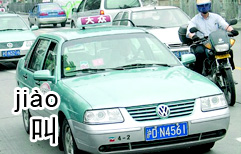
Expo taxi, Volkswagen Touran. I think they are also run by 大众 - dàzhòng.
They are stamped on the side with 96822, and a website:
www.96822.com. Presumably one can request a taxi online?


keruiseOctober 28, 2010
Question - so is "in a little while" and 'For a little while" expressed in the same way and position in the sentence in Chinese?
So 我一会出去买东西 could mean "I'll go out for a little while to buy some things". Could it also mean "I'll go out in a little while to buy some things"?
Am I missing something? I would normally say 我一会以后出去买东西 for the latter. Would I be wrong?
Cheers

JasonSchOctober 28, 2010
Hi Keruise,
When the 一会儿 comes before the verb, it means 'in' a little while. (like in the dialog)
If you wanted to say, 'for' a little while, you could say: 我要出去一会儿, or 我要出去一段时间 wǒ yào chūqù yī duàn shíjiān. I'd say the latter is more common, however.
As for your sentence, just leave out the 以后 and your good. (the sentence then meaning, I'm going to go out and buy a few things in a bit). 以后, when not after a verb, means 'in the future', as in a non-specific time in the future.
keruiseOctober 31, 2010
Hey thanks for that. I was thinking that it had more to do with the position than anything when I was on my way to shops after typing in the question. It seems to make more sense than in English where we use 'in' or 'for' and that's the only clue to the meaning.
I often notice Chinese speakers saying "after" as in "I'll be back after 3 days" instead of "in" 3 days when saying it in English. Is that the Chinese speakers just trying to apply logic or would you normally say "after three days", "san tian zhe hou"?
Thanks for taking the time on this really simple question.
kaixin_in_tampaOctober 26, 2010
Anyone know how 秘书 (mi4shu1 - secretary) came to mean "secretary"? Direct translation is "secret book".

helencao_counselorOctober 26, 2010
"书" also means "document" or "letter", so 秘书 is the one who handles secret or important documents. :)

broinchina88October 26, 2010
A good lesson would be: Don't speak Chinese to a taxi driver when you don't feel like talking for 20 mins. I speak Chinese fairly well, and every time I get in a cab and state my location they say "your chinese is so good" and proceed to talk to you about everything the last 1000 taxi drivers talked to you about. I guess its good for people who need free lessons in the same things everyday, but I wish they had a mute button on cabbies.
As for the motorcycle taxis, I love them, they are more convenient, economical, and you dont have to talk to them usually. The wind is so much nicer than a hot taxi that wont turn on AC because he is trying to save gas.

pretzellogicOctober 26, 2010
Yours is a problem that I hope to have in another few years. Actually, I wish I could say now my Chinese is so good, that i'm no longer apprehensive when the driver opens his mouth, I'm bored.
broinchina88October 26, 2010
It comes with time I guess, I have been here for 7 years but have not studied at all. My spoken Chinese is great but I still cant read much at all. I wish I had taken the time to learn to read. Its so hard (BORING) to go back and learn to read things that you have been able to say for years.
My lesson of the day: Dont just listen to the lessons and learn the pinyin, do your best to learn the characters at the same time or you will end up like me.
pretzellogicOctober 26, 2010
I ended up coming to China before I had any real study under my belt, so I started with speaking first, and I'm glad I did. I think about 2-3 years into the spoken study, i'm now on the character writing track. It is funny to learn to read again.
keruiseOctober 28, 2010
When taxi drivers start on conversation topic No. 5, just change the subject by asking about them and their family etc. It can be interesting and sometimes the driver decides to concentrate on the road instead - probably not a bad idea either...

wangqiuOctober 26, 2010
I love the taxi lessons, very practical and often used. The website has a lot of great ones already, but do you think an intermediate or advanced one would be a good idea?

bodaweiOctober 26, 2010
I will support you - I might even have a scenario or two. I left my wallet in a taxi the other night and discovered that I could do with a bit of help! :)
1. how to book a public announcement to all taxis ovr their radios (3 broadcasts cost you 80 RMB but it is useful if you don't have a 车票 and you think the driver might be unaware of your loss.)
2. Similarities and differences between the taxi companies.
3. The rationale for the name plate (my guy was travelling without an ID).
4. How to handle a situation when you are half way through a trip and the 计价机 has not ticked over, and the driver now wants to negotiate a price because the meter is broken.
5. Discussing how you want to have a bit of a sightseeing tour - the driving equivalent of 逛街 .. ?
6. Talking to your driver about how you don't think it is a good idea to shove CDs into his number plate to avoid the speeding cameras, or to travel in the 'trucks only' lane at 110 kph.
wangqiuOctober 26, 2010
hahaha!! i didnt think that far, i was only thinking of how to say at the end of the road, turn the corner, etc....but yours are much better
kaixin_in_tampaOctober 26, 2010
Wow, that must have been terrifying, sorry to hear. Did they find the wallet??? If so how long it took them? So if you have the taxi receipt it's easier to track down the specific cab you took? Who did you call once you realized you'd left the wallet in the cab?
bodaweiOctober 28, 2010
hi shanghai_rocks
It was a shock to just lose it like that, everything in it, cards, photos, and cash as well cause I'd just been to the bank. So in future I will travel extra light, taking no bank cards at all. If you have the fa piao it does identify the taxi - unfortunately I didn't ask for one. I didn't get his name either because he was not carrying a name plate. (The name plate is a good idea - I usually make a point of reading their name.) And his meter wasn't working, dodgy all round. The taxis have an animal sticker on the dash to identify the taxi company but that wasn't much good with nothing else to go on. A friend called the police and they actually came to see me, but again there was nothing for them to go on. They were sympathetic but ...没办法. I just learnt what to do in future, apart from not being a jackass and dropping my wallet.
bababardwanOctober 28, 2010
hey mate, very sorry to hear that. Was it hard cancelling all your cards deng deng? Very mafan I'm sure.
bodaweiOctober 28, 2010
Nice cultural lesson though - I was on the phone to Australia for 30 minutes cancelling cards (and still could not order new ones because of security rules.) With my Chinese bank I was in and out in 60 seconds with a new card ordered. And getting my staff card replaced was another language lesson.
舍财 免灾
旧的不去新的不来

RJOctober 25, 2010
So if Im at a meeting or dinner party and I have to go to the bathroom, if I stand up and say 我出去办事,will they understand or will everyone think I am not coming back?
RJOctober 26, 2010
hehe, well its supposed to be just a little bit funny, but Im guessing thats not the kind of "laughed at" you were describing. Oh well, back to the drawing board. It would work in the US.
SF_RachelNovember 16, 2010
Ah, but just yesterday I happened to listen to an old QW ("To Do") and Jenny and Connie could barely contain their giggles when they suggested that sometimes 办事 means to "pee in the pool." Would that be specifically only for violating the pool, and not to be politely vague about taking care of (nature's) business more generally?
RJNovember 17, 2010
Thanks for the tip. I re-listened to the QW and actually what was said was (my english ear is better than my Chinese ear) it means to "pee or pooh", not "pee in the pool". So the expression can work this way it seems, but maybe a little too explicit? In english, to say I have some "business to take care of" would be an extremely polite euphemism, with people actually left to wonder what you really meant. You could be making a phone call or checking on something.
SF_RachelNovember 17, 2010
That makes more sense, especially given that I clearly heard and understood Pete's objection that he prefers to say "shàng cèsuǒ" which did seem an odd thing to say in the pool! I will have to re-tune my English ear! Now excuse me, but I have to go see a man about a horse ....
bodaweiOctober 25, 2010
Two comments on the dialogue:
1. The boss thanks the employee at the end - this contradicts my 'rule' - Chinese people do not usually thank other people who are paid to do something for them, unless they are asked to go right out of their way, do something unusual. Maybe it is different in Shanghai - a more polite, civilized society?
2. I like the reference to the Bohemian quarter TaiKang Lu even though I have never been there. The 康 kāng character [jiànkāng de kāng] meaning 'health' or 'healthy' is often used in names. There are several street names in my city featuring this character. I am wondering if the 泰 tài here refers to the 太 tài meaning, very? It may mean 'very healthy' or 'extremely healthy' or 'most healthy', or is it a reference to 泰国 (Thailand)? I would imagine it means extremely healthy. Anybody know? Or is the origin lost in history?
bababardwanOctober 25, 2010
Can't find an answer mate [looks like it originated in the 1930's]. I guess if you Forest Gumped that road all the way to Thailand you'd be healthy in the end [based on the what doesn't kill you makes you stronger theory...is there a saying for that in Chinese?]. Here are a couple of interesting references about the taikang lu:
https://en.wikipedia.org/wiki/Taikang_Lu_%28Shanghai%29
http://www.taikanglu.com/
JohnOctober 25, 2010
1. I'd say your "rule" is still a good one. You will hear an occasional "thank you" though (maybe not from everyone).
2. The Chinese name is 泰康路, and like many street names, it comes from a place name. In this case, it's a county in Henan.
bodaweiOctober 26, 2010
Hey John
I hate to take up your time but I have a supplementary question - you said the street name comes from 太康县 (Taikang County). So, the homonyms 泰 and 太: I can see that they share a meaning [my original post speculated that maybe 泰 means 太], but is this more than coincidence? Is 泰 for instance an old form of 太? How does the street name 泰康路 'come from' the county name 太康县?
I can recall other homonyms with the same meaning - what is the historical reason for this do you think? It seems to me (guessing) that the way Chinese developed from an oral form could well lead to different characters being used in different places to represent the same sound and meaning.
See how we all miss Changye? :)
JohnOctober 26, 2010
Bodawei,
Oops, sorry about that. I provided the wrong link. 泰康县 is in Heilongjiang; 太康县 is in Henan.
I'm no character etymologist, but here's what I found in Wenlin regarding 太 and 泰:
"The seal [form of 泰] shows the upper part to be a fusion of 大 and 廾 two hands, the lower is 水 water; the word is etymologically the same as 太 tài, and as 大 in one of its readings" --Karlgren.
And then for 太:
Cognate with 大 dà 'big' and 泰 tài 'peace'. Distinguished by a dot from 大. Don't confuse with 犬 quǎn 'dog'.
bodaweiOctober 26, 2010
Thanks for getting that for me - I am definitely not a character etymologist either. For 泰 I'm going to forget my theorising and just go with 'peace' (or safe and tranquil) so 泰康路 on this reading just puts together the nice positive sounding words 泰 and 康.
quasifrogOctober 24, 2010
I love how the lesson photo shows the motorcycle in stopped traffic with the cars, waiting in peaceful harmony. I would love to see a China where the cars don't think they have the right to crush anything with only two wheels or two feet in front of them. I'm sure the car behind the motorcyclist is sitting on his horn to express his disatisfaction that the subordinate two-wheeled vehicle is in its entitled space.
bodaweiOctober 25, 2010
车 让 人 (cars give way to pedestrians). :)
I'm going to disagree slightly and say that in my experience motorbikes are afforded at least as much respect in China as in Australia, but possibly for different reasons. In China if a car hits a motorbike, it is almost certain that compensation will be paid by the car owner, regardless of fault. It's a social status thing. (In parts of Shanghai and BJ it may be different because in these cities you do have some motorbikes as recreation vehicles - elsewhere they are mainly ridden by workers.)
quasifrogOctober 25, 2010
I only know riding in BJ, and I cannot count the amount of times a car sat on my ass blowing its horn (even though I was flowing along with traffic slightly better than the speed limit) just because it saw two wheels. I have a motorcycle license in China and I know the laws, but they don't apply on the offensively rude and dangerous streets of BJ. On the other hand, I have enjoyed running more red light lights in a day here than I ever have in America so......;)
bodaweiOctober 25, 2010
They don't have red light cameras?? Even in Kunming people are fussy about red lights because of the cameras.
PS. what bike do you ride?
quasifrogOctober 26, 2010
Used to have a Shadow in the States. Here! A Vespa knowckoff. I might get a real one later. I see yours is QUITE real!
jennyzhuOctober 24, 2010
The taxi in today's lesson picture is operated by the 大众/Da4zhong4 taxi company, one of the most reliable in Shanghai. Look out for these light blue taxis when you are in town.
bodaweiOctober 24, 2010
Jenny - you've let the cat out of the bag for half of my questions (see above). :)
But I would like to know if A, B and D are identifiable regions within the built-up area of Shanghai? (Or is it just a reference to when the taxi was registered?)
Also, is D a region that allows motorbikes, or is this taxi driving outside the area where motorbikes are prohibited?
bababardwanOctober 25, 2010
hey, honestly just seen this now. I liked your trivia quiz so just jumped straight in without reading the posts further on. The last one has me stumped though. I was thinking that it might be on major road to/from the airport or maybe expo, but I don't know, and I can't see any details on the motorbike by blowing it up. I don't know if the motorbike guy is meant to be some cop or other security type person, or if it's that motorbikes are only allowed in certain areas as you've alluded to above.
bodaweiOctober 25, 2010
It does not look like a police bike - looks like a recreational bike. These are allegedly not permitted in Shanghai. (I believe they can't be registered, and you can be fined riding in there even if you have a valid registration from another place.) There is a lot of confusing information on the Internet about this. Some say within the inner ring road, some just say 'Shanghai' which does not help much because Shanghai includes a lot of rural living. I hope some knowledgable poddies provide the up-to-date facts.
My experience with other cities is that there is a general ban on motorcycles in inner areas, often interpreted as inside the inner ring road. But for a range of reasons you see some motorbikes in many cities. In some cases these are on legal registration plates ('grandfathered'); in other cases people just take a chance.
So the lesson photo could be legal riding outside the area where bikes are prohibited, or someone taking a chance. A reasonable answer to my question is: 'probably outside the inner ring road'.
PS. You were spot on with those other answers, but I will bow to VW experts on whether it is a Santana or a Jetta.
PPS. I am not sure about the 'D' - I think it may be that AB and D plates are all issued in metropolitan Shanghai (C is Shanghai rural); I was hoping that D is a specific geographic location but I can't get confirmation on the Internet. In all provinces, a different letter of the alphabet corresponds to a different geographic location. Shanghai might be different.
PPPS. The taxi is for hire - the sign folds down when the taxi is occupied.
RJOctober 25, 2010
does a ban on motorcycles usually include scooters? Because I can tell you they are definitely everywhere inside the ring. I have never heard a ban mentioned in SH although I have heard of this in BJ. I do know its hard to register new scooters in SH because they want to limit the number.
bodaweiOctober 25, 2010
The ban usually applies to petrol-engined two wheel vehicles (motorbikes and what we call scooters in Australia) - it does not apply to 电动车. 电动车 have electric motors running off a battery. The rules applying to these will vary from city to city but if you think 'bicycle' you get the idea. They were promoted as a substitute for bicycles so they can be ridden anywhere (although they are not supposed to go on freeways) including going the wrong way on the road and on footpaths. Nasty and unsafe. Environmental benefits are also way over-rated (they often run off coal-fired power plant electricity). In my city there is no requirement for a licence or a helmet; not even an age limit.
The ban does apply in SH, actually most cities these days.
RJOctober 25, 2010
I will ask. I always wanted to rent a motorcycle to learn my way about SH. Its not going to work if I get arrested now is it.? Admittedly, that may not be the biggest risk here.
bodaweiOctober 25, 2010
They won't arrest you. :) Although that would be one way to see inside of a cell?
The typical response with motorbikes is to take your bike. The bike is usually returned within 24 hrs or so if you pay the fine. However there is some concern that you never get your bike back. Rented bike - I guess that's a whole other story.
Much better (in my opinion) would be to don the little plastic construction helmet and take a motorbike taxi (where available - presumably outside the inner ring road in SH.) But then I actually enjoy riding pillion.
bababardwanOctober 25, 2010
tell me more about the motorbike taxi...that sounds interesting. How common are they? Do they ride like lunatics or are they safe enough? ..deng deng....
bodaweiOctober 25, 2010
Common, very common in smaller cities.
You ride unprotected (except for a silly little plastic hat), so compared to bike riding in the West you are exposed to injury, possibly severe injury.
But on the other hand most traffic in China moves quite slowly.
On a scale of 1 - 10 in safety I would give them a 5. (A big slow old bus would get a 10.) In their favour they are ridden by people who do it for a living, and they have a driving licence, unlike most of those people getting around on 电动车。
Which reminds me of an interesting statistic I was given when doing rider education in Sydney - the single largest category of motorbike insurance claim is for bikes falling over in a car park. To elaborate, the physics of a motorbike mean that up to a point they are easier to control the faster they go. At very low speeds they get difficult - the only time I actually dropped mine I was doing about 2 or 3 kph.
bababardwanOctober 25, 2010
I presume you meant the 2 wheeled variety of motorbike and not this 3 wheeled kind from shanghai:
http://www.funnyphotos.net.au/images/taxis-of-the-world.jpg
Interesting article here about trying to get rid of motorbike taxis in Beijing:
http://www.chinadaily.com.cn/metro/2010-07/15/content_10109775.htm
bababardwanOctober 25, 2010
I guess this is closer to what you were talking about:
http://www.flickr.com/photos/nicholas-chan/3438886012/in/set-72157611763258942
bodaweiOctober 25, 2010
I do. but there is an interesting outcome of the rules in this respect in some cities, including Shanghai: I think the three wheeled version gets the nod "because it is like a car". I was told that they grew up as a way to get around the rules. I kinda agree with the Chinese authorities about those trikes; they look fun but you may as well be driving a car. :)
There may be more to it; trikes are also used by the aged and disabled; they seem to be an exception in most if not all cities.
Bikes with sidecar have a bit more credibility but I would still prefer to be on two wheels.
bodaweiOctober 25, 2010
That article on motorbike taxis is indeed interesting and rich in irony. They are blamed for 'jamming' the traffic - the huge black SUVs are miraculously no problem at all. In fact the motor car industry, a pillar industry, receives generous subsidies funded by the workers. The motorbike industry receives none. They are practical transport for the poor but this strata of society has no clout in Beijing. They used to attack motorbikes for being polluting but it appears that they have dropped that line. The essential arguments can be explained in terms of class. And face. Motorbikes are viewed as embarrassingly third world.
bodaweiOctober 25, 2010
The photo of orange scooters (are they 电动车?) does suggest 'taxi' but I can't say it's something I have ever seen. The standard motorbike taxi is a conventional petrol-engined motorbike - those fancy helmets, and the off-carriageway parking say 'Beijing' to me, could be wrong. :) 'Real' motorbike taxis are usually located at the kerb of major intersections.
RJOctober 27, 2010
bodawei- as a follow up, I did ask. The answer I got was that anything under 250cc is permitted, except on the elevated highway. All others are banned in Shanghai. I guess that explains the scooters I see. I dont see the logic here unless they are just making a concession for those that cant afford another way to work. I have never seen a 3 wheel taxi in SH. Other places yes, but not in SH. I, like most Americans, would not be caught dead riding anything under 250cc or wearing one of those plastic helmets. I do respect the fact that they do what they have to do just to keep on keeping on however.
bodaweiOctober 27, 2010
Do you mind revealing your source? :) Like did you just ask a friend, or do you mean you got it off a website? It doesn't gel with my own cursory research (asking resident Shanghai natives) which admittedly dates to 2006/07. I don't think you can legally ride motorbikes under or over 250cc in inner Shanghai - can't say I ever saw one in several visits. Actually seeing them is also no proof of what the rules are - people do break the law and hope not to be caught. (The police are not as let's say conscientious on this kind of thing as they are in the West - and the main reason, apart from a cultural aversion to 麻烦, is limited police numbers, but I digress.)
The regulations refer to both where you can register a vehicle, and where you can ride it. Some cities also have 'grandfathering'; it can be complicated. And they target 'petrol engined' vehicles. If by scooters you mean 电动车 - yes, they are permitted, everywhere. :)
Interesting comment about the 250cc - I imagine a 250cc limit in China would have very little impact because demand would be almost exclusively for 250 and below. For good reason - much more practical in a large Chinese (or Western for that matter) city. We Westerners tend to have a hang-up about size.
Disclaimer: I do personally have a preference for a 600cc, but that's because .. I'm actually stuck for words.
RJOctober 27, 2010
I asked two Chinese friends who live in SH. Sometimes people "believe" things are one way when if fact they are not, but this is the answer I got. They are not big on details as you know, so I may need to call him to nail it down airtight. I do remember him saying a couple years back that you can no longer register a scooter in SH but there is a grandfather clause. This guy used to have a scooter and I know he rode it to work, but now he has graduated to owning a car. Our office is way outside the city however.
by "scooter" I mean a gas (petrol) powered Vespa. Something so ugly no motorcyle enthusiast would ride. Those abominations with the little 10 inch wheels or whatever they are. I have seen entire families on these things and they are everywhere in china. If you rode one in the US, you would get beaten up by the guys on "real" motorcycles. This has nothing to do with mopeds, bicycles, or electric powered bicycles.
bodaweiOctober 27, 2010
Aaah, a petrol-fueled engine. Well, I agree with your definition, that's a start. :)
In the cities I have lived in and visited I would put these at insignificant numbers; they have been more or less superseded by the electric motor versions (some of which incidentally are replicas of the petrol-fueled ones.) A poddie above refers to the 'Vespa knock-off" - they do look like they used the same moulds. So those scooters you've seen could be 'grandfathers', or illegal riders. Or registered outside the geographic limit for legal registrations.
To understand all this it also helps to understand the Chinese 'campaign' - every now and then the law will be enforced and then we move on to something else. And things return to more or less normality. (See my comment elsewhere about limited resources.)
bodaweiOctober 24, 2010
Trivia question for poddies - where exactly was the taxi in the photo registered? How can you tell?
Name of taxi company?
Model of Volkswagon? :)
Is the taxi available for hire?
Does the motorbike beside the taxi give you any clue to the taxi's current location?
bababardwanOctober 25, 2010
thanks bodawei...I love a good trivia quiz. Ok first cab off the rank, I'll say the taxi was registered in Shanghai as it looks like it has 沪 on it's number plate
bababardwanOctober 25, 2010
I don't know whether the pic is good enough to tell whether the vacancy sign on the dashboard is lit up or not, but I'm going with ...it is..that it is available for hire.
kaixin_in_tampaOctober 26, 2010
Yes, Volkswagen Santana as baba says above. Looks like they will be discontinued in 2012. They are also very popular with the police.
https://en.wikipedia.org/wiki/Volkswagen_Santana
What did you notice in this lesson?
You are posting as a guest. Your reply is reviewed before it appears. Log in to post without review.