antonyruizSeptember 11, 2011
Does anyone know the name of a Chinese Grapefruit which has a lemon taste? I found them in Quinghai. They are not tart at all. I called them gremons. They have the shape of a grapefruit. But they are mild and sweet.

antonyruizSeptember 12, 2011
Yes maybe it is. Although they are quite large, like a large grapefruit. I have been looking for these, and I wish we had these in the states.

RJSeptember 12, 2011
http://www.china-expats.com/HowTo_FVG_DaiGor.htm
http://www.china-expats.com/HowTo_FVG_Orlimons.htm
mo_hanMarch 30, 2011
Two questions to the sentence in the dialougue :荔枝吃起来太麻烦了。
Would it be correct, if I would say this instead: 吃荔枝太麻烦了。? Or would the meaning be different to the one in the dialougue.
And one about the patern 起来: Can I use 起来 with any other verb; like 听起来麻烦了 (difficult to hear),看起来麻烦了 (difficult to see)?
mo_hanMarch 30, 2011
I've just seen, that my secound question is already answered. But what about the other one?
jbowesJanuary 6, 2011
What is the grammatical difference (or is one more common/easier to use) between:
Kan(4) qi(3)lai
and
Kan(4) dao(4)le
Im a little confused....and fully aware that I might be asking a totally newbie question. However, it stands!
Ps - Any China cpod listeners want to comment on the frequency of people dropping the "sh" and "zh" sound in liu of "s" and "z"? As in "Shenme" becoming "senme"...
jbowesJanuary 6, 2011
Ni kan dao na liang che ma?
Ni kan qilai na liang che ma
I should have added these examples...

JasonSchJanuary 7, 2011
Hi Jbowes,
kàndào (看到) and kànqǐlai (看起来) are actually quite different.
kàndào means 'to see'. So, in your example, 'nǐ kàndào nàliàng chē le ma? would be '(Did) you see that car?' (you need a le/了 here at the end to make it a completed action)
kànqǐlai means 'to appear as though' or 'to seem as if'. For example, 'kànqǐlai yào xiàyǔ le', 'it seems as though it's going to rain'.
Hope that helps!

www.aichinese.comNovember 15, 2010
Elementary: Chinese Fruits
1.Do you know how to say "fruit" in Chinese? 水果Bananas are tropical fruit. 香蕉是热带水果。Would you like some fruit salad? 要水果色拉吗?2. The following word is useful too.好吃This fish eats well. 这鱼好吃。What delicious food! 真好吃。In "甜" and "酸" there are "t" and "s", "t" is pronounced like "t" as in "ten", but is accompanied by a stronger puff of air than inEnglish, while "s" is pronounced like "s" as in "sand", but is pronounced more strongly than in English.

bodaweiNovember 15, 2010
This fish eats well. 这鱼好吃
Unless this is American (??), the English should be 'this fish is delicious'.
We say (someone) 'eats well' if they get plenty of good food. 'This fish eats well' means that it is getting plenty of good food.
Sometimes in English you might say something is 'good eating'.

bababardwanAugust 9, 2010
I'm interested in addressing someone as laoban. Is there a risk of offending in this? What if you're addressing an employee as laoban when the real laoban walks in? What about if you assume the older person working there is the laoban and it turns out it's the younger person is the laoban? What if you can't tell. Or is it ok to address anyone as laoban and no-one gives two hoots?
bodaweiAugust 9, 2010
Mix-ups occur with me, but the term 老板 is a little flexible; I think that you are not likely to seriously embarrass yourself. You should just try to avoid referring to the 老板 as 服务员. I go to one restaurant frequently where I am still not sure who is really 老板; I call the one in charge when I am there 老板. The 老板 (where I live) is often the one walking around wearing a money belt. The non-老板 often have a bored look, are texting/playing games on their phones or doing absolutely nothing.
bababardwanAugust 9, 2010
thanks mate. Yeah, I'm sure it's safer than calling the laoban "fuwuyuan". I guess the other thing is ...what is really meant by calling them laoban? Are you suggesting that they are the boss of the establishment, or is it more just a respectful term..almost like suggesting they're you're boss? I guess if you did realise your blunder when the real laoban was revealed you could try and cover it with ...oh, laoban de laoban , hehe ;)

xiaophilAugust 9, 2010
This reminds me, what do we call the wife of the boss? I'm serious. If she is working there, 老板 and 服务员 are both inappropriate.
bodaweiAugust 9, 2010
老板 actually has a number of uses - maybe that is why it is a little 'flexible'. The most common use would be 'boss', but it does also mean owner. It is most used in business, but not only business. A couple of years back we lived next to a research establishment; the senior person was referred to as 老板. It is both respectful, despite the literal translation, and descriptive (of management, ownership).
bababardwanAugust 9, 2010
其实,我猜错了。。我发现在谷歌有八个帖子为“她是谁必须服从”。。就好
[actually, I guessed wrong...I discovered google has 8 posts for "she who must be obeyed"...just fine....that's plenty]
bababardwanAugust 9, 2010
and I s'pose she told you to come right along and type that,right xiaophil ?
bababardwanAugust 9, 2010
ps..Freud would have a field day with 老板娘 [boss mother]...that is if niang is interpreted as mother...and the term as boss's mother ...rather than niang meaning young lady
bodaweiAugust 9, 2010
Sorry to disappoint Freud (and possibly xiaophil?) but 娘 here would certainly connote a young lady (even if 老板娘 is not so young). Flattery is welcome in China.
xiaophilAugust 9, 2010
I'm going to go on a limb here and say that 娘 here would refer to mother. The reason I say this is because while I don't doubt that the 老板娘 would love a little flattery, being called young lady would lower her status. After all, 小姐 and 小妹 roughly mean young lady, so 娘 would just put her in the middle of that pack. Another thing is that while my pop-up dictionary does list 'young lady' for a definition for 娘, nciku doesn't. I think 娘 mean young lady when one adds 姑 to it, as in 姑娘. Another thing is 'mother' just seems to fit into the Chinese psyche better. They do love calling middle-aged women 'Aunt' 阿姨 regardless of family relationship or not. Also, I imagine that long ago, and to a certain extent today, Chinese restaurants were staffed by family (hence 一"家"饭店), so I bet that in many cases, the boss's wife really was/is the mother. I think it is best to treat 老板娘 as two titles fused together, as in 'boss mother,' and not 'boss's mother.'
Speaking of Freud, I was once asked in class what to call someone who is excessively detailed and organized. I told them 'anal.' They looked in their dictionary, and apparently it doesn't list this definition, if you know what I mean. I spent the next 5 minutes trying to convince them that I am not a filthy person, and yes, it really is very natural to use this word this way. I doubt they believed me.
bababardwanAugust 9, 2010
great post xiaophil. Yeah, this was my feeling to go with mother as well, but you've explained your reasoning well. I also can't help but feel you're right with:
"I think it is best to treat 老板娘 as two titles fused together, as in 'boss mother,' and not 'boss's mother.'"
...a nice distinction to draw...but unfortunately does disappoint Freud [and as bodawei pointed out..maybe you too ;) ]
bodaweiAugust 9, 2010
I agree, nice post. I can't help thinking that the Chinese would think that our ramblings on this topic are kind of weird. I really don't know if it pertains more to 'mother' than 'young woman' but I would be surprised if any Chinese person (other than the really nerdy) even thinks about it. It is mainly a foreign addiction this de-constructing the language. Fun too. People actually address both the man and wife as 老板, I have never heard 老板娘 'on the street' but I will keep an ear out for it. Then when I hear it I will inquire:
你说‘娘’,对吧? 老板娘的娘? 很有意思。 在这个词,这个词句,这是姑娘的意思,还是妈妈的意思?
还有‘老板’是不是礼貌的话? ‘老板娘’是不是礼貌的话? 都是礼貌的话?
bodaweiAugust 9, 2010
I'm not sure about your 娘 break down in fact - 姑娘 is I think more formal than 娘. I think 娘 by itself does actually denote 'young woman', at least in some parts of the country, or more colloquially. What is really cool is that from 娘 to 娘娘 you can go from mere girl to actual goddess. :)
I am also not sure of your assessment that this would cause a loss in status. From a sample of admittedly just 2 or 3, Chinese women have told me that they like to be flattered this way - eg. being called 小姐 when they should perhaps be 阿姨. But I don't put myself forward as an expert on how to address women in any culture.
suansuanruAugust 10, 2010
What is really cool is that from 娘 to 娘娘 you can go from mere girl to actual goddess. :)
haha
and 娘 can also means "mother"in ancient times.
bababardwanAugust 10, 2010
hehe, yeah suansuanru, I loved that comment too.
our ramblings on this topic are kind of weird.
..hehe, excellent.. the best kind of ramblings
But I don't put myself forward as an expert on how to address women in any culture.
呵呵,我也是
这是姑娘的意思,还是妈妈的意思?
。。。我抗议!! 这是一个领导的问题,因为你使用“娘”在答案选项。你应该问:
“这是小姐的意思,还是妈妈的意思?。。顺便,你喜欢佛洛伊德吗?“
bodaweiAugust 10, 2010
姑娘和小姐一样的意思差不多。
“你喜欢佛洛伊德吗?“
哈哈 - 我很喜欢他 - 昨天我买了一本书叫‘Civilization and its Discontents' .. to replace a copy I have in storage somewhere. I loved reading it first in 1983 and want to revisit it. I plan to bring some of it into my classes this semester.
bababardwanAugust 10, 2010
here's a challenge for you mate...try reading 文明及其不满:
http://www.books.com.tw/exep/prod/china/chinafile.php?item=CN10152381
bababardwanAugust 10, 2010
呵呵,。。可能【hehe, perhaps]:
http://bbs.sciopsy.com/viewthread.php?tid=19470
[http://translate.google.com.au/translate?u=http%3A%2F%2Fbbs.sciopsy.com%2Fviewthread.php%3Ftid%3D19470&sl=zh-CN&tl=en&hl=&ie=UTF-8]
http://www.mendui.com/h_book/158710.shtml
[http://translate.google.com.au/translate?hl=en&sl=zh-CN&u=http://www.mendui.com/h_book/158710.shtml&ei=gFlhTOW1OsLXcdnsuL8B&sa=X&oi=translate&ct=result&resnum=1&ved=0CBsQ7gEwAA&prev=/search%3Fq%3D%25E5%25BC%2597%25E6%25B4%259B%25E4%25BC%258A%25E5%25BE%25B7%25E6%25BC%25AB%25E7%2594%25BB%26hl%3Den%26safe%3Doff%26sa%3DN%26biw%3D1280%26bih%3D830]
bodaweiAugust 10, 2010
Two things:
1. You are a master Googler. :)
2. That Chinese title for Civilization & its Discontents has me spinning - it is so plain yet .. poetic. Love the character 满 。。
bababardwanAugust 10, 2010
呵呵..I just found out today that you can type www.foofle.com in the address bar and it will correct you and take you to google.com. Now if only Chinese could be as accommodating with understanding my pronunciation [yikes...perhaps they are and I´m just further off than I thought, hehe ]
2. 是满意的满。 Now how about a Freudian analysis of that character mate? ...looks like there's some water on the left and grass above . Is it a manyi man [si S style]?
bodaweiMarch 31, 2011
'looks like there's some water on the left and grass above'
This reminds me of my personal goal to become literate about 偏旁 ..:) I am repeatedly frustrated being unable to describe a character properly in Chinese. Eg. talking to someone who has no English language.
I got some practice today when someone was telling me about the famous dancer 杨丽萍; to clarify the final character they said: 草字头,三点水 (there is no need to identify the position of 三点水 because it is always in the same position.)
For most characters you can identify the position of the 偏旁 in one of three positions: 上下还有左。 A relatively small number of characters require different words. I haven't learnt that language yet but it is on the list.
But on the meaning - I'm wondering if originally it meant 两 (some) 草 (grass) and 水 (water) - maybe that was 'sufficient' for survival in the old days. :)
bababardwanMarch 31, 2011
hehe, yes if you're a cow or other grazing animal [or maybe by extension a farmer], very good mate....it serves as a great mnemonic anyway. :)

matthewrudyAugust 8, 2010
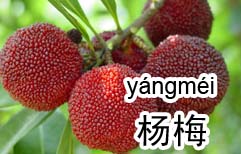
I think a good way to describe yang mei is "like a big raspberry with much smaller cells"
At least that's how I felt when I had them in Guangzhou.

tomwilberAugust 6, 2010
榴莲很臭,但是很好吃! I tried this fruit (durian, or liu2lian2) in Beijing last week. Wow, what an experience.

jen_not_jennyAugust 2, 2010
Is this what you ate during your China trip?
That's糖葫芦 tánghúlu, made from 山楂 shānzhā, or hawthorn. I'm not crazy about those, either, but I love 杨梅yángméi...they're naturally much sweeter than hawthorn, and I don't think they're sold with a sugary coating.

hebertinchinaAugust 2, 2010
yep. that's them. I got the wrong fruit. If hawthorn is a fruit. I'll try the yángméi when I get back out there this fall if its available. Glad to know that one of China's fruit delicacies could still quite possibly enter into Hebert's Palate.
jen_not_jennyAugust 3, 2010
Haha, I don't know if hawthorn is a fruit, either, but since coming to China I've had all sorts of things I hadn't previously known were edible!

simonpetterssonAugust 3, 2010
Since coming to China I've had all sorts of things I'm still convinced are not edible.
jen_not_jennyAugust 3, 2010
Haha! 你在广东,对吗?People say the Cantonese eat anything with four legs that's not a table, anything with wings that's not an airplane, and anything in the water that's not a boat! Considering some of the stuff floating around in the Pearl River, that's pretty frightening! ;)
hebertinchinaAugust 2, 2010
Are yángméi an acquired taste? I think I had some when I was in China with a sucker like red candy glaze on the outside. The sugar didn't save it from the sour taste so I ate 3 to save face then gave the rest to a friend. Is it a lot better without a candy coating? Anyone strong proponents of giving it a couple more tries? I really am more of a sweet tooth.
eight8isenufJuly 30, 2010
I would be interested to know the names of some chinese green leafy vegatables that I have no idea what they are- some are sort of like collard greens, but there are several I have seen here in Florida that are sold in the Chinese groceries, that don't resemble anything I have ever seen. I have only been told they are very healthy and some are kind of medicinal.

ruishi_zhizaoJuly 22, 2010
還有空心菜跟枸杞子 (Goji berries)
hai2you3kong1xin1cai4 gen1 gou3qi3zi3
空心菜用英文怎麼說我還真不知道。。。
kong1xin1cai4 yong4 ying1wen2 zen3me0 shuo1 wo3 hai2 zhen1 bu4 zhi1dao4/0
枸杞不但很美味,而且也是不可缺少的補品之一。聽麻吉們講是明目的,我覺得還蠻有效。
gou3qi3 bu4dan4 hen3 mei3wei4, er2qie3 ye3shi4 bu4ke3que1shao3 de0 bu3pin3 zhi1yi1. Ting1 ma2ji2men0 jiang3 shi4 ming2mu4 de0, wo3 jue2de0 hai2 man3 you3xiao4.

xiao_liangJuly 20, 2010
Anyone seen Snake Fruit from Indonesia. I ate some in Bali and have been obsessed with it ever since. Can't get it in England, and my attempts to grow the nuts I stole have failed miserably...
jen_not_jennyJuly 20, 2010
Drier than apples? Hmmm...crunchy? Like a water chestnut or something? I'm having trouble imagining it.
xiao_liangJuly 20, 2010
Yea, I have trouble describing it. Never had a water chestnut. If ever succeed in growing any, you're welcome to have some, but I'm totally failing at the moment :p
jen_not_jennyJuly 20, 2010
Connie, JiaoJie, anyone...你看见了这样的水果呢?怎么叫它?Nǐ kànjiànle zhèyàngde shuǐguǒ ne? zènme jiào tā?
My apologies for my obsession with soursop, everyone...

alexlexiluJuly 13, 2010
Hi everyone... I made this list of fruits and veggies. Could you help correct / add to it??
Thanks, I think it might be useful to bring to the market!
_________________________________________
Fruits and Veggies
Fruits
梅子méizi – plum
杨梅yángméi – red bayberry
草莓 căoméi – strawberry
木莓 mùméi / 山梅 shānméi – raspberry
蓝莓lánméi – blueberry
黑莓 hēiméi – blackberry
荔枝 lìzhī – lichee
龙眼 lóngyăn – dragon eye
山竹 shānzhú – purple mangosteen
百香果 băixiāngguŏ – passion fruit
蓮霧 liánwù – wax apple
青枣qīngzǎo – green jujube
西瓜 xīguā – water melon
香蕉 xiāngjiāo – banana
火龙果 huŏlóngguŏ – dragon fruit
红毛丹 hóngmáodān – rambutan
番荔枝fānlìzhī – custard apple (Buddha head)
橙子 chéngzi – orange
桔子 / 橘子júzi – tangerine
柑橘 gānjú – mandarin orange
柠檬 níngméng – lemon
青柠 qīngníng – lime
西柚xīyòu / 葡萄柚 pútáoyòu / 香橼xiāngyuán – grapefruit
柚子yòuzi – pomeloe
苹果 píngguŏ – apple
榴莲 liúlián – durian
芒果 mángguŏ – mango
桃子táozi – peach
杨桃 yángtáo – star fruit
番石榴 fānshíliu – guava
大树菠萝 dàshùbōluó – jackfruit
木瓜mùguā – papaya
菠萝bōluó – pineapple
椰子 yēzi – coconut
Veggies
菠菜 bōcài – spinach
芹菜 qíncài – celery
莴苣 wōjù – lettuce
西兰花 xīlánhuā – broccoli
芥蓝gàilán – Chinese broccoli菜花càihuā – cauliflower 洋白菜 yángbáicài – cabbage
卷心菜 juănxīncài – cabbage
泡菜 pàocài – pickled cabbage (Kimchi is Hánguó pàocài 韩国泡菜)玉米 yùmĭ – corn 大豆 dàdòu – soya bean
毛豆 máodòu – soybean 蘑菇 mógu – mushroom
萝卜luóbo – radish
白萝卜báiluóbo – white radish
胡萝卜húluóbo – carot
番茄fānqié / 西红柿xīhóngshì – tomato 青椒 qīngjiāo – green pepper
柿子椒 shìzijiāo – bell pepper辣椒 làjiāo – chilli pepper藕 ŏu – lotus root
土豆tŭdòu – potato 红薯 hóngshŭ – sweet potato
大蒜 dàsuàn – garlic
葱 cōng – green onion洋葱 yángcōng – onion 小葱 xiăocōng – shallot 大葱 dàcōng – leek 南瓜 nánguā – pumpkin
苦瓜 kŭguā – bitter melon
冬瓜dōngguā – winter melon
黄瓜 huángguā – cucumber
丝瓜 sīguā – luffa (loofah) (towel gourd)生姜 shēngjiāng – fresh ginger
茄子qiézi – eggplant

danchaoJuly 13, 2010
Hey, that's pretty good. Some things that I've spotted:
Soy bean is also called 黄豆 huang2 dou4
青椒 qing1 jiao1: green bell pepper
红葱头 hong2 cong1 tou2: shallot

bodaweiJuly 14, 2010
I agree a great list! There are lots of local variations of course, eg. several names for potato. 洋芋 yángyù (potato) is the more common term where I live.
Other notes on above list:
菌 jùn (mushrooms/fungus)
苦菜 kǔcài (bok choy – a larger version of 青菜)
Also, what is normal or common in one part of the country may not be in another. I attach a few that are common in the South-West of China. They may sound esoteric but they are common here:
瓜尖 gua jian (pumpkin shoots)
蚕豆 cǎndòu (broad beans)
凉拌薄荷 (mint)
凉拌蕨菜 juecai (bracken, fern)
百合 bǎihé (lilies)
板栗 bǎnlì (chestnuts)
蕉花 jiāo huā (the flower of the lady finger banana)
鱼腥草 yǔxīngcǎo (scientific name Houttuynia Cordata)
裳梨花 shanglihua (an edible flower)
魔芋 mo yú (taro)
海菜 hǎicài (edible seaweed)
Note: 酸淹菜 suānyāncài (pickled vegetables) or just 腌菜 yāncài is 泡菜 pàocài elsewhere.
bodaweiJuly 20, 2010
Hi egret
This is a little misleading I'm sorry - if you are after the word mint it is just:
薄荷 bòhe (mint)
凉拌薄荷 liángbàn bòhe (a dish mixing a number of things but using mint as the main ingredient);
凉拌 is a term applied (in Yunnan at least) to a whole range of cold dishes that are usually eaten early in the meal.

richnirishJuly 13, 2010
qilai.....it appears that there is much more to this term than the simple definition indicates.....Thank you for the useful comments.
alexlexiluJuly 12, 2010
This site is amazing... it has all the fruits in English... how do we find them in Chinese now?
http://www.baanbophut.com/wordpress/koh-samui-guide/thai-fruits/
The other fruit I was talking about earlier is the green jujube fruit!!! Cool name!
is it qīngzǎo 青枣 ?
bodaweiJuly 13, 2010
yes, 青枣 (but it is surely not related to dates as we know them in the West).
PS that link does not seem to work for me.

alexlexiluJuly 12, 2010
Sorry I can't figure out how to put a picture.
These are the wax apples: 蓮霧 liánwù lotus mist!!! so poetic!
http://www.flickr.com/photos/81226325@N00/245171751/
alexlexiluJuly 12, 2010
Could you prepare more lessons on Chinese fruits and veggies... I find it hard to figure them all out... pictures would be awesome!!

TalJuly 12, 2010
Hi alex
In the video channels > vocab tour there's a lesson called Trip to the Vegetable Market, I think you'd enjoy it.
(I can't give you a link, sorry! I've just tried 3 times to link to it but it seems the site is not working properly and I can't.)
bodaweiJuly 12, 2010
杨梅 yángméi I would put roughly in the middle of the strangeness spectrum of Chinese fruit, and only because we don't see them in the West. The taste and texture is not strange - a delightful fruit that I commonly have on 'corn paste' for breakfast. (I just blew the 'not strange' vibe.)
Definitely to the right of杨梅 are 柚子 yòuzi (close to my heart as it is the first thing I ate in mainland China) - dictionaries call them 'pomelos' which we don't have in Australia. They are rather like grapefruit in taste but the texture is quite different. These are another classic breakfast fruit, but they appear in a hundred different dishes. I have seen each 'cell' of the fruit separated (painstaking work for the cook). And柚子茶 one of the best ever teas, when mixed with grated orange peel and honey.
Note on 荔枝 lizhi (lychees) - they are sold tied like bunches of flowers. This slows down the decay process, but they still last only a couple of days where I live. (Difficult to eat? I don't follow that discussion at all. Shanghai people happily crack the husks off nuts with their teeth - normal people need to break them with a hammer. Lizhi have soft skins that break easily.)
I would like to hear other poddies views on stranger fruits.
alexlexiluJuly 12, 2010
Actually we can buy pomelos everywhere in Canada now, as well as lychees and many more... including... DURIAN... but it nearly smells anything here as, like all the other tropical fruits we buy here, they arrive not rippened so they don't taste that great. Anyway, when I was in Vietnam in June 2002, I remember that aweful garbage truck smell everywhere from the Durian.... ouuuuch. But I have to check for those yangmei... I am not sure if we have them or not...
A few more fruits I ate in HK/Taiwan but have not seen here yet: wax apples (bright red, empty in the middle, very juice, not as hard as apples, no seeds) and this little green apple looking fruit but with a seed kinda like a plum in the middle... I forgot the Chinese name but I think it was a plum type fruit.
bodaweiJuly 13, 2010
Hi alexlexilu
We have the 'little green apple looking fruit' - I think it is an apple (or pear?) variety - it does not strike me as a plum - but as you say it has a seed like a plum seed in the middle. Delicious.
Generally there is a much greater variety of fruit in China than we have in Australia, and generally the fruit tastes better. Big generalization - but it is seasonal, and does not get transported great distances or refrigerated for long periods. Where I live. In Shanghai and other eastern seaboard cities this Western-style industry is developing. (Australia has been lending its research know-how to the fruit and veg industry - this has its pluses and minuses.)
But also the price of fruit varies enormously from very cheap to very expensive. About a month - 6 weeks ago in SW China cherries were about 50 or 60 RMB a kilo. This doesn't stop people buying them - people are very serious about their food in China.
jbowesJanuary 5, 2011
"no seeds" ...budui!!
Some have seeds....if the plant had no seed bearing fruit we'd be eating the population down to zero (unless it goes the way of the seedless banana...)!
Some wax apples do have seeds...brown furry seeds...they look like rabbit turds. Which I thought it was the first time I came across one! I have since found many, but you are right that most are seedless.
richnirishJuly 12, 2010
Could you expand on the proper use of " qilai"?
TalJuly 12, 2010
起来 qǐlai is often used after a verb as a complement to express various meanings. Among other meanings, 起来 qǐlai may mean 'begin to...,'
e.g. Wǒmen bù děng bàba le, chī qǐlai ba. (我们不等爸爸了,吃起来吧。) = We're not waiting for Dad, let's start eating.
In this lesson's dialogue I'd say the sense of 吃起来 is that the process of eating begins, continues, and turns out to be 太麻烦了!
http://www.nciku.com/search/zh/detail/%E8%B5%B7%E6%9D%A5/1311770

go_manlyJuly 12, 2010
I don't think you can talk about THE use of qǐlái.
There seem to be a number of uses, and its difficult to see a common thread.
There is only one meaning in this lesson however.
Take kànqǐlái, tīngqǐlái and chīqǐlái.
When kàn, tīng and chī are used alone, the subject is doing the seeing, hearing and eating.
When qǐlái is added, the subject is BEING seen, heard and eaten.
But, more than that, it describes how that action is interpreted by the 'observer' - the person doing the seeing, hearing and eating.
So: 'looks ...' (exhausted, for example), 'sounds ...' (pleasant, for example), and - well the 3rd one is harder. I don't think it can be translated directly into English. I think that is because in English we only use this structure to describe the 5 senses - there's also 'smells ... (rotten, for example)', 'tastes ...' (sour, for example), and 'feels ...' (prickly, for example).
Different Nciku sample sentences, the lesson dialog, and the Expansion sentences for this lesson suggest that chīqǐlái can variously refer to the taste, texture, or how easy or difficult the food is to eat.
So its like 'how is it to eat?' rather than 'how does it taste?'.
Anyway thats my take on this one use of qǐlái.
therapistJuly 12, 2010
Regarding 起来 :-
1)A simple usage:-
他起来得很早 = he got up very early
2) Used as a complement after a verb:--
a) to indicate beginning / continuation of an action
天气冷起来了= It is getting cold
b) completion of an action
我想起来了 = I remembered
c) Indicates impression made:--
听起来 ,看起来 =listened , noticed
d) indicates an upward movement:--
旗举起来 = raised a flag
Therapist


dunderklumpenJuly 13, 2010
Lychees are troublesome to eat.
荔枝吃起来很麻烦。
Li4zhi1 chi1 qi3lai hen3 ma2fan.
This is a pair of comfortable shoes.
这双鞋穿起来很舒服。
Zhe4 shuang1 xie2 chuan1 qi3lai hen3 shu1fu.
http://www.nciku.com/search/all/examples/%E7%A9%BF%E8%B5%B7%E6%9D%A5

ideotekOctober 29, 2010
I'm having trouble seeing point d).
Are you saying you can't use 起来 qilai for "lowered" the flag? or is it simply "HAS lowered the flag" and the same as point b)?
Are the meanings for "raise children" or "raise a temperature" not upward motions of their respected verbs + qilai?
Or are there different verbs for these concepts?
Also: doesn't "hear" or have more of an impression made than "listen" except when you use "have heard" or "have listened"?

mrluoboJuly 12, 2010
杨梅Mojitos:
Ingredients: a few mint leaves, 1 lime, simple syrup, ice, rum, soda water, and of course, 杨梅 (pitted and chopped into delicious chunks).
1. make simple syrup (combine equal parts water and sugar over low heat until mixed)
2. place a few teaspoons of simple syrup into the bottom of a sturdy glass. Add the Mint leaves and grind it until its minty flavor is released.
3. add one or two lime slices and repeat the grinding process (either with a mortar or a heavy spoon).
4. fill your glass with ice
5. add rum (I'm not going to tell how you much to add... hehehe)
6. add the 杨梅 chunks
7. fill glass halfway with soda water
8. stir
9. fill the remainder of glass with soda water
10. add a mint leaf and lime slice for garnish and enjoy!
(If you liked this 杨梅 recipe, please add more or post to the ChinesePod blog)

cowenparkseattleJuly 12, 2010
In the fourth line of the dialog, it sounds like Speaker B says tian4 -- fourth tone instead of second tone. This is on the full dialog file, not the individual sentences, where it is clearly tian2. Or am I mishearing?

johanchristerssonJuly 12, 2010
I hear a second tone too, however I think it sounds like she says yángměi and sūn instead of suān...
/Johan
dunderklumpenJuly 13, 2010
cowenparseattle, try and listen to the dialogue in slow speed. You will hear the tone goes up in the beginning (second tone) and then falls.
dunderklumpenJuly 13, 2010
Jenny 您好, the textbook definition of pronunciation of a second tone is something like "it starts low and then rises" 对吧. In the dialoge, 梅 and 甜 are pronounced like a second tone but thers is a clear drop in tone in the end too, something like "it starts low, then rises and finally drops back to low". What does that add to the meaning of those words? Is it a way to emphasize 梅 and 甜? Can both men and women use that way of speaking?
go_manlyJuly 13, 2010
I've just listened to the dialog a few times, both at regular speed and at 50%.
I can't detect any sign of that drop in pitch you refer to in either of those words. Possibly the rise isn't linear, that is all.
dunderklumpenJuly 14, 2010
Actually I find the drop it even more clear in laoban's 吃 (chi1) and 有 (you3). I made a time-frequency analysis of the you3 and uploaded it here: http://www.tabblo.com/studio/stories/view/1798511/ The y and x axes represent frequency and time respectively.

JohnJuly 11, 2010
It's 杨梅 (yángméi) season in Shanghai! Get them now, if you can...
rkraftJuly 12, 2010
I haven't seen them in Canada (I'm from Victoria, British Columbia and we have a pretty good selection of exotic fruit)...I tried 杨梅 (yángméi) while I was in Shanghai last May (sorry, sorry, I just couldn't fit in a visit to CPod - next time!). I wasn't too crazy about 杨梅 but I loved another fruit that was readily available in Beijing: 山竹 (shān zhú) - I hope I found the right translation for 'purple mangosteen'.
JohnJuly 12, 2010
Weird, I'm not familiar with that at all. At first I thought you meant 山楂 (shānzhā), but no, you got the name right.
https://en.wikipedia.org/wiki/Purple_Mangosteen
jen_not_jennyJuly 12, 2010
You should definitely try 山竹! Tasty and very funky! They're pretty common in southern China, too. I've seen them here in Shanghai but not as often.

wallabyJuly 13, 2010
杨梅 are also popular here in 高知, Japan. But in most areas in Japan, they don't even know what 杨梅 are. So for a long time, I thought they are eaten only in a small part of Japan! It's good to know that they are popular fruit in China.
By the way, when I was living in South Florida, My neighbor had a big 荔枝 tree in his backyard. I used to eat them for free :)
jen_not_jennyJuly 14, 2010
Aw...that link doesn't seem to work! @alexlexilu, the peel is so thick that it comes off quite easily, like a really thick-skinned orange. Then you scoop out the segments inside. Most segments have seeds, which I don't usually eat.
JohnJuly 14, 2010
In a weird coincidence, someone offered me 山竹 just last night after I got off work at ChinesePod. I'd never had it before then.
Not bad!
jen_not_jennyJuly 14, 2010
I seriously cannot believe you've been here so long and only just tried mangosteen last night! Always something new in China....;) Glad it lived up to my hype! It reminds me just a tiny bit of another fruit that was completely foreign to me before I moved abroad, soursop. (nciku says it's 刺番荔枝 cìguǒfānlì but a bing image search with those characters revealed photos of quite broad spectrum of fruit, so I'm not certain that's an authoritative translation.) Both soursop and mangosteen have a sort of creamy, fresh tang to them. Very interesting in a fruit, to a Western palate at least!
JohnJuly 14, 2010
Yeah, I'm not sure how I missed the mangosteen all these years... Oh well; problem corrected!
I'm not sure about the Chinese for soursop. Connie and Jiaojie have no idea what 番荔枝 (fānlìzhī) -- or whatever you want to call it -- is.
jbowesJanuary 5, 2011
Perhaps the problem is that you are searching with Bing instead of a functioning search engine!!
:)
Sorry....had to opine!
Fruits and veggies are so plentiful and diverse here in Taiwan, I usually ask a place "what green veggies do you have?". After they go through all the ones they have, I simply pick one I have never heard of before and try it out. Fruit stands are easier to pick and choose, of course. I love the feeling when you notice that a fruit season is changing...whats next, whats next! Pine for the lack of X but be excited for the plethora of Y.
TalJuly 11, 2010
草原上来了一群羊。猜一种水果 --- 草莓!草原上又来了一群狼。猜一种水果 --- 杨梅!
Cǎoyuán shàng láile yī qún yáng. Cāi yīzhǒng shuǐguǒ --- cǎoméi!Cǎoyuán shàng yòu láile yī qún láng. Cāi yīzhǒng shuǐguǒ --- yángméi!
A flock of sheep came to a field. Guess the fruit --- strawberry!Then a pack of wolves came to the field. Guess the fruit --- red bayberry!
alexlexiluJuly 12, 2010
WOW, someone told me this joke a week ago and it was the first time I heard it... At the time I didn't know about 杨梅 so I couldn't it that day but I could 猜 "草莓"!!!
TalJuly 12, 2010
Hi alex
glad you enjoyed it! In fact it comes from another Chinesepod lesson (link below) which mention of 杨梅 reminded me of!
https://chinesepod.com/lessons/sheep-wolves-and-fruit-a-riddle
bababardwanAugust 9, 2010
thanks tal..hadn't seen that before..it's a ripper. This should be a fun one to commit to memory and crack out...the huashengmi joke's been a big hit ...now, thanks to you, I have doubled my repertoire ,haha :)
TalAugust 11, 2010
Cheers mate. Occasionally when I tell this one to Chinese friends, I will say:
草原上又来了一群狼。猜一种水果 (Cǎoyuán shàng yòu láile yī qún láng. Cāi yīzhǒng shuǐguǒ) and they, thinking themselves very clever will answer: 杨桃 (yángtáo) which is the wonderful carambola or 'star fruit', but which could also punningly mean 'the sheep run away' (from the verb 逃走 táozǒu = to run away, flee).
What did you notice in this lesson?
You are posting as a guest. Your reply is reviewed before it appears. Log in to post without review.