
dimabearNovember 18, 2010
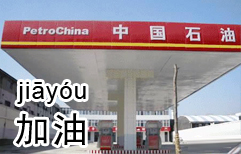
When I was in Beijing, Xi'an, and Shanghai, I was so surprised to see so few gas stations. I don't think I saw one gas station in Shanghai (Xujiahui, Waitan, Pudong). But I did see so many cars. Given the gas stations I saw in Beijing and Xi'an, and the vast number of drivers, I was also surprised that the gas stations were not crowded.
Go to any Costco in the US, and that's one crowded gas station.

pretzellogicNovember 18, 2010
Not sure what the metric for "few" is, but I know where 4 gas stations are in a 4 mile stretch, and I don't even drive.

hamshankAugust 22, 2010
I think a thanks is in order since this was one of the lessons I requested on the suggestions page.
謝謝你.

bodaweiAugust 18, 2010
A rough petrol price ranking (from the Australian Institute of Petroleum) follows, in Australian cents/litre (June quarter 2009):
· Mexico (cheapest) – 75
· USA [and perhaps China] – 80
· Canada – 110
· New Zealand – 120
· Australia – 130
· Japan – 160
· Korea – 160
· United Kingdom – 200
· Germany – 250
As I noted above, the main reason for the differences is tax.
Of course these kinds of comparisons are of limited use, taken in isolation. While Mexico may have cheaper fuel than Australia, because taxes are lower, it is necessary to consider what the community receives for their tax dollar.
Mexico, the United States and China are all ‘short’ on certain taxpayer-funded public services compared to Australia, Japan and Germany.

xiao_liangAugust 23, 2010
· United Kingdom – 200
And that's why I have so much debt :-p
每天说, "怎么这么贵!"
Měi tiān shuō,“zěnme zhème guì!”
bodaweiAugust 23, 2010
xiao_liang
Just think of all of those nice benefits you get for your tax dollar!

shanghai_heliosAugust 18, 2010
A key to driving indeed is knowing where the gas stations are, and when they are open. There are stations in residential areas, but stations are much more common in the countryside along provincial highways. The one thing that the dialog left out is that the attendant always asks if a fapiao is needed.
Road trips are becoming more popular--check a bookstore for the many driving guides. We put in more than 4,000 K last winter, and in October it's off to Hunan.

rodsAugust 18, 2010
The octane numbers Jenny mentioned sounded at little high to me. So, I checked with wikipedia and discovered that we use a different numbering scheme in North America.
https://en.wikipedia.org/wiki/Octane_rating#Regional_variations
karbukAugust 18, 2010
Question about the use of 师傅 Here in the States we know it as 'master' as in Kung-fu master. This is the first time I have heard of it in reference to a worker. My wife (who is American born Chinese, but speaks Mandarin) categorically states that no one would be called that unless they are a kung-fu master. I disagreed, citing that US English is different in usage than UK English sometimes, and that maybe it is a China specific thing. This resulted in a fight. Has anyone else heard this usage? If I actually said it to someone in Beijing, would they laugh at me or is it common enough to be accepted?
Thanks!
Steve
pretzellogicAugust 18, 2010
you'll regularly refer to the taxi drivers, bus drivers and other skilled workers as shifu. There have been multiple conversations about this on this site, but I can tell you I said xie xie shifu to the taxi driver, and he didn't punch me out. Shifu is definitely an accepted term, but not with your teachers or politicians or other likely college educated people.
karbukAugust 18, 2010
Ah that makes sense. I figured it was something like that. I didn't realize there was somewhat of a class separation thing going on there. Members of workers guilds were often called 'master' in Europe, so I guess it is something along those lines. I appreciate the information! xie xie ni!
bodaweiAugust 18, 2010
Jenny's explanation for a dearth of petrol stations in the city of Shanghai sounded .. (I will try to be nice) .. staggeringly unconvincing. Try a couple other possibilities: (1) the rate of car ownership in China is roughly one tenth car ownership in the US - so the demand for petrol stations is significantly lower. I would expect the incidence of petrol stations to be roughly one tenth the incidence in the United States just on demand alone. (2) Chinese city design is radically different to the West (despite Shanghai having borrowed much of its statutory control mechanisms from Sydney of all places). You don't have many 'sub-arterial' roads (half way in the hierarchy between really major roads and minor roads) - this is where most petrol stations are found in the West.
If there were 'fewer' petrol stations in Chinese cities out of concern for personal safety this would be rather 'out of character' with the rest of the physical (not to mention commercial) environment. In my city, petrol stations tend to be tucked away all around the city (including in largely residential areas), in contrast to Jenny's observation about Shanghai. My question then: where are petrol stations in Shanghai if not in 'residential' areas? Shanghai 'zoning' of residential versus other land uses appears to be weak, to put it mildly, so it is very hard to point to an area and say - that is for residences, there is no commercial allowed here, no light industry, no bars and restaurants. The different uses in Chinese cities tend to be highly mixed. (I must say that is one of the things I like about China.)
PS If you look at an American city that approaches the density of Shanghai (take New York City for example) - how obvious are the petrol stations there?
boshidunjeffAugust 18, 2010
I'm surprised there's no mention of the other use of 加油 in this lesson - especially since I've been humming and singing Rob's song!

bababardwanAugust 18, 2010
yeah. It's pretty rare here now to get petrol stations with full service, so I was going to ask: what if you're impressed with the service and want to cheer 'em on as they fill 'er up? Can you say 加油加油!? 。。and keep flicking back and forth enthusiastically between meanings? ...I guess a bit more emphasis on the 加油的加油 and a little less emphasis on the 加油的加油 should make it clear,right?

suburbaniteAugust 18, 2010
中国石油 is one of the companies, what are the others?
@John -- it seem like the gas stations are slowly being replaced with pharmacies and the occasional Starbucks.
martinwooAugust 18, 2010
中国石化 and there are also many gas stations are private owned... It'seasy to get cheated there.
zhuimiAugust 18, 2010
I think it's great that gas stations are state-owned in China. That's one of the ways Communism is working. In the US, gas companies made more profit when they had to buy their product at a higher price, which is the opposite of how most industries work. (usually when a salesman buys goods from his supplier for X dollars and then then next day has to pay 2X for those goods, he ends up making much less money/profit than he did when he was buying the goods for X dollars.)
suburbaniteAugust 18, 2010
oddly enough the price of ~4L of gas in China was similar to the cost in the states.
bodaweiAugust 18, 2010
The whole petrol pricing thing takes a bit to get your head around. The most important thing to take on board is that the main reason for price differences around the world is TAX. Production costs differ little - okay some countries like Mexico/US might have a little comparative advantage but not much. Trivial. It's all about tax.
The second thing is that just because a business is Government owned does not mean that it forgoes a profit. That applies anywhere - in China as well as the West.
As for why costs go up and down and what that means for profit - let's just say that if the world price for oil goes up it does not follow automatically that the oil company makes more profit (than when the world oil price was low.)
ericpotterSeptember 7, 2010
Satate owned is true the problem. There is not enought competition so that the pirce maybe high.
bodaweiSeptember 7, 2010
If there is a problem (and I don't think there is - petrol in China is still well under-priced because it does not account for environmental damage of uses) the answer is better regulation. This is because competition of the kind you have in mind, sufficient to impact on price, is really unavailable in petrol retailing. If you left it to private companies you would end up with three or four companies at most, all charging the same price more or less. (See the United States and Europe for example.)
bodaweiSeptember 7, 2010
By the way - I haven't seen you around before - welcome! Do you live in China? If so, do you drive a car in China?
zhuimiAugust 17, 2010
so, on average, how many minutes do people have to drive to get to a gas station in Shanghai? I realize some people are going to live closer to gas stations then others, but on AVERAGE, do people have to drive 10 minutes? 15 minutes? About how long?

go_manlyAugust 17, 2010
Your on-site podcast sounds like the chipmunks. The downloadable versions are fine.

catherinemAugust 18, 2010
Sounds ok from our end... are you still experiencing the problem? If so, what browser are you using?
What did you notice in this lesson?
You are posting as a guest. Your reply is reviewed before it appears. Log in to post without review.