
go_manlySeptember 9, 2010
CPod, in the last expansion sentence, the Pinyin for 假 shows as jiǎ. Shouldn't it be jià?


SF_RachelAugust 21, 2010
Looking for a bit more clarification on the expansion sentences. I saw two new (for me) vocabulary words for "mood": 情绪 and 心情. Before adding them to my SRS, I looked them up in the hopes of finding differences in shades of meaning.
Although neither my dictionary nor nciku explicitly say so, I get the impression from sample sentences in both places that 情绪 has an implication of negative moods. This word seems to come up when talking about moods affected by things like anxiety, depression, peevishness, etc. On nciku, even the more positive colloquations using this word seem to suggest a change in state away from something bad.
心情 on the other hand seems a bit more neutral to positive. Without other modifiers, it might suggest a relaxed state, or possibly one of being open to being acted upon (particularly excitement).
All in all, it seems pretty subtle.

JasonSchAugust 23, 2010
Great question...and great answer! You're right, they're quite similar, but with some important subtle differences. From my understanding, all of what you've said above is correct. Although 情绪 doesn't implicitly carry a negative meaning, it's usually used this way, whereas 心情 is like your 心(里)情(况), and therefore more neutral.
SF_RachelAugust 21, 2010
Gosh, best expansion sentences ever, very useful kinds of things here! In the last sentence, is it reduplication or an error in the last expansion sentence where to re-engergize (adjust one's mood) is 调节调节心情?
JasonSchAugust 23, 2010
Glad you liked the expansions!
This kind of verb duplication is quite common. (看看,说说) It may have seemed strange seeing it with a disyllabic verb, but this happens as well. (商量商量, 研究研究) It acts to soften the tone of a verb, and also to emphasize the process of it. (Something like 一下, and the 'up', in the English 'cook up some food'.)

calicartelAugust 20, 2010
In the third expansion sentence:下周一把报告交给我,可以吗?, 下周一 is translated as "next week". Is this the standard way of saying "next week"? I would put it as "next Monday".
JasonSchAugust 22, 2010
It should in fact be, 'next Monday'. I misread 周一 as 一周. (下一周 meaning, 'next week'.) Thanks for pointing that out.


zaphekiahAugust 14, 2010
Could anyone tell me what that word for "tip" that Jenny uses is? Tip has so many synonyms and my dictionary doesn't seem to include that one.

bababardwanAugust 14, 2010
what time in the podcast did she say the word?
what did it roughly sound like?
bababardwanAugust 18, 2010
zaphekiah,
..it's at 11m14s and I think it's 窍门儿...so I think you were right on the money [except .men not man ]. I like the breakdown here ..intelligence/opening+door.

eupnea63355August 8, 2010
RJ, great vocab. Many thanks!
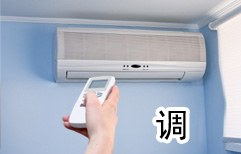
Recently here in the states I have been seeing TV commercials for ductless air conditioners, mounted high and controlled with a remote, like in this picture. I've never seen one in person, but the commercial makes it seem like a great idea. Easy to install. No ducts? How?

RJAugust 8, 2010
Hi Eupnea,
A "ductless air conditioner" or "mini-split system", has two major components: a unit mounted on an inside wall that delivers cool air to the room, and a unit mounted on the outside of the house. A pair of refrigerant lines run between the two.

xiaophilAugust 7, 2010
I have a question
Can we use the 把...调高 for other situations, say for the sound of an mp3 player?
For example:
把声音调高吧。 (Turn the sound up.)
Or perhaps:
把声音调大吧?
RJAugust 6, 2010
Air conditioner – 空调 – kōng tiáoRemote control – 遥控器 – yáo kòng qìAutomatic – 自动 – zì dòngCool – 制冷 - zhì lěngDehumidifier – 抽湿 – chōu shīHeat – 制热 – zhì rèFan Wind – 送风 – sòng fēngHigh Wind Speed – 高风 – gāo fēngMid Wind Speed – 中风 – zhōng fēngLow Wind Speed – 低风 – dī fēngSet – 调整 – tiáo zhěngMode – 模式 – mó shìOn / Off – 开/关 – kāi/guānWind Speed – 风速 – fēng sùWind up/down – 上下风 – shàng xià fēngEconomy – 经济 – jīng jìTime Set – 定时 – dìng shíBlowing Direction – 风向 – fēng xiàngSweeping Wind – 扫风 – săo fēngCleaning – 清新 – qīng xīnDisplay – 数显 – shù xiănStrength – 强劲 – qiáng jìnSleep – 睡眠 – shuì miănLighting – 灯光 – dēng guāngCancel – 取消 – qŭ xiāoPower Source – 电源 – diàn yuán



luobinzhenmeiAugust 6, 2010
Great lesson. Now we need a lesson on the directions on washing machines (and rice cookers). We were relieved to see the term 标准 (biao1zhun3, standard) and we only use that setting, but I suspect some of the other settings might be better for our clothes. Of course, we could have asked, but we don't want to lose face :)
(As if we don't lose face every time we open our mouths.)


jennyzhuAugust 6, 2010
These are the typical words you will find on a remote control for air-con, most of which are in today's vocabulary section.

suburbaniteAugust 6, 2010
Thanks for the lesson and the photo. I was looking for a picture of a 空调遥控器。

anonymous19008August 6, 2010
The complicated and mysterious air con remote. For me this was one my first great mysteries I encountered in China. To this day I still have more luck randomly pressing the buttons and hoping for the right result than actually reading the instructions.
Mags MAugust 6, 2010
I listened to the dialogue first and, as is fairly common in the Chinese Pod boyfriend/girlfriend, husband/wife conversations, the woman sounded really bad-tempered, whining, even a little aggressive, wanting her partner to do everything for her while the partner takes it all lying down. However, when I read the dialogue the woman sounded perfectly reasonable in her remarks and requests. So she just sounded like she was in a foul mood but she wasn't really. Is that so?Does the way the women speak in the dialogues reflect reality? Should I try to cultivate this way of speaking to sound more Chinese? If so, it's going to be really difficult.

JohnAugust 6, 2010
I'd say the woman wasn't in a foul mood, but "slightly whiny" is probably a fair assessment. I wouldn't worry about trying to cultivate the exact manner of speaking.

neddanisonAugust 6, 2010
This is an interesting observation, User. I've been living in and around the Chinese world for 17 years (8 of those years in Taiwan, all of those years married to a Chinese woman -- and her family), and it has been my observation that Chinese women in male-female relationships are permitted a degree of "whiny-ness" somewhat beyond the degree deemed appropriate in English-speaking cultures.
An American fellow I knew years ago was newly married to a Taiwanese woman, and he complained that his wife pouted and feigned anger to get him to do things. As a compatriot, I knew what he meant. Unfortunately, he didn't recognize that her tone conveyed a certain endearing dependence. He should have noted that a Chinese woman won't take this tone with just any man! It's a mark of intimacy.
It's related to another observation foreigners often make, that Chinese intimates (such as family members) don't seem to use the polite terms an English speaker uses -- like "please" and "thank you". Again, there is an assumption of intimacy that is incompatible with polite formalities (translation: "We're homies -- why you gotta front?").
In Intercultural Communication jargon: While individualists (Westerners) seek to preserve an assumption of autonomy with polite strategies, collectivists (Chinese) seek to preserve an assumption of in-group membership by avoiding politeness formulas.
Another possibly related point is "撒嬌" (sājiāo), which the dictionary glosses: to act like a spoiled child, or to act coquettishly. This is one of those terms we just don't have in English! In intimate relationships, Chinese women often "sājiāo" as a sort of romantic gesture. Maybe our Chinese teachers can illuminate this for us!

RJAugust 6, 2010
Thanks ned, you said it well but based on other observations I have made, I would be very surprised if any chinese teachers (female) choose to illuminate.
staminkiasukkiaAugust 8, 2010
Q: Does the way the women speak in the dialogues reflect reality?
A: YES perfectly normal....

aylishAugust 6, 2010
I remember staring blanky at my 遥控器, unable to read past 一二三, and I certainly couldn't see any of those of my remote.
I never did figure that thing out actually...

mandarinboyAugust 6, 2010
Very useful vocab in this one. We are having daily battles about this since i like it to be Swedish summer warm (20 degrees C) and my wife and our children prefer it to be more Chinese standard (28 C).Now I can more accurately discuss this with them:-)
rodsAugust 6, 2010
Okay, that clears things up for me, because I was thinking to myself, "27°C (80.6°F)! that's kinda warm ... 19°C (66.2°F) sounded much more comfortable." I generally leave the AC at around 22-23°C. A bit warm but saves some electricity.
What did you notice in this lesson?
You are posting as a guest. Your reply is reviewed before it appears. Log in to post without review.