maryjeanneDecember 9, 2010
可以说:
A。 你家附近有银行吗?
B。 对,因刚就在前面左边。
A。 请问,附近有厕所吗?
B。 咖啡厅就在前面有厕所。

light487December 9, 2010
(Please include Pinyin at this level. I will add for you this time)
A. nǐ jiā fùjìn yǒu yínháng ma?
B. duì, yīn gāng jiù zàiqián miàn zuǒbian.
A. qǐngwèn, fùjìn yǒu cèsuǒ ma?
B. kāfēitīng jiù zàiqián miàn yǒu cèsuǒ.
Regarding 厕所 (cèsuǒ): Most people actually use the term 洗手间 (xǐshǒujiān) to ask where the bathroom/washroom/toilet is. Basically, it's the difference between saying "Where can I wash my hands?" and "Where can I go do my business?".. :) hehe..
maryjeanneDecember 9, 2010
Thank you! I was trying to post my sentences for my teacher, but I put them in the wrong place!! Thank you for your response! Mary

connieDecember 9, 2010
Good dialogue! I made some corrections for you.
A:你家附近有银行吗?
nǐ jiā fùjìn yǒu yínháng ma?
B:有。应该就在前面左边。
yǒu. Yīnggāi jiù zài qiánmiàn zuǒbian.
A:请问,附近有厕所吗?
qǐngwèn,fùjìn yǒu cèsuǒ ma?
B:咖啡厅就在前面。咖啡厅里面有厕所。
kāfēitīng jiù zài qiánmiàn. Kāfēitīng lǐmiàn yǒu cèsuǒ.

xiao_liangMay 27, 2010
In the expansion sentence "你就是朱老师吧?", why is there a 就 here?
suansuanruMay 27, 2010
你是朱老师吗?
(不知道是不是朱老师,所以问一下。)
你是朱老师吧?
(我觉得你是朱老师,但是我不肯定。)
你就是朱老师吧?
(朱老师不是他,不是她,是你吧?)
xiao_liangMay 27, 2010
Whoops. That's my fault for not putting pinyin in my first post, but it's an elementary lesson, so we should be pinyin'ing things. Oh, I've just noticed my text has mouseovers. Win!
Ok, but I'l try and translate your response (for which I thank you!).
你是朱老师吗? (nǐ shì zhū lǎo shì ma?)
(不知道是不是朱老师,所以问一下。)
I don't know if it is teacher Zhu, so I'll ask
你是朱老师吧?(nǐ shì zhū lǎo shì ba?)
(我觉得你是朱老师,但是我不肯定。)
I think you are teacher Zhu, but I'm not sure
你就是朱老师吧?(nǐ juì shì zhū lǎo shì ba?)
(朱老师不是他,不是她,是你吧?)
He's not teacher Zhu, neither is she, it's you right?
crandlesMay 23, 2010
Going back to the top and the request for how to say "americano" in Chinese. Back in the 90s in Taiwan, "americano" was 淡咖啡,which I guess referred to the process of adding water to an espresso.

stevecMay 23, 2010
Since Catherine posted a coffe-related pic, thought I would too. When Obama was elected, I sent my African-American friend a can of this Japanese espresso drink I found here in Taiwan (as well as a tube of 黑人牙膏 hēi rén yá gāo). He thought it was hilarious and keeps them on display in his home.
kaixin_in_tampaMay 21, 2010
Hi, how would we say a chain of restaurants or coffee shops? For example,
Starbucks is an American chain of coffee shops.
Thanks!

kaixin_in_tampaMay 22, 2010
Very good changye, thanks!
https://chinesepod.com/tools/glossary/entry/连锁

billMay 21, 2010
About two weeks ago my wife and I were visiting 岳阳楼 (Yuéyánglóu) or Yueyang Tower on 洞庭湖 (Dòngtínghú) Dongting Lake in 湖南 (Hunan). There is a beautiful tea house there where we were served 君山银针茶 (Jūnshānyínzhēn chá) Junshan silver needle tea.
真的好喝!Really delicious ! And sure, we brought some home.

jennyzhuMay 23, 2010
君山银针茶 (Jūnshānyínzhēn chá) Junshan silver needle tea is Mao Zedong's favorite tea, which brings up an important point about tea in China: it tends to be very regional. Almost every locale in China has its own tea, so people from that place would normally stick to their own tea unless they are tea connoisseurs. For example, people from Hunan probably rarely drink any Longjing (which is from Hangzhou) and vice versa. This is also what makes learning about different teas in China so interesting.
xiao_liangMay 27, 2010
Are you going on Hank's tea journey too? :-)
It's really hard to get hold of good chinese tea abroad. At the moment I have Yupin TieGuanYin, but it ages really quickly - after a while, the tea starts to smell like fish! Not great.
BillJefferysMay 20, 2010
I noticed an interesting discrepancy between the discussion of the lesson versus what was said in the dialog.In the lesson, the English translation in the fifth line of the transcript reads: "咖啡厅再哪儿?" (Where is the coffee shop?). But interestingly, Jenny says "再哪儿咖啡厅?"Now, I am not a native Chinese speaker, and Jenny is. The order of these two elements, as I have been taught, seems to me most natural if you mention the place first, and then the question, as in the written dialog. So, it seems that the order of these two elements is more free than I had been taught.I wonder if Jenny or some other native Chinese speaker would comment. This is a very interesting subtlety of Chinese of which I was not aware. I know that sometime the order is very important (as for time markers). In what cases is it not so important?

bababardwanMay 20, 2010
good question. I'll have to listen to this one again,but sometimes I think Jenny is just breaking down the phrase or sentence and repeating different elements ,not necessarily in the correct grammatical order,just to emphasise those parts...kind of a teaching style. I don't know if that's what's happening here. Yes,hopefully Jenny or native Chinese will confirm.

dunderklumpenMay 21, 2010
Wjefferys, at what time does Jenny say that? Sounds interesting but I can't find it.
BillJefferysMay 21, 2010
I realize now that I misheard exactly what she said. It's at 7:24 into the podcast; what she actually said was "The way to ask 'where is something' is '再哪儿'. 咖啡厅再哪儿?" I didn't "hear" the period after the first '再哪儿'. I "heard" it combined as a sentence with '咖啡厅' ending the sentence.
My mistake. Apologies to all, especially to Jenny for not listening as carefully as I should. At least I now know that I was taught correctly!
Thank you, dunderklumpen, for making me go back and find this mistake!
dunderklumpenMay 21, 2010
No problem :-)
BTW, I think you got 在 (zai4, located) and 再 (zai4, again) mixed up. 汉字好麻烦吧 ;-) Han4zi4 hao3 ma2fan ba. Chinese characters are troublesome.
BillJefferysMay 21, 2010
You're right. Careless on my part. Thanks for the correction. I just typed the pinyin into my Mac's Chinese input and without thinking took the first character it offered. I'm usually better than that.
BillJefferysMay 21, 2010
When you use the wrong character there's a term for it: 白字. I always loved this term. My misuse of 再 for 在 is a good example. Same tone, same pronounciation, completely different meaning.

JasonSchMay 20, 2010
For any tea people out there, our own Hank Horkoff is blogging about his 'Taobao Tea Trail' in which he's (from the blog):
Armed with the Chinese-language茶叶地图and百度百科I am sampling my way through the spectrum of Chinese teas – more than 85 in all, one a week. I am using Taobao to order the tea leaves and then postinga bit of information, photos and a link to the Taobao merchant here on this blog.
It's been great tasting all these different teas in the office and learning a bit more about tea culture. Check out the blog here, for more pictures and info.

bodaweiMay 20, 2010
Does he have any other obsessive tendencies I wonder? Actually good luck to him. I had this tentative plan to go on every bus route in the city (I have some spare time), until I learnt that there are 185 routes, And that is an understatement; a fair few routes are varied depending on the time of day. That's not counting the county buses. I'm going to sample them.
xiao_liangMay 20, 2010
Wow. That's a lot of tea chat. Hope he sticks through it for the full 100 - what an enterprise. Their house must be full of tea :-)


zhong_bideMay 19, 2010
Unless it has changed in the last few years, China has very few decent coffee shops. Starbucks is awful, and expensive. But at least you can buy nescafe in the supermarkets.
changyeMay 19, 2010
Hi zhong_bide
Nescafe is still "a life saver" for me here in a small city in northeast China, but I admit the situation has been (very) gradually improving.

maktubhelouMay 19, 2010
Really?! Nescafe is a life-saver? That's... kinda scary. I might have to bring a few bags of real European coffee before heading to China, ha.

munsonMay 19, 2010
I remember making lots of friends by having a bag of nice french roast when I was in China in '88. There was no coffee to be found there back then as far as I could tell.
bodaweiMay 19, 2010
Hi maktubhelou
'European' coffee? I'm confused, you're American right? :)
If it is European coffee you want you will find that Illy has a sizeable presence in China including with a Chinese chain of coffee shops, at least where I live. They make Italian style coffee. Proper coffee; nothing like Starbucks. ;-)
'
maktubhelouMay 19, 2010
Well, Canadian... spent most of my formative years straddling the border between French Canadian and English Canadian culture, so I like a good European style coffee. Nothing against American coffee, it's just not my "cup of tea."

rcle6782May 19, 2010
I recommend McDonalds and KFC for *black* coffee in China. It tastes the same as it does in the US, is cheap (~8 RMB for a large cup in Beijing) and at McDonald's you'll get free refills if you ask. Likewise I recommend both for English tea.
Granted that McDonalds and KFC coffee is definitely 'American coffee' and not 'European coffee' it is still far and away better than anything else I ever found in Beijing (including Starbucks, which set me back about US$4). I only drink Italian espresso at home (I'm European), but black American coffee is still better than no coffee ;)
I haven't been to Illy on the Mainland but I went there in Taipei (there's an Illy branded cafe next to Academia Sinica) and the coffee was the real deal... but from memory it was quite expensive (around $5).

JohnMay 19, 2010
I must admit, I consume my fair share of Nescafe as well... Sometimes you just need it!

oranginaMay 19, 2010
And I don't know if I am just imagining it to preserve my sanity, but I think it is better than Nescafe in the States. Not that it competes with a nice espresso by any means.

xiaophilMay 19, 2010
I have the advantage of liking both high and low quality coffee. I would agree with anyone that liking bad coffee is strange, but it allows me to reminisce late nights studying at Denny's. What this all comes down to is I avoid coffee shops in general in Shanghai. They are all too corporate for me. Just one notch above relaxing at McDonalds in my opinion. Thus, I too partake in the Nescafe. I don't like cream and sugar, though, so I don't buy the little packets. I buy 500 grams worth of instant "rich blend". I may be low class, but I sure can save some loot.
JohnMay 19, 2010
Yeah, I'm similar to you. I don't need high-class coffee, although I appreciate it. As long as the coffee is caffeinated and not watery, I'm OK.
catherinemMay 19, 2010
In a pinch there's also coffee in a can at the nearest convenience store (see image below)!
maktubhelouMay 19, 2010
I agree with the "not watery" imperative. I once drank three cups of coffee my Korean friend had brought on a picnic:
ME: "This tea is delicious... but, kind of unique. What flavour is it?"
FRIEND: "It's coffee."
ME: "Coffee flavoured tea??? That's different. Why would you do that?"
FRIEND: "Ummm..."
JohnMay 20, 2010
Ha ha... that's pretty funny, but sounds disgusting!
BTW, you can get coffee-flavored milk tea here in China. I always found it weird.
bababardwanMay 20, 2010
hehe,that is funny. I love a good dialogue too. hmm,how to say? ...咖啡味道茶?【coffee flavour tea?]
bodaweiMay 20, 2010
Someone from HK has to come in here and admit that mixing tea and coffee is a national (or is that sub-national?) pastime. Yeh, folks, a favourite afternoon drink of the HK native is tea mixed with coffee. Compared with what they eat though that is definitely not weird.

JohnMay 23, 2010
Both cold/in a can, as well as the instant stuff. (Is that what a "tetra pak" is? I don't know this term...)
bababardwanMay 23, 2010
Sorry John,this is what I meant:
http://www.recycle.ubc.ca/tetra-pak.jpg
..we commonly refer to them as "poppers".What do you call them? More importantly ,what would they be called in Chinese ?
bodaweiMay 24, 2010
Yesterday I had a hot chocolate flavoured tea. 巧克力味茶. I must admit I did not have the full experience. It comes with a package of those little gelatine balls you get in Taiwanese tea; I went vegetarian and left out the little balls. You fill your cup with the chocolate tea mixture then add boiling water. It wasn't bad actually - maybe I am completely losing my sense of taste.
oranginaMay 24, 2010
I would call that an aseptic container, or a box. Eg. "Do you want a box of juice?" "Yes, aseptic containers are recyclable."
jennyzhuMay 19, 2010
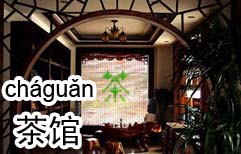
Many high-end tea houses in Shanghai are done like a traditional Chinese house. You will find traditional furniture inside with a miniature pond, a small bridge and some bamboo, etc. These tea houses charge over 100 RMB for a bottomless cup. But the price includes buffet snacks. It's a nice place to hang out and read a book, given that it's not too crowded. Otherwise it will be like a noisy market filled by customers chatting, playing chess, cards or even mahjong!
catherinemMay 18, 2010
@maktubhelou Here is an image of a Starbuck's menu in Chinese/English:
The basics:
latte /拿铁 /nátiě
espresso /浓咖啡/nóng kāfēi
cappuccino / 卡布奇诺 / kǎbùqínuò
americano / 美式咖啡 /měishìkāfēi
maktubhelouMay 19, 2010
Thanks. Now this, this is what I call a good response! :-) Fantastic! And, to quote a previous idiom Jenny used, I'm going to be all over this lesson for two reasons: (1) I love coffee; (2) Following reason number 1, I've had like four cups since I came to work... I'm speaking English so fast my students have asked me to stop speaking Chinese, lol.
catherinemMay 19, 2010
Heh. Know how that goes :) I love coffee too - thanks to Shanghai am now a Costa Coffee convert (it's a British company, but they don't have them where I'm from in the US)! The most indulgent (and delicious) drink on their menu? 焦糖味的加冰冷饮系列 [jiāotáng de jiā bīng lěngyǐn xìliè], Espresso Caramel Cream Frescato. At least I think that's how it's said in Chinese!

jen_not_jennyMay 18, 2010
Coffee vocabulary: http://hi.baidu.com/starbucks/blog/item/dfff1àc4dc3def9d72afcb7.html
One concentrated area of coffeeshops and sidewalk cafes in Shanghai is Tiánzǐfāng田子坊。I'm not sure if they have any teahouses though...perhaps Jenny can tell us if there are any on her map!
maktubhelouMay 18, 2010
Useful lesson. I'm wondering, what's more common in big cities in Mainland China, 茶馆 (cháguǎn) or 咖啡馆 (kāfēiguǎn)? Oh, it looks like Jenny just answered that in the dialogue as I'm writing.
Also, I was wondering how you would say a café or teashop with a terrace.
I have a few other vocabulary questions if anyone can answer. How would you say espresso, café latte, cappucino, americano? I guess these are not tea-related questions, but if Chinese teashops are anything like Korean ones then usually they serve just as much coffee as tea.
Sorry, another question: is there any particular area in Shanghai or Beijing that are known for nice coffee shops and/or teashops?
catherinemMay 18, 2010
Also, I was wondering how you would say a café or teashop with a terrace.
You could call a patio/outdoor seating area a 露台 (lùtái) or you could just describe a 咖啡厅/咖啡馆 as having a place where you can 坐外面 (zuòwàimian)。
JasonSchMay 18, 2010
Hey maktubhelou,
espresso = 埃斯普雷索 (āisīpǔléisuǒ) but that's a mouthful. 浓咖啡 (nóng kāfēi) works as well and is descriptive rather than being a phonetic approximation to the English. (浓 nóng meaning something like 'strong' here)
latté = 拿铁 (nǎtiě)
cappuccino = 卡普奇诺 (kǎpǔqínuò)
americano = 美式咖啡 (měishìkāfēi)
As for specific areas, I personally haven't heard of an area known for tea houses/coffee shops. But, there are a bunch all over the place. (At least here in 浦西 (pǔxī), the part of Shanghai east of the Pu river.)
catherinemMay 18, 2010
Dang we all posted similar responses at the same time. We should really coordinate better next time! :)
maktubhelouMay 19, 2010
Thanks. Any idea which one is more common or widely understood? (埃斯普雷索 (āisīpǔléisuǒ) or 浓咖啡 (nóng kāfēi)?
JasonSchMay 20, 2010
No prob. 埃斯普雷索 (āisīpǔléisuǒ) isn't really used. People who know coffee will get you, but 浓咖啡 is what's on the menu and actually describes 'espresso'.
What did you notice in this lesson?
You are posting as a guest. Your reply is reviewed before it appears. Log in to post without review.