gloria_counselorNovember 5, 2009
怎么(zen3me)sometimes means "为什么why"

chrisJanuary 8, 2010
Gloria, this is something I always struggle with! When should I use wei4shen2me and when should I use zen3me, when trying to say "why"?
Perhaps a useful QW episode, if not done already.....

bababardwanJanuary 8, 2010
I don't really know mate,but from what I've seen it doesn't seem so different from the situation in English.I think in English we can also use "how" to mean "why"..as in "how so?"..."explain how this is the case".."how can it be?".I guess it comes back to context.
prindyJanuary 8, 2010
i think it has more to do with tone and context,as bababardwan explains. i'm not sure if any rule exists to denote when and why you should use one or the other. 为什么 is a more formal and polite form of enquiry, whereas 怎么 used in the context of why may suggest exasperation, frustration or surpise.
for eg:
你为什么今晚要出去玩?
你怎么今晚要出去玩?
vann0000August 10, 2009
I REALLY REALLY really like the voice on the expansion dialogs. It is "softer" than usual, and it seems to make it easier for me to retain the word relationships. I think that we need to have a selection of different sounds and vocies because of the nature of language, but I do want to underline the voice in this expansion lession set is somehow outstanding...

Michael KrzykowskiAugust 9, 2009
大家好!
Is anyone else having trouble with the "reordering" exercise. I can not seem to make any of the sentences move. It says click and drag, but after a lot of clicking and dragging, nothing is happening. I'm using a Mac if that makes any difference. Help! 帮我!

everettAugust 9, 2009
I agree that it was better when the audio review didn't cover the supplementary vocab. CP please change it back! :-)
jheitzAugust 6, 2009
I also use the iPod almost exclusively. I miss the English/Pinyin/Hanzi of the dialog you had in older lessons in the lyrics on the track. I can't follow along anymore. No, I can't read all the hanzi. That's why I'm here to learn.

helenshen_counselorAugust 6, 2009
@stevemisch, thanks! We can not fix that right now. But we'll fix it ASAP.

kaixin_in_tampaAugust 6, 2009
Thank you Connie and Changye! 谢谢 你们!
上 / 下 电梯 (get on / off the elevator)
老友记 ~ Old Friends Remembered (差不多)
^_^

stevemischAugust 5, 2009
I enjoy this new exercise format--the "SUBMIT ANSWERS" has a stern feeling to it and I feel like I'm bowing and submitting my answers to Master Jenny. :-)
Small error you may want to fix: In the last expansion sentance, "I get out of class at 5:00 today" the "5:00 O'clock" doesn't show up in pinyin when moused over. Thanks.

connieAugust 5, 2009
Hi carlos_in_irvine
The measure word for TV show's episodes is "集jí".
"I watched 2 episodes of Friends."
我看了两集《老友记》。
Wǒ kàn le liǎng jí "Lǎoyǒu jì".

changyeAugust 5, 2009
Hi carlos
You can 上/下 a lot of things in Chinese, for example,
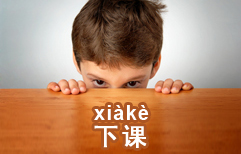
上车,下车 car上船,下船 boat, ship上山,下山 mountain上班,下班 office, work上课,下课 class, school上楼,下楼 floor上床,下床 bed
Please be noted that 上床 usually means "make love" in China, hehe. You can say 上/下 高速公路 (expressway).
kaixin_in_tampaAugust 5, 2009
Also, any other examples of shang4 and xia4 to "get on/off" something/somewhere? A non-native speaker once told me people shang4/xia4 gao1su4gong1lu4 (get on/off the highway), is that right? Any other frequent uses? Thanks!
kaixin_in_tampaAugust 5, 2009
Hi, so if we are talking about a TV show's episodes, do we use jie2? How would I say:
"I watched 2 episodes of Friends"
Thanks!
bababardwanAugust 5, 2009
jwhitson,
There are quite a few ways to pose a question in Chinese.I believe you are completely correct about the inflection here,but also the general exasperated tone of here voice was important.Once again context is also important I think.I struck this interesting concept you are raising some time back.I think the more you listen to [especially emotionally charged] dialogues,the more you get a feel for it.

jwhitsonAugust 5, 2009
Hey everyone,
This podcast actually made me wonder about asking questions in Chinese. I've learned that, in English, we raise our voices at the end of sentence to indicate a question even if we haven't used a question word such as "who." On the other hand, in Chinese words like "ma" and "ne" are used whenever asking questions and the voice is not raised (as this would change the tone of a word).
However, it appears that in this podcast the mother raises her voice and does not use a question word when she asks "wu3jie2?" I know it's second tone, but it still sounded slightly raised compared to the other speaker who was simply stating "wu3jie2."
Does this mean that in certain circumstances raising the voice without a question word is acceptable in Chinese, or am I just misinterpreting the situation?
Thanks!
ivor88August 5, 2009
The new exercises are certainly a lot easier to use than the old ones. I haven't really used them much before, but it was quite easy now.
I wasn't so keen on the change that means the audio review now covers the supplementary vocab as well as the key words, and the larger number of sentences covered. For me, one of the best things about ChinesePod is that I can listen to it on my ipod while I walk to work and don't have to make time to sit down and work through a textbook. Also it is a lot more entertaining and easy to listen to than most tools available. Having to work through the PDF or expansion exercises in order to do the audio review kind of undermines this. I also liked the old repetition of sentences - when I got the sentence wrong first time, I had the chance to learn from the mistake, rather than just moving onto a new sentence. Just my point of view, I don't know what others think.

francesAugust 5, 2009
I have a question about the measure word 节 jié with respect to television.
Jenny said that it could be used for segments of TV shows. Does that mean episodes, or viewing segments? (A one-hour TV show is usually shown as 4-6 segments with advertising in between.)
francesAugust 5, 2009
In my high school (in a rural part of New York State) every class was 44 minutes long, with 5 minutes in between classes. How weird is that? If a student's next class was not nearby they would need to hurry out of the room as soon as the bell rang and fight through the crowded halls to arrive on time. Students who were in less hurry might be able to speak briefly to the teachers. I like the idea of 15-minute breaks! Our five minute breaks were exhausting to both students and teachers.

cassielinAugust 5, 2009
xiaophil and bodawei,
You are right, every course takes two 45periods(an hour and forty-five) in the university.During the break, most of the teacher will choose to stay in the class and chat with the students. The topic might be related to the lessons and also not related. Teachers in the university have seldom chance to communicate with the students. Most of them don't live in the campus and they have to catch up the school bus after class. Some teachers often use the 15 minute break to keep on teaching. And some of the teachers will go to the retiring room 休息室(xiu1xi1shi4)and have a rest.

xiaophilAugust 5, 2009
bodawei
Ah, so there is the reason. I always thought 45 was a funny number. A little too short for one class. But then again, they usually come in twos.

bodaweiAugust 5, 2009
@xiaophil
I understand that the 45 minute class, 一节课, a Chinese teaching hour, is the result of hard-fought negotiation for teachers' working conditions. (I think that was one of my older teachers said.) The theory is that teachers have 15 minutes to 'prepare.' (If only that was possible.) My experience with various courses was that the teacher was always there for the 15 minutes non-teaching time, always willing to chat. But the teaching always began abruptly on the hour and stopped just as abruptly 45 minutes later, unless it was a 'double'. :-)

lujiaojieAugust 5, 2009
itouch1983:
節 can aslo be used for "classes". For example:今天我有两节中文课。jīntiān wǒ yǒu liǎng jié zhōngwén kè. "lesson 1" in your textbook is “第一课 dìyīkè”.
laura2001August 5, 2009
I like the way you changed the excercise at the end of the lesson. It is much more detailed. However, making us write the tone was a very good exercise. It forced me to review the tones.
itouch1983August 5, 2009
Hi Shenyajin,
Okay, got it :)
I have a question. I thought that 節 can only be used for "lessons" , rather than "classes". All I've ever heard is :
一堂課 and 一門課
helenshen_counselorAugust 4, 2009
@itouch1983, pls check your mail box and you'll understand! Thanks!
helenshen_counselorAugust 4, 2009
I got that, Xiaobao is 翘课ing, haha. His mother is mad at him. Poor boy!
@xiaophil, when I was a student, we called this an hour and fourt-five minutes' class "大课", and a "大课" is made up of two “小课”, and one 15 minutes' break in the middle.
xiaophilAugust 4, 2009
Thanks guys
I know this is getting detailed, but I am still unclear about something I wanted to say in the past, so I hope someone can clarify it. I taught at a university before, and the classes I taught were an hour and fourt-five minutes. However, the school considered this to be two 45 minute periods. How would I say 'two 45 minute periods'?

jennyzhuAugust 4, 2009
@xiaophil,
The measure word for a class as in a period is 节/jie2, which applies to also long classes lasting more than one period. Or you can also use 堂, 一堂课。It's exactly the same as 节。The measure word for a course (课程/ke4 cheng2) is 个。一个课程。
xiaophilAugust 4, 2009
Got a question
I forgot the measure words for classes. If I remember right, these three situations have different measure words, and sometimes more than one measure word can be used:
a class (节 jie2, right?)
a class period, i.e. some classes take up two, one hour periods
a course, e.g. "I signed up for a math course." (Maybe this is 名 ming2?)
Can somebody help out? Thanks.
Looks as if Xiao Bao has found some deep water.
What did you notice in this lesson?
You are posting as a guest. Your reply is reviewed before it appears. Log in to post without review.