
changyeJuly 19, 2009
Hi desluo919
My pleasure. Thank you for giving me the opportunities to look up in dictionaries. I love dictionaries very much.
risingdampJuly 19, 2009
Thanks again changye. Your responses are so useful, you should be working for Cpod.
changyeJuly 18, 2009
Hi desluo919
You are very right. You have to select a right measure word for 房 to make its meaning clear. 一间房 is "a room", but 一所房 (or 一座房) indicates "a house". Please be noted that the measure word "座" implies that the house is large.
Anyway, 房 is a rather confusing character, and this is the very reason that two-character words, such as 房子 and 房间, are mainly used in modern Mandarin. On the one hand, you can see a lot of one-character words in classical Chinese.
P/S. In the case of two-character words, you can use the measure word "个" both for 一个房间 (a room) and for 一个房子 (a house) without making their meanings unclear.
risingdampJuly 18, 2009
changye,
So, do I assume that in the sample sentence, we know a room is being spoken about only due to the measure word 间.
Could we have used a different measure word to make 房 mean 'house' ?
changyeJuly 18, 2009
hi desluo919
The character 房 means not only "house" but also "room". For example, the 房 in 厨房 (kitchen) and 书房 (a study) clearly means "room". On the other hand, the one in 房屋 and 房子 indicates "house".
risingdampJuly 18, 2009
Thanks for that Pete. However, I thought 房 by itself meant 'house', so I'm a little confused.

pearltowerpeteJuly 18, 2009
Hi desluo919
Good question. The expansion sentence is correct, because 间 can function as a measure word for rooms. This is an unusual looking sentence, though, as it includes the reverse of the common "房间."
risingdampJuly 17, 2009
In the 7th Expansion sentence, shouldn't
你住哪间房? Which room are you staying in?
instead read 你住在哪个房间?
Or am I missing something?
pearltowerpeteJune 28, 2009
Hi redbeard07
You are right that 了 and 吧 can both soften the tone and make a phrase more 好听. But we couldn't substitute 吧 in the sentences here. Only 了 will do.

redbeard07June 27, 2009
Thanks for your help pearltower!
In regard to your last comment about 了le softening the tone, is it similar to 吧ba in that regard?
pearltowerpeteJune 21, 2009
Howdy redbeard,
Thanks for an interesting question. The 了 in the dialogue implies that they don't have any standard rooms left. They used to have them, but they're all full. If the hotel just didn't have them, you would not need the 了.
However, as a cultural point, many people will be reluctant to tell you that they never were able to provide the good or service you are seeking. Many times I have asked a DVD salesman if he or she has a particular movie, only to hear 没了. It is very likely that they never did have the movie (or that the restaurant never did have that ingredient, etc.) but they think if you knew that, you might not come back.
Plus, sometimes 了 (or even 啦) is added just as a way of making the tone seem softer and less abrupt. I would say that's what's going on in the last sentence.

PurrfecdizzoMarch 30, 2010
People can say '没了‘ to indicate that they do not have something? I thought you always had to say '没有了‘.
redbeard07June 21, 2009
Howdy,
I was wondering why the 了le is at the end of 没有了。Is the the change of state 'le'? If so, why do we need it here? In restaurants I have had people tell me 没有,but they usually dont say the 'le'. I have the same question for the end of the dialogue: 只有这一间了。 Why do we need a 'le' here?

stevemischMay 29, 2009
Would be helpful if slightly less banter from Ken, and in this saved 30 seconds use a quick vocab review at the end like you've done with some lessons. The banter DOES make it more approachable, but if it was trimmed a bit your warm personalities would still make it inviting.
For example, details/specifics are useful--there was no explanation on why "ge" was used with standard room and "jian" was measure word with big bed room.
And just banging out the key vocab really cements it. Thank you.
weibwoMay 16, 2009
Jenny:
I stayed at the capsule hotels when they were first constructed. Unfortunately I suffer from claustrophobia a little and the experience was not good. I am not a small person and the capsule room wasa little small for me. I managed to stay the night but I never checked into another one. Message, if you are claustrophobic see the capsule first.
yuikocMay 15, 2009
Hello! I'm a college student studied in Shanghai . I'm now looking for a partner to help me improve my poor english . Of course , at the same time I can teach you the pure chinese as well.We can have a free talk once a week .Anything can be the topic.I believe it will be a good time.
If you are interested in my suggestion,please send me message and we can have a try.
I'm waiting for you .Sincerely!

bababardwanMay 12, 2009
suchan,
Thanks.Yeah,I had just found 单人 and 双人 on wikipedia ,but it doesn't seem to give anything for the larger sizes.Perhaps larger beds are a new luxury in China??
sushanMay 12, 2009
When I was getting sheets/bedding for my place, it was 单人 for a single bed、 双人 for a double、 and 大双 for a 'large double'. 大双 probably corresponds to queen size; it's not as big as king size. They also had measurements in cm. (And it was cheaper to get bedding custom made than buying sets.)
bababardwanMay 12, 2009
Pete,
Thanks for getting back to me on that one.I'm not surprised that they don't use King/Queen,etc,but I'm a little surprised that they don't have a name for different standard sizes and just describe in terms of feet.I presume the feet measurement refers to the width as most beds don't vary too much in their length.I wonder what the standard widths are,and whether they approximate the 5ft Queen and 6ft 4in King.

bodaweiMay 12, 2009
@fibberdie, light, barbs
Sorry I caused some discomfort over my 'reporting' of vann and his Mingtown Hiker recommendation (my weak attempt at being funny). It was a bit of a mixed message. I was feeling slightly overwhelmed with the volume of unecessary detail in the post (including the misleading 43 for a room - he means a bed in a dorm and it would be more like 50). And barbs yes I see little is served if you really like the place but in this case it is already in LP so the 'damage' is done.
And i have no inside knowledge on that hostel, I have never stayed there. If it is your first trip to SH it would be pretty easy to find..
pearltowerpeteMay 11, 2009
Hi bababardwan,
Connie and Jenny confirm that Chinese do not describe bed size in terms of royalty. They just say 几尺, how many feet.
bababardwanMay 11, 2009
So I note this 大床 refers to a large single bed [very funny scenario in this lesson btw..another great dialogue].So do Chinese hotels have equivalents of Queen and King Size beds [and if so are they the same dimensions?],and if so how do you say them?

alwingateMay 9, 2009
I must remember the 168 hotels in Shanghai. Not too gui4. But, I hope they are safe.
Jenny I really appreciate your work. I must say this in order to see the good things in my life.
Ken, you too. What a guiling Irishman ye be. Perhaps, your background...sorry, my background as a pirate in my family will earn me that Irish personality although I am not all Irish I have the Eng-Irish-Scottish split. Hey, my family had to move in order to be safe.
Enjoy.
alwingateMay 9, 2009
Wow. jonsg I think that 100 will not make this appear. Maybe 1000?
Anyway, just joking a little.
I enjoyed the lesson. Thank you Pod Dwarfs for mining the mysterious cavern of the Chinese language and bringing out hard earned gems to share with us.
Hi ho! Hi ho!

bababardwanMay 8, 2009
I think Bodawei is joking around mate,and wants to avoid LP syndrome ,as discussed here.

bababardwanMay 8, 2009
hehe,
Perhaps Bodawei doesn't want his secret bargain given away to all and thus booked out?

flibberdieMay 8, 2009
Bodawei,
I do not understand your objection. I see several comments on this discussion that recommend specific lodging places in Shanghai. What is it about van0000's post that offended you?
bodaweiMay 8, 2009
@van0000
Sorry, but I have to report you. There is no room for this kind of advertisement on ChinesePod - this is a worse offence than money laundering.
As the ad is up I feel obliged to point out that you have your facts wrong. Except the one about paying WAY WAY WAY too much for a bed in Shanghai.
vann0000May 8, 2009
My comment on the hotel prices..., You are way way way WAY WAY WAY! paying too much for a bed to sleep in Shanghai. On the corner of JIANGXI Road and BEIJING Road in Shanghai is a so-called "youth" Hostel. Rooms are clean, no televison, you share a bathroom and shower. IT is in a great area of Shanghai. It is On block from the Bund. You can go via SICHUANG Road or NANJING Road to the bund.It is called the MINGTOWN HIKER YOUTH Hostel. ANyone can use it. Age is not a requirement. IT's address is #450 Middle Jiangxi Road. 0086-21-6329-7889.It has free wireless internet. Rooms are 43 RMB per night. The beds include sheets and pillows. IT is clean and has washer facilities.I have spent a considerable amount of time at the fine hotels through China, but a youth hostel, especial in Shanghai, and for this price is really worth taking a look at. Check it out on the internet....http://www.hostelbookers.com/hostels/china/shanghai/7394/
travelgirl21May 8, 2009
Anthony 73
Thanks for you explanation on 呢. That totally helps and its great to understand how works!

antony73May 8, 2009
dunkerlumpen
I think so. It's like saying 'one pint' (pint being an English measure word, like loaf). For example, we don't always say what we want a pint of because it's obvious, a pint of milk or one pint of beer. I think the 间 is used in the same way in your sentence, one room.
dunderklumpenMay 8, 2009
Thanks antony73. That makes sense.
Here's one more "question"...
不好意思,只有这一间了。Buhaoyisi, zhiyou zhe yi jian le.I guess the 间 functions as a measure word here. Somewhat like the 个 in 这一个 zhe yi ge (this one).
antony73May 8, 2009
dunkerklumpen
I think 呢 it's a softer form of a question, like you say a suggestion, but for something already under consideration.
So in the sentence in this lesson it suggests: What do you have to say on the subject of staying here, staying here being the subject already under discussion.
Example:
你好吗? nǐhǎo ma ?How are you?
我好。你呢?wǒ hǎo, nǐ ne? I'm fine, and you?
The 呢 in this dialogue is responding to the 你好吗. The person probably wouldn't reply, 我好,你好吗 because asking about welfare is already under discussion.
Not sure if this helps. Check out this lesson:
https://chinesepod.com/lessons/dont-underestimate-the-power-of-%E5%91%A2-ne
dunderklumpenMay 8, 2009
Hi light487
try copy/paste 只有 into the search field and expand the search. Tick the "Lesson Dialogue & Vocabulary" box and go. You'll have a lot of hits. I noticed the results deal with zhi3you3 and zhi3yao4.
jaymMay 8, 2009
FWIW, hotels in China are taking a beating in this economy, with occupancy rates in the 20%-30% range. I live in Beijing and visit Shanghai about one per month. I generally stay at the Westin Bund Center (nice place). But I am finding that a call in advance to hotel managers can result in impressive discounts off of published rates, even (maybe especially) at the 5-star properties.
pearltowerpeteMay 8, 2009
Hi jonjar1979
Thanks for a good question. There are slight differences in meaning.
你說呢 implies “please give me your suggestions or advice."
你决定吧 means "go ahead and make the decision."

lujiaojieMay 8, 2009
waitingroom:
X bed dorm 可以说:
单人间 dānrén jiān 双人间 shuāngrén jiān
三人间 sānrén jiān
security locker:寄存柜 jìcún guì
changyeMay 8, 2009
Hi heimama
I hear that the word 酒店 (as a hotel) began to be used in Hong Kong first and was later exported to mainland. There is another "confusing" word that indicates a hotel, "饭店" (fan4 dian4). It seems that 酒 and 饭 are very important for Chinese people when they stay at a hotel, as pete pointed out. For the record, both 酒店 and 饭店 usually indicate luxury hotels, even if the "luxury" is based on self-rating by a hotel owner.
pearltowerpeteMay 7, 2009
Hi heimama,
啤酒 came to China only very recently (about a hundred years ago.) But the Chinese have thousands of years of drinking culture.
Like in many other countries, the earliest hotels were more like taverns (酒肆 jiǔsì, 酒樓 jiǔlóu). You could be sure to get some booze to warm you up.
heimamaMay 7, 2009
Why is it that the word for hotel has 酒 in it? Is there some historical connection between 啤酒 pi2jiu3 beer/alcohol and 酒店?

helenshen_counselorMay 7, 2009
Hi pinkjeans
入住时间 check-in time
退房 check-out
You're right! Cheers! :)

pinkjeansMay 7, 2009
In the PDF Supplementary Vocab, would the translation for 入住时间 be check-in time and 退房 be check-out? Just want someone to confirm that I haven't misunderstood the rather wordy explanation.
travelgirl21May 7, 2009
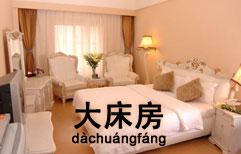
Great lesson like always! It made me think of a time in Taiwan when 5 of us girls shared 一间大床房! It was hilarious.
If you just said 你说 would it still get the point across? Like you say or you decide. What does the 呢 suggest? Thanks , Britta
waitingroomMay 7, 2009
大家好,有人能告诉我"X bed dorm"和"security locker"中文怎么说?
[Hi everyone, can anyone tell me how to say "x bed dorm" and "security locker"?]
@jonjar Yes, I'm pretty sure 你决定(吧) works in this context.
jonjar1979May 7, 2009
hi, thanks for the lesson
one question;
at the end of the dialouge his friend says 你说呢
would 你决定 nǐ juédìng also work in this situation?
bodaweiMay 7, 2009
@lwelsh
there is usually a wealth of choice on price - if you want some luxury (as Jenny says) the hotels that are not international chains offer better value
you can use guidebooks (eg. LP) to book ahead
OR once you have stayed somewhere they will usually help you book at the next place you want to go to
OR you can arrive without plans and let yourself be whisked around by one of the innumerable touts at stations etc. who make a living taking a commission on your room rate. A little risky, particularly on price.
OR (if you have time) you can go to the neighbourhood of your choice and just look out for accommodation signs.
light487May 7, 2009
This is the sentence that holds the most value for me:
我们现在只有一间大床房。
wǒmen xiànzài zhǐ yǒu yī jiān dàchuángfáng.
We only have a room with a big single bed.
The reason is that it has a lot of "stuff" that I normally have trouble with when trying to form my own sentences. All the pieces themselves are fine and I understand them and the way they work in the sentence. What I have trouble with is the order of the words when I try to make my own sentences, and also I would have trouble with 一间大床房 simply because I would likely end up reversing the order and having a 的 in there. I also have trouble with where to put 现在 and 我们 (or other subjects) in the sentence.
Is there any other lessons that use this type of "only have" language or can someone provide further examples of it or explain the ordering rules etc?
On the topic of hostels/hotels:I stayed in a decent hostel called "Shanghai City Central International Youth Hostel". Here is their website:
http://www.hostelshanghai.cn/ (opens in new window)
The rooms are clean and affordable with a few different options available. They also give a free breakfast every morning plus many other extras.

lwelshMay 7, 2009
Is it pretty easy to find hotels/hostels in smaller cities? What would the price difference be (approx)?
mikenotinjubeiMay 7, 2009
A Question on 兒's, I lived in Taiwan for two years and before that in the Boston area for over 25 years, so my normally tin ear of course hears the hard "兒" of a Beijinger and the lack of "r's" from a "Southie" in the old Beantown. As an example: it is the Boston Gahden. However; even if Bostonian's have their own pronunciations as do many other parts of the US, or as various parts of Britain have distinctive speech dialects, nobody changes the way we write it. Perhaps having lived in Taiwan I just never like seeing 這兒 instead of just 這 or ok 这
When did the addition of "兒" become a proper way of writing? Is this a Mao era development? If one were to get a novel from the 20's written by a Beijing writer would this be found in their writing? I don't ever recall seeing this character used this way when looking at old calligraphy.

jennyzhuMay 7, 2009
evasiege,
Go to this page https://chinesepod.com/contact
Our customer service colleagues will help you do it. Must be an unsettling yet refreshing experience to live without computer for a while.
You can go to 'help' section at the bottom of this page for customer support.
chrisyuMay 7, 2009
Hi evasiege,
Should you have any questions, please contact us at:support@praxislanguage.com
Regards,
Chris

cjhawk7May 6, 2009
Trying to cancel my subscription before I get charged and until I can get my other computer up and running again, but I don't see the option anywhere under the subscriptions page. Any ideas?
changyeMay 6, 2009
Hi Jenny
The rates for capsule hotels (胶囊酒店, jiao1nang2jiu3dian4) in Japan are around 3,000~4,000 Japanese Yen (200/270RMB). The hotels are very convenient and "futuristic".
basilio00May 6, 2009
I have learnt a new way of saying "sorry!" bu4 hao3 yisi1. And the explanation of this is on page 381 of Ross and Ma's wonderful Modern Mandarin Chinese Grammar: A Practical Guide that I always have within easy reach!
Thank you!
changyeMay 6, 2009
What a coincidence! I've just booked rooms (单人间, single room) as I'm going back to Japan next week (and coming back to China at the end of this month). The rate is 160RMB, and the hotel is very close to the airport.
jennyzhuMay 6, 2009
A number of visiting Poddies have asked us for accommodation advice in Shanghai. Since we are on the subject today, I will make some suggestions.
Reliable budget hotels:
1. Motel 168. It has a massive number of outlets in Shanghai, all conveniently located. As the number suggests, rates are around RMB168, very cheap in a place like Shanghai. Clean rooms and safe. If you want something a bit fancier, the chain also operates a number of Motel 268 in town.
2. Home Inn, a chain similar to Motel 168 at roughly the same price point.
Pricier options:
The big name 5 star hotels can set you back up to RMB 2500 per night. But some locally owned luxury hotels are a good bargain costing around RMB500-600 per night.
Boutique hotels:
There are a few in the French Concession, almost all in old European style houses built in the 20's and 30's. They are pricey though.
Room with a view (and affordable):
I have recommended this hotel to many people. It is the PuJiang Hotel at the tip of the Bund, near the Russian Consulate. Charles Chaplin stayed here during his visit. It is state-owned now, making them cheaper than international chains. They have renovated the rooms 2 years ago. The rates are around RMB600.

bendidelaowaiMay 6, 2009
@miantiao, thanks for an interesting point, I have never thought about it:))
jennyzhuMay 6, 2009
Miantiao,
Well explained re 预定 and 预订. I wonder if the majority of native speakers know the distinction.

miantiaoMay 6, 2009
@joeborn
预定和预订 are interchangeable in some contexts, but are not entirely interchangeable.
定和订声调一样(同音词).both have the same tone.
although the meaning is different the concept is similar.
预定 means to make prior arrangements or to schedule.
预订 means to book, place an order.
joebornMay 6, 2009
Are 预定 and 预订 interchangeable? I've seen the former, too, defined as "place a reservation."

jhfjhkjMay 6, 2009
大家好,very useful lesson. A small hint: in the expansion the text has a bug and reads 你住这间大的, 我住那小间的 instead of 你住这间大的,我住那间小的.
Thanks


What did you notice in this lesson?
You are posting as a guest. Your reply is reviewed before it appears. Log in to post without review.