gracechen7874June 22, 2019
In China, if you need to go through the secuirity machine checking, you need to drink a bit for your liquid that you are taking.

netcadet7September 30, 2010
Hi Amanda:
This is the first time I have linked to the lessons directly from the interface, so I didn't know there was a private email interface. Pretty cool!
-Michele
giles123May 1, 2010
How do you say 'calm down' to an angry person, for example in a bar on the football pitch? Is it 慢走?
jiangcheng1985May 1, 2010
O(∩_∩)O哈哈~
慢走 means "take care!" ,especially used when you want to say goodbye to someone you had a good time with,say,a dinner.
If you want to express certain feeling of "calm down" to angry persons,you may say "冷静点" or"别急"or"不要激动"
冷静点 is commonly used.
jiangcheng1985112@hotmail.com Feel free to ask anything related with your Chinese learning

chrisOctober 7, 2009
I agree with Baba and usr260809 above - the "nǐ gǎo cuò le" is definitely omitted from the spoken dialogue, which is a pity given John and Jenny specifically discussed this structure in the lesson banter!
Chris
usr260809August 31, 2009
"你搞錯了!我不是!" is in the text,
but not spoken in the dialogue,
should removed from text script.
No quality checks??

njalsJune 3, 2009
With regard to occbill's and pretzellogic's (still unanswered??) questions, getting a frequent flier card and making sure to get miles for a flight might be an interesting topic for a dialog...

pearltowerpeteJanuary 28, 2009
Hi keithk
Thanks for asking a tricky question. You are right, the "是“ has been left out here. The full sentence might go "这是我自己要吃的." These kinds of changes are pretty common in spoken Chinese.
keithkJanuary 28, 2009
In this sentence:
我自己吃的。
What is the significance of the de?
Is it a shi-de pattern with no shi? Or is it a noun phrase with the noun missing? I've seen this pattern before, e.g.
谁让你买的?
Is that the same?
Thanks

JohnJanuary 20, 2009
suxiaoya,
Looks like Jiaojie answered your question. A lot of would-be objects of 把 can be topicalized, allowing you to drop the 把, but often at the expense of clarity. For that reason, it's more common in speech, where the speaker's full situation tends to give more context.

lujiaojieJanuary 20, 2009
suxiaoya:
“把包放在上面”也可以。
“包放在上面” 和 “把包放在上面” are different sentence patterns. They have the same meaning.
suxiaoyaJanuary 20, 2009
lujiaojie
Thanks so much for your helpful examples :-)
I am just wondering why we don't use 把 ba3 in front of this sentence:
包放在上面 bao fang zai shangmian
or other 'topic, comment' phrases that John mentioned. What's the difference? Sorry if I'm just being slow to understand this!
lujiaojieJanuary 19, 2009
suxiaoya:
1 When we express that how to deal with certain thing, we can use "把" sentence to emphasis on it, For example:
把东西给我吧。 Bǎ dōngxi gěi wǒ ba. Please give me that thing.
2 When we want to realize certain purpose. If we need to deal with something to realize it, then we can use "把"sentence. For example:
太热了,把空调打开吧。Tàirèle, bǎ kōngtiáo dǎkāi ba.
It's too hot. Please turn on the air conditioner.
你把声音开大一点 Nǐ bǎ shēngyīn kāidà yīdiǎnr.
Please turn up the volume a bit.
3 If we want to illustrate something appeared in the above context, which is being dealt with or has been dealt with, we can use this kind of sentence. And we introduce the concerned thing as a small topic. For example:
我买了一件衣服,但是有点儿小,我打算把它送给妹妹。 wǒ mǎi le yījiàn yīfu, dànshì yǒudiǎnr xiǎo, wǒ dǎsuàn bǎ tā sòng gěi mèimei.
I bought a piece of clothing, but it's a little small. I'm planning to give it to my little sister.
suxiaoyaJanuary 19, 2009
John, thanks for the useful explanation of 'topic, comment' phrases.
I just wonder where 把 ba3 fits into all this? Where/why would you choose to use it?
I understood that it would be used to link the noun/topic with the verb/comment, as below:
你把声音开大一点
ni ba shengyin kai da yidianr.
Do you have to use ba here?
everettJanuary 19, 2009
This actually happened to me last year. They had seen a half-full bottle on the x-ray of my luggage, and asked me to open it and show them. It was homemade camphor medicine you're supposed to drip in your nose – with no label on it – and I said it was "yao". They seemed suspicious till I drank a sip. Then they laughed and said okay. So I guess I got off easy compared to the guy in the dialogue.
crandlesJanuary 19, 2009
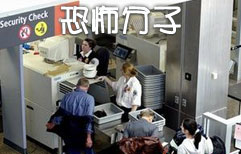
恐怖分子 was an old word for me. I used to live in Taiwan in the 1990s. The first Gulf War started soon after I moved there and, I guess, because I had a beard that reminded them of a Middle-Easterner, the Taibei police would often stop me and demand ID. This went on for about six months, but I will always remember hearing them mutter 恐怖分子。

pearltowerpeteJanuary 18, 2009
Hi calicartel
I think the white powder in the lesson raised concerns about an anthrax (炭疽 tan4ju1) attack.
And I agree, in my experience, the Chinese security system is remarkably laid-back compared to many in the West.

calicartelJanuary 18, 2009
A white powder would be more likely to raise suspicions of drug smuggling in my opinion, but it's a good lesson all the same. I've found Chinese security and passport controls to be very reasonable, not at all oriented towards hassling passengers or getting them into jail.


bababardwanJanuary 17, 2009
baiwenkai,
Actually,I was just being lazy on this occasion.I copied and pasted that sentence from the expansion examples [and when you do that you get the rollovers as in this case.I don't know how to add them myself...but would be glad if anyone told me how to do it ].I liked that sentence so much and it reminded me of superheros [I'm sure I've specifically heard some superhero say it but I couldn't quite recall exactly which one...anyone have any ideas on this?] so I thought I'd post it.
matthiaskJanuary 17, 2009
I took red bean paste in my hand luggage. Gave a bad time to the security officer, luckily, it was enough time, so I could check in my hand luggage as regular luggage. Would have been a pity for the 5kg I bought :)
baiwenkaiJanuary 17, 2009
Dear bababardwan, I like your Hanzi. A flick of the mouse and I don't have to think too hard. Great!

henningJanuary 16, 2009
Bill,除了可纳市(Kona)国际机场意外旅游过的很顺利。我们在旧金山待了半天走来走去 ,在渔人码头吃了早饭。 我们去什么地方就在什地方遇到了从大岛而来的德国同事。
bababardwanJanuary 16, 2009
Maybe there was a glitch when I downloaded this lesson,but the ni gao cuo le 你搞错了 in the last line didn't seem to come out in the podcast dialogue.Did anyone else get this problem?
John,
Great explanation of "topic comment sentence".I find it also really helps breaking down these sentences as you're listening into little chunks such as is done in the topic then comment.
Definitely one of my favourite lessons.I enjoyed the exaggerated drama and you could just imagine the poor guys stress levels rising,climaxing with the announcement.I agree with pretzylogics comment about things going wrong...and it seemed to be going smoothly at the start.Ah yes,another great dialogue.Reminds of the importance of a docs letter to cover your meds just in case.Yeah,probably a very easy intermediate,but it's nice to have these encouraging little lifelines for ellies to get a toe in to a higher level.Obviously CPod is cleverly catering not for 6 strictly defined levels,but every shade of grey between.谢谢CPod.
kanjihanziJanuary 16, 2009
>> to express person aswell, such as 者(zhe)
Yes, I know. I've studied Japanese for almost 10 years, OK on and off very much. What surprised me here was the use of
子 in 分子. I hadn't seen this character in more that "things-words", apart from son/child/daughter etc. of course. According to my dictionary 分子also means numerator and molecule, but then pronounced fēnzǐ. 1:st tone, instead of 4:th. (And 电子 is electron.)
BTW: I find zi and ci the most difficult sounds in Mandarin to differentiate when speaking. OK, listening is perhaps even more difficult.

billJanuary 15, 2009
Hi Henning,
We were wondering about how your 30 hour trip 从夏威夷 to home went. Great to have met you and your wife too!
John,
Maybe I was still a little jet lagged and not up for airport humor. 最近过多机场!
I did enjoy the lesson today (-:
Bill
xuchenJanuary 15, 2009
Kanji hanzi, If you do some more searching you'll see other ways to express person aswell, such as 者(zhe)
记者 - reporter 老者 - Old person
binggeJanuary 15, 2009
Wow, speaking of airplanes - an A320 just crashed on the Hudson Bay after taking off from LaGuardia. Double engine failure (?) but all the passengers and crew have survived!!
kanjihanziJanuary 15, 2009
Oh no! I forgot the Do Not Paste From Word:
到处都是恐怖分子! – Terrorists everywhere!
It's such an interesting combination of Hanzi in kǒngbù fènzǐ that I thought it worthy of a tiny little essay :-) But isn't the 子 ending a bit strange? I would have guessed that 人 would be the first choice when talking about a person?
Better
irekJanuary 15, 2009
Here are some more 'fènzǐ' words I found with MDBG
武装分子 wǔzhuāng fènzǐ gunmen
颠覆分子 diānfù fènzǐ saboteur
积极分子 jījí fènzǐ enthusiasts/zealots
异议分子 yìyì fènzǐ dissidents
激进分子 jījìn fènzǐ radicals/extremists
活跃分子 huóyuè fènzǐ activists
纳粹分子 nàcuì fènzǐ Nazis
反革命分子 fǎngémìng fènzǐ counter-revolutionaries
激进武装分子jījìn wǔzhuāng fènzǐ armed extremists
kanjihanziJanuary 15, 2009
Is this correct?
<!-- /* Font Definitions */ @font-face {font-family:汉鼎简中楷; panose-1:2 1 6 9 1 1 1 1 1 1; mso-font-charset:134; mso-generic-font-family:modern; mso-font-pitch:fixed; mso-font-signature:1 135135232 16 0 262144 0;} @font-face {font-family:"\@汉鼎简中楷"; panose-1:2 1 6 9 1 1 1 1 1 1; mso-font-charset:134; mso-generic-font-family:modern; mso-font-pitch:fixed; mso-font-signature:1 135135232 16 0 262144 0;} /* Style Definitions */ p.MsoNormal, li.MsoNormal, div.MsoNormal {mso-style-parent:""; margin:0cm; margin-bottom:.0001pt; mso-pagination:widow-orphan; font-size:36.0pt; font-family:"Times New Roman"; mso-fareast-font-family:汉鼎简中楷; color:maroon;} @page Section1 {size:612.0pt 792.0pt; margin:70.85pt 70.85pt 70.85pt 70.85pt; mso-header-margin:36.0pt; mso-footer-margin:36.0pt; mso-paper-source:0;} div.Section1 {page:Section1;} --> 到处都是恐怖分子! – Terrorists everywhere!
It's such an interesting combination of Hanzi in kǒngbù fènzǐ that I thought it worthy of a tiny little essay :-) But isn't the 子 ending a bit strange? I would have guessed that 人 would be the first choice when talking about a person?

richJanuary 15, 2009
Hi Changye...will you take my pitbull on the plane with you? Gotta first, uh, go grab some lunch... Sorry the latch of the carrier is kind of broken...ok, bye...
bababardwanJanuary 15, 2009
Henning,
ouch.Great story and very typical I'd say.Some can't think outside the box/suitcase.That was going to make things complicated.There was only a minor fuss when security was stepped up here to include frisking international travellers a couple of years ago as shown in the article here.It wouldn't worry me overly but I would be pretty unimpressed if they tried that on one of my daughters.Our personal freedoms are being eroded without too much protest as far as I can see.
Great captions Rich.

changyeJanuary 15, 2009
This dialogue is not a joke. You have to be careful not to accept things that a stranger tries to consign to you at airport.
richJanuary 15, 2009
I think though through the years I have losts my sports水平 too...ha ha... (level of atheletics...should go swim more)
Is 运动水瓶 even a word, or am I even saying that one right? Probably don't bother putting 运动 with it.
richJanuary 15, 2009
yes, 水瓶, wasn't paying attention.... sorry for that.
and looks like biqi in the post before me had the intelligent-typing-program problem too...should be 网络...unless "trap" was the intent (yet in mine, 网络 come before 网罗)
glad you all liked the captions,pictures, etc....I miss the audience we all have at ChinesePod... and being creative with this crazy culture differences we can share.
I still like my Ken "deplane deplane" line best though, and now really want to hear him say it....


wxgcathyJanuary 15, 2009
Hi Rich
你写的太有意思了。
1 I think John's looking at planes, thinking how he could terrorize them.
2John, hard at work eating, with the new guy doing all the work
3Two Dwarfs and the Beanstalk Giant
lol

pinkjeansJanuary 15, 2009
@ rich, do you mean 水瓶? Got to be careful with that intelligent text typing. LOL.
@ john, same thing happened to my better half; he accidentally left a Swiss knife that had a great deal of sentimental value attached in a pocket of his bag. But luck had it that the security officer was kind and there was a post office just next to the entrance. He was allowed to go back out and send his knife home.
richJanuary 15, 2009
I just keep accidently losing my sports 水平 because I keep forgetting to empty out the 水. That was in China, in the summer, when it was hot on my travels to 厦门 and 南京, but fortunately those 瓶子 are not too expensive at your Chinese supermarket (but now, from my 妈妈, I heard made with the wrong kind of plastic, go fig...don't use bottles with the plastic #s 3, 6, or 7...or if no #...which they were...stop terrorizing me China!), but then when I went back to America, and I was sick with a very sore throat and cough, I had FINALLY managed to get an 空的水平 through security, which is ok, but then after filling it up in the terminal, I had it in my pocket when boarding the plane and they saw it, and took it away from me. *哭哭* I tried to fight that it is okay to bring 水 I had filled up past security, but no, they wouldn't let me.... oh, but they did let me drink as much as I could before giving them the 瓶子...they must love watching travellers chug water.(how do you say chug in Chinese?)
Rich - the guy who's hardly around any more
but hey, I did manage to vist ChinesePod last month!
Click on the pic for more pictures of inside Praxis, this one taken on the deck outside: https://picasaweb.google.com/richmahn/2008120410_Shanghai
(I think John's looking at planes, thinking how he could terrorize them...can't believe I dared to fly back to 天津 that very same day...)
Ken, in his Tatoo/Irish accent: deplane! deplane!

chanelle77January 15, 2009
My experiences in China are quite good (incredibly fast through customs and they even helped me with a big suitcase). When I travelled with friends their lighters passed security twice. Unfortunately, I had to give op my 25 Euro hand cream. Still think lighters are more dangerous. I begged the security lady to use it herself its too good to throw away. In retrospect: maybe that is exactly what she wanted. Last summer I brought back home 2 big Chinese kitchen knifes in my luggage without any hassle :-). Makes a great gift.
henningJanuary 15, 2009
Bill,on our flight back - at that gigantic airport where most buildings do not even have walls - the security checks were terrible.
And of course my wife was called out for an additional screeing (oh, the fun of traveling with a Chinese passport).
Security guy: "Are those two bags yours or hers?"
I: "Ours."
Security guy: "That is not what I asked! Are those yours or hers?".
I: "They belong to both of us. We travel together."
Security guy: "I want to know who those bags belong to. Are those your or her belongings?".
I: "Both bags are mixed with my and her stuff".
Security guy: "I need to know who's bags those are!".
I: "OK - in this bag you see two sweaters. One is mine, one belongs to my wife. Two coats. One for my wife, one for me,..."
Security guy: "OK. The first bag is yours, the second belongs to her!".
Whatever!
BTW: It was great meeting you! Thanks again!
JohnJanuary 15, 2009
bill,
Yes, it's definitely an exaggeration. Exeggeration for the sake of entertainment, entertainment for the sake of education!
billJanuary 15, 2009
Interesting lesson but exagerated with respect to being called a terrorist. The word is never used publically in airports from what I know. If an individual is really supected of such a thing, then they are taken aside for questioning.
Suspicious medicine may be confiscated, and that is rare. But, there are garbage bags full of illegal items at the end of security lines.
Things may be different in mainland China. I'm not sure. I've made over 40 international flights ... Most hassles are with visas, and this can be really tough.
Bill
JohnJanuary 15, 2009
I once had to leave a pocket knife behind in a security check in China. I left it in my bag by accident. (I loved that pocket knife...)
Fortunately I wasn't accused of being a terrorist. 我不是恐怖分子!
matt_cJanuary 15, 2009
Awesome!!! Loving that you guys are happy with this. Thanks to Jiaojie, Zhangfeng, Connie and Linhui for the great voice acting, and to Joy and David for their efforts in the editing suite.
I always get in trouble for having lighters in my bag at the airport - I can bring two in my pocket from Australia, but once in China I can't take them anywhere. That reminds me of my exit from Beijing two days after the Olympics had finished and I had a Zippo in my suitcase...

shanghaichangesJanuary 14, 2009
I'm so happy, I can understand everything in this lesson. Yes, I'm actually getting better at Chinese. The system works!

pretzellogicJanuary 14, 2009
Oh, now that Air China is part of the Star Alliance, how do you say, "my frequent flyer number is....?"
pearltowerpeteJanuary 14, 2009
Hi patmetheny and biewangji
So glad you enjoyed it. Real life is messy, and we hope we can do our small part to help you boldly meet the challenges!
pretzellogicJanuary 14, 2009
I like it that cpod has these lessons of ordinary experience where everything doesn't go ok. Other language programs might give a scenario where you go through the security line, and everything's ok. On the other hand, cpod could have tried to turn this into a comedy of errors. Or have an experienced frequent flyer in a hurry, stuck behind an family of 5 traveling for the first time in an airplane.
biewangjiJanuary 14, 2009
Another brilliant lesson. Looks like the 恐怖分子嫌疑人 wasn't particularly successful at "explaining away that bottle of white powder", though...
Whose handwriting is that in the lesson picture? ;)
What did you notice in this lesson?
You are posting as a guest. Your reply is reviewed before it appears. Log in to post without review.