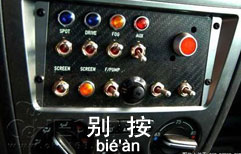

yingxiongDecember 6, 2009
I agree this lesson is one of my favorites I also like the Newbie one about the Door

everettFebruary 22, 2009
The expansion has:
你按了哪个键?
(Did you hit that key?)
Shouldn't the translation be "Which key did you hit?"

bababardwanFebruary 15, 2009
I meant to say that I loved the drama of this lesson.Impressive that you can make such a simple skit so dramatic.Keep pushing those buttons and boldly go where no man has gone before.Jiayou.
bababardwanFebruary 15, 2009
pinkjeans,
Thanks for pointing out and explaining the difference between zhei and zhe etc.I had wondered about that as well.
10 creepiest things you wanted to touch.

christofJanuary 26, 2009
Hi tommasoshanghai,
Of course ItalianPod invented the "Red button" dialogue ! Or maybe they copied FrenchPod, that published the First amazingly intense Explosion dialogue 3 weeks earlier ...
So dear Italian friends, what's the next step ? You gonna claim that Mona Lisa is yours ?

connieJanuary 18, 2009
Hi billgloveruk,
"背" is a 多音字,has two pronunciations as in your list.
In the expansion sentence "我的背很痛,能帮我按一下吗?", it should be "bèi ", means "back".
Thank you for pointing that out. Fixed now.
谢谢你!

billgloverJanuary 18, 2009
Just a quick question about the tones on 背 (back) in the expansion exercises.
In the expansion exercise this is written with the first tone, bēi. I was wondering whether this should be fourth tone, bèi.
背 bèi learn by heart; the back of the body
背 bēi to be burdened; to carry on the back or shoulder
背 bēi carry on one's back
manenJanuary 11, 2009
This lesson was hilarious! Ken, you didn't need to spend so much time justifying it. I totally agree that silly dialogues can help enforce language just as much as "practical" dialogues, because they stick in your mind. Good work!

dunderklumpenJanuary 7, 2009
Hi pete
Thanks for the reply!
Summary:这是给你买的。zhe4 shi4 gei3 ni3 mai3 de5 This was bought for you.这是被你买的。 zhe4 shi4 bei4 ni3 mai3 de5 This was bought by you.Audio: gei, bei

pearltowerpeteJanuary 6, 2009
Hi dunderklumpen
Good question. You're right, and I have corrected the sentence.
If you wanted to say "This was bought by you," you would say "这是被你买的."
给 can indeed be used in passive constructions, but it is a little beyond the scope of this discussion.

dunderklumpenJanuary 6, 2009
Many thanks, lujiaojie
这是给你买的。This was bought by you (emphasizes the object)
(The object is "you", right?)
Apparently I'm not too familiar with 给. I thought this would mean "This was bought for you" (给 gei3 to, for, give). But then I looked it up and found 给 ji3 can also mean to supply or provide. Hence "This was bought by you" I guess. So, how would one say "This was bought for you" in chinese?
tommasoshanghaiJanuary 6, 2009
If you guys copy italian's pod dialogues than you shouldn't say that you invented it!
I remember exactly that me and Marco we wrote a dialogue about a red botton and an explosion!
我要批评你们俩!哈哈!
Nice work guys I always listen to chinesepod.com even if I'm suppose to work...

lujiaojieJanuary 5, 2009
dunderklumpen:
The "是...的” pattern is generally used to describe things that happened in the past. It emphasizes the time, place, method, goal, agent, or object of the action
For example:
我是三月来的。I came during March (emphasizes time)我是从美国来的。I came from America (emphasizes place)我是坐飞机来的。I came on an airplane (emphasizes method)我是来学汉语的。I came to study Chinese (emphasizes goal)水果是我买的。I bought the fruit (emphasizes agent)这是给你买的。This was bought for you (emphasizes the object)
These sentences below are not " 是......的”pattern.
The person who is looking for miss Wang is very tall.Your sentence "zhao3 wang2 tai4tai de ren2 hen3 gao1. "is right.This sentence can not be built in another way.If someone asks: 哪辆车是他的?You can answer: 他的是大的。If someone asks: 谁的车大?or 你的车大还是他的车大?You can answer: 他的大。
jerrybriantJanuary 5, 2009
hi,glad to meet you all of you.I am jerry from china.if you want to join me.please contact me.my e-mail address is jerry_translator@hotmail.com we can learn each other.

danni42January 5, 2009
I love this audio drama style of lesson! Thanks so much for making it. More please!
dunderklumpenJanuary 5, 2009
Thanks john.
Hi mikeinwshot
For some reason I am unable to edit my previous comment.
That happends to me too.
Hi pete, chris, Wande, Chiongzibide
So the point isn't so much to emphasize the adjective (as in a 是...的 sentence) as to simply describe the noun.
I'm not really sure when to use the shi...de... pattern.
E.g.
The person who is looking for miss Wang is very tall.zhao3 wang2 tai4tai de ren2 hen3 gao1.
Is this a use of the epmhasizing function of shi...de... or is it just that this sentence can not be built in an other way?
One more example: let's say we are talking about cars and I want to say "his is big". This could be ta1 de da4, rigth? (No shi4 needed since chinese adjectives sort of include the "is".) ta1 de shi4 da4 de is also OK, right? Now, is that to use the epmhasizing function or is it just a short form of ta1 de shi4 da4 de che1? We need shi4 here since da4 de che1 is not an adjective but rather a noun(?)
Sorry, this post is a mess and my question is not crystal-clear :/

mikeinewshotJanuary 5, 2009
For some reason I am unable to edit my previous comment. I wanted to remove the bit about navigation, as I can now see how to do it with the pane on the bottom right
mikeinewshotJanuary 5, 2009
John
Thank you for the link to the Pronunciation guide and more specifically to the 'yuan' explanation.
The reason I did not find it before is that when I go to the pronunciation tab, I can see no way of navigating to other pages, so I did not realise they existed. Likewise, how do you navigate from the yuan page to anywhere else?
It could be my stupidity however!
(So you seem to say that yuan is really pronouned more like English yuen not yuan - my hearing seems to put it somewhere on the spectrum of yuan to yuen)
pearltowerpeteJanuary 4, 2009
Hi chris,
You're right. In this sentence and others like it, some noun (usually 东西 dong1xi1 thing) has been omitted. So the point isn't so much to emphasize the adjective (as in a 是...的 sentence) as to simply describe the noun.
Thanks for helping out your fellow poddies!

JohnJanuary 4, 2009
mikeinewshot, chiongzibide, dunderklumpen:
We cover all these pronunciation issues at length in our Pronunciation Guide. You can download a chart which contains all possible syllables, and you can read specifically about yuan. If all the explanation is too much, scroll down to the audio.

chrisJanuary 4, 2009
Wande, Chiongzibide,
I was also thinking about that Expansion sentence. I don't actually think it's an example of the "shi.....de" construction. I actually think it is an example of the object following the "de" being omitted, since the "de" itself makes it redundant. By this, I mean that the word "shape" has been omitted from the sentence, i.e. a fuller translation would be:
"Is Earth a round (shape)?".
Would appreciate any clarification from CPod team or native speakers though!
Thanks, Chris
lujiaojieJanuary 4, 2009
dedlam:
changye is right.
When 这/那/哪+measure word
or 这/那/哪+numeral+measure word,
we often say zhèi/nèi.
For example:
这个 zhèige
这边 zhèibiān
这样zhèiyàng
那些 nèixiē
那样 nèiyàng
这几个人zhèi jǐge rén
哪个 něige

changyeJanuary 4, 2009
Hi jenny,
Gee, it's too late, but I should have posted the comment after your posting! Incidentally, is it also OK to say "那里" (nei4 li3) and "那么" (nei4 me)? I'm rather confusing. And may I have any other examples that can be pronounced "nei" ?

jennyzhuJanuary 4, 2009
dedlam,
There is no fixed rule regarding the usage of na3 and nei3. You can pretty much use either in most cases.
Keep your comments coming!
changyeJanuary 4, 2009
Hi dedlam,
That's a good question. I was just thinking the same thing. Let me tell you my tentative answer. As you already know, 这 (zhei4), 那 (nei4) and 哪 (nei3) are all shortened forms of 这一 (zhe4 yi1), 那一 (na4 yi1) and 哪一 (na3 yi1) respectively.
By the same token, for example, 那些/那边 can be also pronounced as "nei4 xie1/nei4 bian1", because these words are originally 那一些/那一边. However there is no such word as 那一里, and that is the reason it only has the pronunciation "na4 li3".
dedlamJanuary 4, 2009
Hi folks.
My first ever comment on ChinesePod is Happy New Year and keep up the great work guys....before I move onto the bit that confuses me.
So the pronunciation of 那个 is nei4 ge1 but then 那儿 is nar4. And then 那里 is na4 li1.
Is there a rule for when 那 should be nei or na? Similarly with 哪?
jennyzhuJanuary 3, 2009
大家真是好学生!No holiday hiatus. Thank you for the very informative questions and answers you guys have given. The pronunciation of 哪 as poddies have explained, shouold be na3. But in daily speech, many people say nei3 by combining 哪一, which one. Both pronunciations are correct. But I have to say the pronunciation of 圆 is something I and many native speakers don't notice since theoretically there is only one way to pronounce it. But as Pinkjeans pointed out, there is subtle differences. But it's more due to accents or maybe time and age, a different case from 哪. In any case, the different pronunciations are all comprehensible and used by people in conversations.
I learn so much from you guys everyday. Happy 2009!



jin1si1January 2, 2009
Bill,
Thanks for the help. I have a long way to go on my sentence composition, and the feedback is very helpful and much appreciated.
谢谢你们.

mayor_bomboliniJanuary 2, 2009
jin1si1,
My Chinese friend loved your recommendation, but she recommended a slight change in the word order to make it sing:
你的女朋友问你,"我胖起来了吗?"的时候,千万别对她说实话.
Thanks for practice sentence. Very funny.
dunderklumpenJanuary 2, 2009
The pinyin "- uan" is rather tricky. It's usually pronounced as "- wan", but is pronounced as something like "- wen" when it appears in "xuan, quan, juan, yuan". In short, these "u" (= yi) is different from other "u" (= u) in, for example, "tuan" or "duan". I would appreciate other guys' insights.
Thanks changye for the explanation. Here are some audio examples:xuan, quan, juantuan, duan

pinkjeansJanuary 2, 2009
chiongzibide, I think 船 is definitely chu-ahn, if not it will sound like quán and not chuán. LOL.
zhong_bideJanuary 2, 2009
RE: na4ge v nei4ge etc
Let us English speakers not forget that we have varieties of pronunciation for many words across the English speaking countries as well as within.
For example I always pronunciation "graph" with a short vowel, as I think the North Americans do, but many of my countrymen pronounce it with a long "a" sound as in "ah".
My point is that we should expect some variety in pronunciations to occur, without necessarily resorting to sorting out a correct or incorrect form.
I am grateful for other pointing ou the differences in pronunciation of the "-uan" words, since this has concerned me also. Recently I was talking to a Taiwanese speaker about ships and said 船 (chuan2) with a short "a" as in apple, similar to the "ywen" others have written about, but she corrected me by pronouncing it with the longer vowel form like chu -ahn. By the way, she was in her 20's. I have a furhter question about these "-uan" words - is there just age differences accounting for pronunciation, or are there regional preferences as well.
zhong_bideJanuary 2, 2009
@wande
I think I am right in saying that this is a shi4 .... de pattern - where the adjective follows shi4. See QingWen lesson 58 for discussion.
jhfjhkjJanuary 2, 2009
大家好。新年快乐! in the expansion you use: 地球是圆的吗 (di4 qiu2 shi4 yuan3 de ma) why do you have to use the 的 de in yuan3de. Couldn't it be just 地球是圆吗 (di4 qiu2 shi4 yuan3 ma)
changyeJanuary 2, 2009
Hi rjberki,
then they are "contractions"
Yes, this is just what the dictionary says, but I don't know if it's an accepted theory in Chinese linguistics.
RJJanuary 2, 2009
Changye
So if the pronunciations of 这, 那, and 哪. "zhei4, nei4, nei3" are all originated in "这一,那一,哪一", then they are "contractions", not just different pronunciations of 这, 那, and 哪. Is this what you are saying? Maybe they should be represented as zhe'i4, na'i3 and na'i4?
changyeJanuary 2, 2009
Hi aipeili,
纽 is used for "纽扣" (niu3 kou4, clothing buttons), and 钮 is for switch buttons, just like "电钮" (dian4 niu3).
changyeJanuary 2, 2009
The pinyin "- uan" is rather tricky. It's usually pronounced as "- wan", but is pronounced as something like "- wen" when it appears in "xuan, quan, juan, yuan". In short, these "u" (= yi) is different from other "u" (= u) in, for example, "tuan" or "duan". I would appreciate other guys' insights.
aipeiliJanuary 2, 2009
I am a bit puzzled about the character for button in the supplementary words. "niu3"
Should it be 钮 or 纽 ?
changyeJanuary 2, 2009
Hi pinkjeans,
You are very right. One of my Chinese dictionaries also says the same thing about the pronunciations of 这, 那, and 哪. "zhei4, nei4, nei3" are all originated in "这一,那一,哪一" respectively. These pronunciations are more conversational than "zhe4, na4, na3". In general, the longer a sound is, the more colloquial it is, when a character has a few readings.
hetong_007January 2, 2009
As a native speaker,I have to say yuan and ywen are al the same to me.It's a topic on accent.
hetong_007January 2, 2009
by the way:id there anyone who knows how to regist in the forum?I can't do that.Could anyone just help me?Thanks a lot
mikeinewshotJanuary 2, 2009
pinkjeans
This (ie pronunciation yuan or yuan) has puzzled me for years! I think the same applies to all the tones, so also for 远 for example.
I asked a chinese lady from Beijing and she said yuan was better but she is 'older'.
Does quan also have these variants?
pinkjeansJanuary 2, 2009
I always thought that pronouncing 这、哪、那 as zhèi, něi and nèi originated from 这一、哪一、那一。The yì is the modifier.
Just for discussion sake, I wish to bring up the difference in pronunciation of the word 圆. The guy in the dialogue pronounced it "ywan" whereas Jenny pronounces it as "ywen". My Chinese teacher told me that Jenny's pronunciation is more current and that pronouncing yuan as "ywan" is a sure sign that you are from an older era. We know for sure Jenny is very young but I'm just wondering how old the guy who did the recording is.
jamesianJanuary 2, 2009
Another great lesson. I really enjoy it when Cpod break open the special effects vault.
按 (an4) seems to be a highly visible word in most (up to date) buildings in China. It's often displayed (singularly) on red fire alarm boxes similar to those in the west that read "in case of fire break glass" (and push the button).One thing does puzzle me though. The real world inconsistency in pronunciation for; 这 zhei4, 那 nei4 and 哪 nei3. In LBC (Life before ChinesePod) I was always taught; 这 zhe4, 那 na4 and 哪 na3Yet on the odd occasion (like this lesson) I hear it spoken as the former. I know Cpod like to keep it interesting, but I would really love to track down the official stance, lesson or discussion on this. Does anyone have some further insight into this one, or do I just put it down to a regional/dialect thing?

KethJanuary 2, 2009
I would like to ask why sometimes na4 ge is pronounced with an English "a "sound and sometimes with the sound "ney".
Does it matter? Is it just comman usage that determines when "ney" is used?

pretzellogicJanuary 1, 2009
this is a cute scenario for teaching button pushing in mandarin. I listened to the dialog only, and not Ken/Jenny's lesson (testing if i'm getting any better at mandarin), but I wonder if this is the same "push", as in, "I pushed my brother's buttons, and then he hit me".
hetong_007January 1, 2009
actually,I'm...a native Chinese speaker.
I'm here to find someone who can teach me English...
:-)

obitoddkenobiJanuary 1, 2009
Ken, your words about how you learn in this lesson strike me as so true. Great job!
obitoddkenobiJanuary 1, 2009
Jenny, Changye, with all the nervous talk, I was somewhat nervous to push the button to start the lesson. I liked the sound effects!!!! Very dramatic lesson... so few words, but such drama. Great lesson. Thanks to all involved.
changyeJanuary 1, 2009
That is exactly the reason why two guys have to push two separate buttons at the same time for launching a nuclear missile, hehe.
别碰! (bie2 peng4, Don't touch!)
What did you notice in this lesson?
You are posting as a guest. Your reply is reviewed before it appears. Log in to post without review.