KMMay 4, 2022
I have a question about the Chinese 飯 character - I've heard it pronounced interchangeably as fan and fun many times. I'm confused as to which Chinese sound to say - am I supposed to say it more like fan or fun? 🤔

BeccaChuMay 5, 2022
The character 饭 is pronounced as [fan4], you can go to our pronunciation page for tips on how to pronounce "an"! chinesepod.com/tools/pronunciation/section/1
iewrJuly 17, 2020
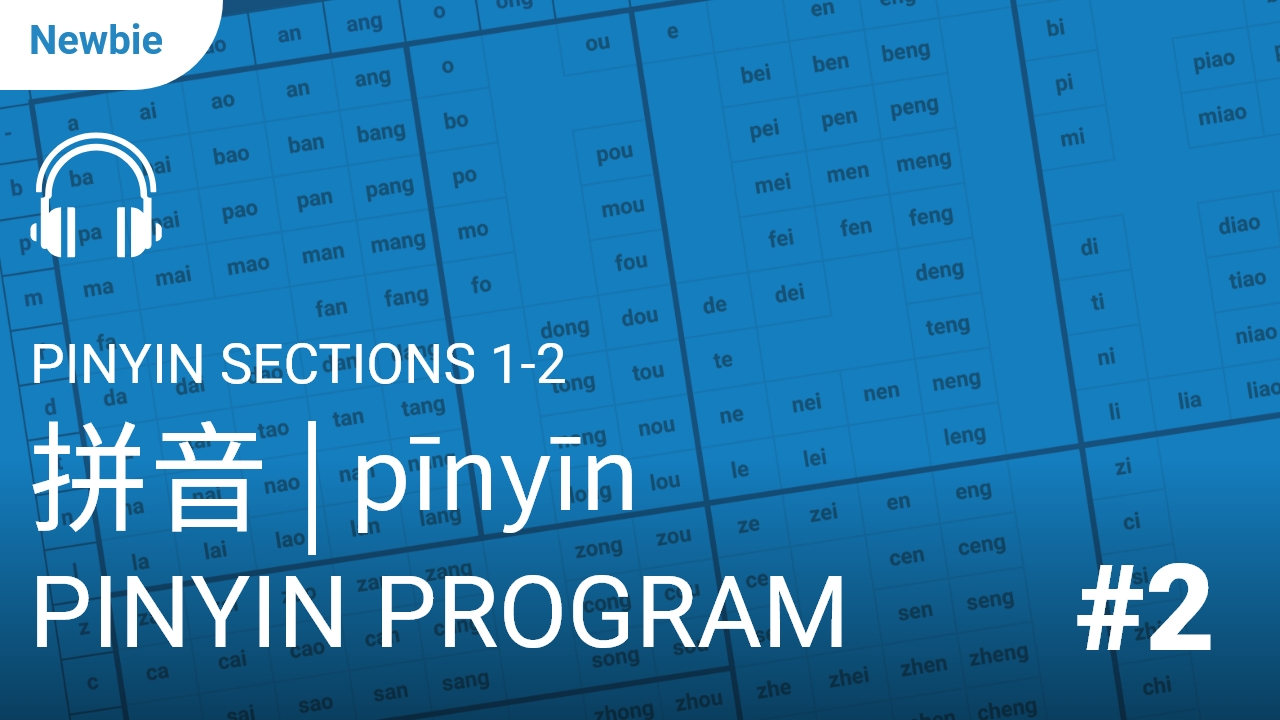
I downloaded the pinyin chart yesterday. It is visual only. No sounds. What did I do wrong? Or is the pinyin chart where you can click on sounds on the web somewhere? From the first pinyin lesson it sounds like it could be very useful.

JoshuaFanJuly 21, 2020
Yes, it is a sheet for you to practise pinyin. By following a step-by-step learning guide with Jenny and John, you will be able to improve your pinyin speaking and reading skills. Let me know if you have any more questions.
468146709December 30, 2018
Where can I find pinyin chart for windows? Cannot find it anywhere! Where are the resources?

ElijahWDecember 30, 2018
The downloadable Pinyin charts for Mac and Windows seem to be long gone, but the online version, which is actually more extensive, is available here. There are also iOS and Android versions. The old Mac version is posted on Google Drive here, but I unfortunately don't know of a place to get the old Windows version.
497694624February 22, 2018
This lesson was useful. But it would be nice to have the link to the chart on the lesson page so I don’t need to search.
953969081May 13, 2015
where do i find resource section to download pinyin chart?
660590371July 16, 2015
Tools, pronunciation. I couldn't download it for my laptop, but they have it on the broswer and as a phone app.
clairejacobMarch 10, 2015
I can't find a link for downloading the pinyin chart on windows - is it still available?

jamesspenceFebruary 19, 2015
I'm not aware of any current OSX for Windows Pinyin apps. There are a number for iOS and Android.... or you can use and webapp option on your Mac like this: http://pinpinchinese.com/pinyin-chart-online/
This is the best iOS option: https://itunes.apple.com/us/app/allset-learning-pinyin/id483673874?ls=1&mt=8
vikingbohmanicloudcomFebruary 19, 2015
The download isn't there anymore?
There are only links to download apps for iphone and android.. I need it for mac

antony73June 29, 2014
I studied pinyin sounds back in 2006, but it's time to brush up/sharpen my pronunciation skills once again.
I've always been very good with pronunciation. Even now, it's often commented that my pronunciation is really good. But recently, I feel I'm losing it.
With everyday Chinese, it's ok, it's second nature, truly a second language. Something I don't even need to think about, both in knowing what to say and how to say it. But with new Chinese recently, I'm finding it difficult to get the sounds right. So I've decided to go through these pinyin lessons, followed by memorizing some passages from one of those kid's books, to try and recapture that fluent magic sound of Chinese.
anaisgonzalezNovember 14, 2012
Hi everyone,
Any option of Pidgin table for linux?because it is almost impossible use it with wine or equivalent
Thanks in advance, Anaïs

Right-WingnutNovember 15, 2012
Pidgin table? Is this what you mean:
American Indian Pidgin English
Chinese Pidgin English
Chukotka Pidgin English
Fulani Pidgin English
Japanese Bamboo English
Japanese Pidgin English
Korean Bamboo English
Kru Pidgin English
Liberian Interior Pidgin English
Loyalty Islands Pidgin English
Madras Tamil Pidgin English
Maori Pidgin English
Melanesian Pidgin
Micronesian Pidgin English
Nauru Chinese Pidgin English
New Caledonian Pidgin English
New Guinea Pidgin
Newfoundland Pidgin English
Port Augusta Pidgin English
Port Jackson Pidgin English
Queensland Kanaka English
Scottish Pidgin English
Sierra Leone Pidgin English
Samoan Plantation Pidgin
Taiwan Pidgin English
Thai Pidgin English
Togolese Pidgin English
Vietnamese Pidgin English
West African Pidgin English
putonghualoverApril 24, 2012
To me, the Pinyin version of "o" ("o" on its own) sounds identical to "uo/wo"... Are they supposed to sound the same? :/
For example, are "bo" and "buo" supposed to be pronounced identically or differently?

helenshen_counselorJuly 23, 2009
@amesburygeorge, sorry for this late reply. I downloaded it! It turned out to be OK. The second tone, third tone and fourth tone work! So, maybe you can download it again to see if it works.
Cheers!

PurrfecdizzoJuly 22, 2009
Hi everyone,
I notice on the pinyin chart that is downloadable from this site, that the 'a' is only functionable for the first tone. When I click on the 2nd, 3rd, and 4th tones, I hear nothing. When I click on 1st - 4th tones, I hear the sound for the first tone then silence. I have thus concluded that a is only used in the first tone, but I wanted to comment on this in this thread to be sure. Thanks in advance.

bababardwanJuly 6, 2009
luobinzhenmei,
Sorry about the Julius Sumner Miller reference.He is an old Aussie science professor that used to be on TV.Very inquisitive and entertaining.I provided a link above in the highlighted word "thing" to a youtube clip if you happen to be interested.Like a lot of famous quotes,the clip let me down in one respect in that I don't think he actually came out with "why is it so?" ,but I was too lazy to sit through other clips of his.Sorry again for the digression folks.

luobinzhenmeiJuly 6, 2009
I have a feeling that the explanation of W that is yet to come is going to help me a lot, because right now I say 问 a lot like English "when", and my "yi" has much more Y in it than Jenny's.
And the chart helps me differentiate "se" and "si", "ce" and "ci" etc. "nong" and "neng". Maybe if I listen to "jiao" and "zhao" back and forth often enough I will hear them properly. Now I just have to find out who this Julius Sumner Miller is.

bodaweiJuly 6, 2009
@barbs
Thanks for the reminiscences of JS-M - I love your work. Remember Cadbury Chocolate?... 'A glass and a half of milk in every block!' Okay, that was a bit sad, he was past his prime.
bababardwanJuly 6, 2009
oops,
Sorry.I've spotten wen after all,right on the line henning pointed me to.My bad.

kimiikJuly 6, 2009
@bodawei and bababardwan,
This way to use the "W" in pinyin may come from the Sin Wenz (Wu or W):
"As in pinyin, spacing in Sin Wenz is based on whole words, not single syllables. Except for "u", others syllables starting with u is always written with a "w" replacing the u. The syllable "u" is only preceded by a "w" when it occurs in the middle of a word."
bababardwanJuly 6, 2009
bodawei,
"(I was putting on my Julius Sumner Miller voice there.) "
..就是。I can't pose such a question without having that same voice in my head.Sorry folks,it's an Aussie thing.Gotta love someone with so much passion.
bodaweiJuly 6, 2009
@barbs, john
Barbs, you make a good point - I am dying to find out the answers too..[John: do we really have to wait?]
'y' is often barely pronounced or not at all, but 'w' ..?
What about
吴先生问我为什么。。
It's hard to say that without a 'w' sound!
So, granted it may not be a separate sound in pinyin, WHY IS IT SO? (I was putting on my Julius Sumner Miller voice there.) Is this one of the limitations of pinyin in describing Chinese sounds?
bababardwanJuly 6, 2009
Thanks henning and john,
I've spotted them and I hear what you're saying.I was actually looking for "wen" as in 文 and still can't spot that one and I also did not think the "w" was silent in 文。

JohnJuly 6, 2009
bababardwan,
Henning is right. The chart doesn't have a Y either. W and Y are not separate sounds in pinyin; they are letters used to mark the beginning of syllables which would otherwise be written "uang" or "ing" or "iong." (Writing them that way would cause a lot of confusion when you connect syllables, much the way that words like "jingan" still do.)
We'll actually get into this later on in the Pinyin Program.

henningJuly 6, 2009
Babardwan,because it is basically an "u" (or unpronounced when followed by an "u"). You find all the "w-s" in the "u" column, 1st row.
BTW: For the same reason the "y-s" are under "i" and "ü".
ruhnkemJuly 6, 2009
I really like this approach to teaching the pinyin sounds. Brute force but one little bite at a time. Once you have gone through the whole chart you will have a wonderful reference tool!
I wish I had this when I started learning Chinese three years ago.
bodaweiJuly 5, 2009
Dear Happy River
I think this demonstrates my point exactly; humour often doesn't cross cultural boundaries.
PS. I like your name.

lechuanJuly 5, 2009
To solve the many-students-mother-tongue-is-not-american-english problem: How about a "reboot" and breaking it down more:
Have one show for each ending; one for each initial.
ie. One show will have the ending 'a', shows how it sounds with all the initials, but concentrate mainly on the ending. Another show will have the initial 'b', shows how it sounds with all the endings, but concentrating mainly on the initial sound.
By giving each sound equal air time, this show can benefit speakers of all mother tongues. Lesson sets can be put together that target the common problems in the native language of the learner. It would be about 57 lessons, and at one lesson a week, could be completed in just over a year.
bodaweiJuly 5, 2009
Now that others have also had a say I would like to clarify my comments .. I really think this is a lesson series for Anglophones (particularly Americans), I wasn't just making a sly dig. As an Anglophone myself I will still come here. But having read Mark's input above, I think CP will only earn or deserve the INTERNATIONAL tag if it makes more of an effort to acknowledge cultures other than North American. [Digression.. in Jack the Ripper film, police chief to investigating inspector who has suggested that the culprit may be an educated Englishman, 'What!! No Englishman would do this! Look for the Red Indians who live in Whitechapel..']. Damn.. it would be so much more interesting as well!! CP guys (nod to Americans), don't take this hard or diss me as an Aussie whinger. I am pointing the way to a richer learning experience for us all. 'You can do it! You can do it!' (another nod to a famous American we see incessantly on our Aussie TV screens.)

markJuly 4, 2009
It is probably hard for an international show like Cpod to point out the difficult pronounciations for everyone. For example, for me, unlike Henning, vowels with dots over them are terrifying. Also, my particular accent in English tends not to pronounce initial h's in words. When this habit carries into Chinese it often creates mischief.
That said, I believe that accent reduction would be an important topic for any non-native speaker, at any level. I think the pinyin chart is a worthy, if imperfect, attempt to provide material on accent reduction. So, I'm all for it.

mikeinewshotJuly 4, 2009
Actually this should be called pinyin for Americans, who have never studied a foreign language before.
I started to listen but quickly decided I might get corrupted by John's suggestions of how not to say things - which had never occurred to me before.

paulinurusJuly 3, 2009
Good lesson! Looking forward for more.. especially the difficult ones to pronounce such as z, zh, c, q, r.
bodaweiJuly 3, 2009
I quite like what you are doing here and look forward to the more chanllenging sounds.
But I think Chanelle77's point is right - and I learnt that Dutch has something in common with the many Melanesian languages. Although master of none, I can read these because the pronunciation is generally the same as pinyin. So, while it is funny for English speakers, I think that most people who occupy the Pacific would have no problem at all with these examples in today's lesson. They would not understand the 'bangbang mang' joke. I'd hazard a guess that the Pacific has the majority of the world's languages (because of lots of islands/ or unhospitable country that discouraged travel and interaction?) - and some of them learn Chinese! (I once had a class mate from Tahiti.)
Maybe this should be titled 'Pinyin lessons for Anglophones'? Or, as Tvan has reminded me before, maybe I should just get with the majority.. :-)

chanelle77July 3, 2009
Henning, genau! Wir haben kein Angst vor ü-Tönen. Sie sind über-cool!
I wonder how Brüno will bee translated into Chinese
: )

zhenlijiangJuly 3, 2009
When we learned the word 出租汽车 and had to say things like 坐出租汽车去 I thought I would never be able to travel to China (then was annoyed, later, to learn of the term 打的). That one's no longer a problem, but I still fear the terribly simple 我们一起去吃饭吧. Makes me sputter and bite myself.
You guys having no issue with ü's make me sick. That IS my major problem--and you can forget the combination üe.
Nobody asked, but my favorite vowel combination by far is uo ♪
henningJuly 3, 2009
chanelle,Ha! Just give us more of those ü-sounds! We are not afraid.
But I think that are some universal problem syllables. Oh, how I hated sentences like 骑自行车去吧...
chanelle77July 3, 2009
To be honest, the Pinyin chart is quite useful. But, for a non-native English / Dutch speaker like me, this show has no real added value.
Actually the Dutch pronounciation is quite close to Pinyin. I can imagine the same goes for (partially) for French, German or Scandinavian languages.
Also different languages have different problem syllables :-) I remember vaguely a DA show on different Chinese accents....

suburbaniteJuly 2, 2009
I think this is useful. I learned 'an' being a shade closer to en as in 'ten'. It's good to get a refresher and hear Jenny and John talk about some of the pitfalls of pinyin. Bang Bang Mang -- that's just too close to home. (like Clay's "knee way show jong when ma?*" -- if anybody remembers that -- I about fell out of the chair. too funny)

sydcartenJuly 2, 2009
Just to be confusing
my wife uses Indonesian pinyin
so: BU becomes PU
GAO becomes KAU
ZHAO becomes CAU
etc.


dunderklumpenJuly 2, 2009
Bang Bang Mang was hilarious.
:)
Some rules for writing pin1yin1 here. Apostrophes in han4yu3 pin1yin1 here (e.g. Tiān'ānmén).

matt_cJuly 2, 2009
So I'm the first commenter today eh. Bang Bang Mang was hilarious.
Áng 昂 was a difficult one back in the day.
头昂起来 / tóu áng qǐlái / Lift your head up.

What did you notice in this lesson?
You are posting as a guest. Your reply is reviewed before it appears. Log in to post without review.