
artkhoSeptember 19, 2011
I learned about this story in elementary school eons ago and suggested to my parents that they tell this story to my niece for her next Chinese lesson with them. Enjoyed this lesson!



hanlintingSeptember 15, 2011
for some reason i am not seeing any new lessons... is it something wrong with my computer or there are no new lessons coming out for wed and thursday. Are we gonna stop making new lessons like we did in Spanishpod?

RJSeptember 14, 2011
great lesson


黄飞猴November 10, 2011
Yes, it's great to have a little bit of a varying level. This is my first successful time through an Upper Intermediate lesson. It would be even better if it was noted which UI lessons were more "Upper UI" and which were "Lower UI".

alexyzyeSeptember 13, 2011
I think this kid died from some illness (not sure what disease) when he was 12 or 13. Poor kid.
RJSeptember 15, 2011
alexyzye,
I believe you are correct. Cao Cao evidently had 25 sons. (and I think I count 13 wives and concubines that gave birth) He favored Cao Chong and wanted to make him his heir.
http://www.chinahistoryforum.com/index.php?/topic/10106-translation-of-bios-of-cao-cao-sons/

johanchristerssonSeptember 13, 2011
I'm a bit confused, the word I know for scale is 秤 chèng, and for weigh I've used 称 chēng. Can 称 chèn also be used as scale? Or have I've been wrong the whole time?
/Johan
lujiaojieSeptember 13, 2011
称 chèng also be used as scale. Thanks for poingting that out.
秤 chèng=称 chèng
johanchristerssonSeptember 14, 2011
Thanks Jiao Jie! But my dictionary says 称 is just chèn, no G at the end.

podsterSeptember 14, 2011
Maybe time to get a new dictionary? I'm seeing 3 entries for 称
1. chèn: to fit, balanced, suitable
2. chēng: to weigh, to state, to name, name, appellation, to praise
3. chèng: variant of 秤, [chèng], steelyard

jennyzhuSeptember 14, 2011
秤/chēng (first tone) means to weigh. It's a verb.
秤/chèng (forth tone) mean a scale. It's a noun.

JohnSeptember 13, 2011
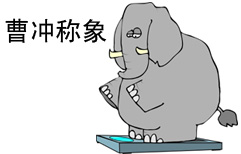
The relevant story about Archimedes (阿基米德): The Golden Crown. (spoiler alert!)

pretzellogicSeptember 13, 2011
(not quite spoiler alert). Ok, granted this is just a Chinesepod lesson intended to teach Chinese, and share some Chinese culture. And granted this is a nice Chinese legend. And i'm sure that in his day Cao Chong was a very smart and kind little boy with lots of friends. And granted there's some reasonably well known Greek dude on whose principle this story might be based. (and granted I didn't listen to the lesson, so I don't know if this was brought up). But somehow, I feel like asking Cao Chong a few questions around the difference between mass and weight, and the effects of temperature and chemical impurities on density....

yarajeevSeptember 13, 2011
Not sure what the Golden Crown has to do with measuring weight -- isn't it more about density? I'd argue that what Cao Chong did is pretty unconnected with Archimedes's principle.
kimiikSeptember 14, 2011
I think, it's more about buoyancy (浮力).
"Any floating object displaces its own weight of fluid." Archimedes
https://en.wikipedia.org/wiki/Buoyancy
The same boat with the same weight on it would have the same floating line (浮线?).
yarajeevSeptember 14, 2011
"The same boat with the same weight on it would have the same floating line"
I'd argue this is intuitive (anybody observing a boat loading will notice that a heavier boat is deeper in the water, and it's not far-fetched to extrapolate that equally loaded boats sit equally deep). This can be deduced of course from Archimedes' principle, but Archimedes' principle is more general and until you do the maths, is counter-intuitive. The wikipedia page above notes that even Galileo thought that Archimedes' "golden crown scale" was remarkably accurate.
The Baidu story translates flotation line as 水面的地方.
JohnSeptember 19, 2011
Yes, you're right that the two aren't exactly the same, and that Archimedes tackled a more difficult (and less intuitive) problem. But I still think they're related, in that if you know the story of Archimedes, the elephant weighing issue seems pretty easy. Still, though, if you've never heard either story (and especially if you're a kid), I don't think it's entirely intuitive!

markSeptember 19, 2011
My first thought was to use water displacement to weigh the elephant, but not having researched the story, I have a couple questions about the kid's technique.
How is he planning to weigh the stones?
What if, the elephant is too heavy for the boat and it sinks?
I think a swimming pool filled to the edge of a spillway and measuring the volume of water that went missing when the elephant took a swim would be the most reliable and easiest method. Assuming elephants float.

billgloverSeptember 22, 2011
You aren't alone, for some reason I imagined a tiny little dinghy. No way the elephant could fit in that.
为什么这个故事没说“大船”,哈哈。
shishiwenSeptember 13, 2011
“驳斥” 和 “反驳” 有区别吗?
I'm interested in this “不通” from “行不通”。It seems to me like it functions like “不了” here. Is that right? Can someone embellish on how its used and give a few common examples? Thanks.
jennyzhuSeptember 13, 2011
There is a small difference between "驳斥” and “反驳” .
”驳斥” means to refute and criticize, because "斥" means to criticize, 就是既反驳又批评。
“反驳” just means to refute.
不通 and 不了 both are potential complements. But the collocations are different, e.g. 去不了,吃不了, 行不通,打不通 (电话)。They can't be interchanged in most cases.
yarajeevSeptember 13, 2011
Good q, let me add to Jenny's two examples I found from 句酷, not 100% sure they are all examples of this particular complement though.
我【想不通】你为什么让那个孩子单独旅行。
我不理解这些指示――根本【讲不通】嘛。
谁也【搞不通】这样一台机器是怎么造出来的。
他们至今还不相信【买不通】去美国的路子。(??)
跟他道理【说不通】。
说这是粗鲁的西部人的缺点是【解释不通】的。
可是他的电话当真坏了【叫不通】。
Surprisingly, given the meaning of 通 many of them seem to have "get through" type idiomatic translations in English: I just can't get it through my head why you let that child go on vacation alone; I can't get through (on the phone); reason doesn't get through to him etc.
What did you notice in this lesson?
You are posting as a guest. Your reply is reviewed before it appears. Log in to post without review.