bohan2007June 15, 2013
Before there was pinyin, Nanjing was often spelled as "Nanking". Does anyone know why? If the two separate spellings sounded similar, then I wouldn't wonder about it, but "n" and "k" don't sound similar at all. Does anyone know?

Right-WingnutJune 15, 2013
Not sure of the story here, but the comparison would be between "J" and "K", not n and k.
Wikipedia says of the name change Peking to Beijing: The name corresponds to the Middle Chinese pronunciation kjaeng prior to a phonetic shift from [kʲ] to [tɕ] (the sound represented by the pinyin letter j) and preserved among the southern dialects (e.g., Cantonese, Amoy, Min Nan, and Hakka) used by the traders of the port cities visited by early European traders.
So it seems that the k pronunciation was a result of Westerners trading with southern Chinese, where the language has resisted the sound change from k to j.
bohan2007April 16, 2013
Question:
Is 夫子庙 a general name for any Confucian temple, or is the name of one specific temple in Nanjing ?

perrytex967December 29, 2011
I have a question about what Jenny says at the 11 min. 25 sec. mark of the podcast, to wit, she says "...zuì zhòng yòng de yī ge 'dapei-?'. Dǎoyóu jiǎngjiě..." I may have it wrong here but what is 'dapei'? Xièxie nǐn.
perrytex967January 11, 2012
Qǐng, lìngwài wèntí? Zài 16 fēn 35 miǎo Jenny shuō "...jiù zài Nánjīng péngyou dōu hui hěn heng(?)huà." 'Heng' shì shénme? Xièxie.

perrytex967January 13, 2012
Duìbuqǐ, wǒ zài zhè tái diànnǎo bù néng xiě shūfá. Suīrán wǒ méiyǒu zìdiǎn wǒ néng kàn yī xià shūfá; érqiě zhè ge zì zài hěn hé wǒ zhījiān shì shénme? Xièxie nǐn.
dougwkimAugust 29, 2011
I really found this helpful! Although recently I have found that I can read short novels and novels, my speaking and listening has not improved so I have been worrying a lot. I know this is a start

bababardwanAugust 31, 2011
Got any novels you can recommend reading in this thread?:
https://chinesepod.com/community/conversations/post/12151
wordbroked20August 2, 2011
Would someone please tell me if there is any lesson in which 'Chángchéng' is featured at all? And I don't mean where the Great Wall is mentioned just in passing. I've seen some of that. To me Chángchéng is the pre-eminent Chinese historic & geographic symbol in that it represents more than anything China's long tradition of civilization behind which human culture can flourish without being overrun by less advanced cultures. Of course, this has not always been the case in the short run, but in the long run China has always managed to overcome its temporary declines under foreign influence. So it seems strange I haven't been able to find a lesson about the Great Wall per se unless such a lesson is under some title I have overlooked. So, tài xièxie nǐ le, if you can direct me to the right lesson even if it is an advanced one. That might force me to learn a lot more shūfá fast.

loarJuly 28, 2011
I just have a quick question about "那么" and “这么" that are used in the expansion section. There are three sentences in the expansion with the above words:
(i) 这个东西质量一般般,怎么要那么贵。
(ii) 路上这么堵,还不如走路回家。
(iii) 结婚这么麻烦,还不如不结婚。
Can these words be used interchangeable e.g. for (i) can i say:
这个东西质量一般般,怎么要这么贵
Or are there specific rules to how we use them?
lujiaojieJuly 28, 2011
Generally, “那么”形容比较远的事情或时间,“这么”形容比较近的事情或时间。比如:
今天这么热!上海怎么这么热!(在上海说)
上海怎么那么热?(可能在北京看天气预报)
(i) 这个东西质量一般般,怎么要那么贵。
可能是你已经买好了这个东西,回到家太太这样说。
如果你正在商店看这个东西,可以说“这个东西质量一般般,怎么要这么贵”。
(ii) 路上这么堵,还不如走路回家。
应该是正在路上。
如果在上海看新闻,你可以说:北京那么堵,还不如坐地铁!
(iii) 结婚这么麻烦,还不如不结婚。
这个可以 "interchangeable", 因为不容易分出“远和近”,“现在还是以前”。
buffeggJuly 27, 2011
I arrived in Nanjing 3 weeks ago after being in Taiwan almost 2 years. It's a great city with all the facilities like subway and HSR connections with a smaller city feel. Despite the warning from my Taiwanese friends "大陸人沒有禮貌" I've found people here to be as friendly as I would expect anyone else to be to a foreigner in Australia / America. I got stuck drinking with the 老闆 of a local noodle place, and when I went to pay my beer tab the next day the waitress just said 沒關係! :)
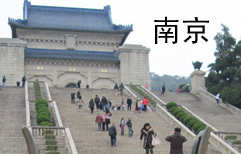
There is also that historial connection with Taiwan like seeing the colors of the Taiwan flag on the top of Sun Yat Sen's memorial (中山陵). Purple Mountain (紫金山) and Xuan Wu Hu (玄武湖). I had a real "I'm in China" moment when going to the lake on my second night in Nanjing. All the different kids of groups dancing, the lights illiminating the old wall, relections off the lake and boats quietly cruising around. I'm very glad I've had the chance to see this side of China before I hit the big smoke of Shanghai for travel and Beijing for study.

bweedinJuly 27, 2011
Those negative stereotypes from Taiwanese annoy the *** out of me. Doesn't the government in Taiwan insist that Nanjing is their real capital, anyway? lol
I've never been to Nanjing, but I would really like to go!
buffeggJuly 27, 2011
I arrived in Nanjing 3 weeks ago after being in Taiwan almost 2 years. It's a great city with all the facilities like subway and HSR connections with a smaller city feel. Despite the warning from my Taiwanese friends "大陸人沒有禮貌" I've found people here to be as friendly as I would expect anyone else to be to a foreigner in Australia / America. I got stuck drinking with the 老闆 of a local noodle place, and when I went to pay my beer tab the next day the waitress just said 沒關係! :)
There is also that historial connection with Taiwan like seeing the colors of the Taiwan flag on the top of Sun Yat Sen's memorial (中山陵). Purple Mountain (紫金山) and Xuan Wu Hu (玄武湖). I had a real "I'm in China" moment when going to the lake on my second night in Nanjing. All the different kids of groups dancing, the lights illiminating the old wall, relections off the lake and boats quietly cruising around. I'm very glad I've had the chance to see this side of China before I hit the big smoke of Shanghai for travel and Beijing for study.

waiguorenJune 21, 2011
I seem to remember from a previous podcast that 土 (tu3) is associated with 'backwardness'. When I was teaching in Beijing, we got sent on a winter camp to Chengdu, where a lot of the Chinese teachers were describing the place as '土’ but I didn't seem to think so...like you said, I think it's very much a Chinese thing.

elikuMay 25, 2011
about the word 土。 It sound on you guys like its the same as 屯 (tún) that we use alot in Harbin. What's the difference if there is any?
你看他的衣服,太屯了!;P
dominic_auMay 16, 2011
One of the expansion sentences:
他的工资一般般,只够自己生活。
Listening to the example pronunciation, the way that 只够 is pronounced, it sort of sounds like 足够? I guess they both make sense. And as a bonus I learnt a new word :)

JohnMay 16, 2011
Sharp ear! It turns out that one of our staff had a slight slip of the tongue when recording that sentence. She did indeed say 足够 (zúgòu) rather than 只够 (zhǐ gòu).
What she said is also correct, so we're glad you learned a new word out of it! :)
Anyway, we'll fix that audio so it matches the text.

ejrungeMay 9, 2011
I was amazed how much different Nanjing was compared to Shanghai. Much more "Chinese". I will always remember walking up the steps to the Mausoleum, and then up to the garden behind the Mausoleum(35 degrees C and 100% humidity of course). Very impressive scenery.




joycedimaculanganMay 4, 2011
去南京就是去感受历史。
What's the purpose of the second 去? Is it okay to just say 去南京就是感受历史?

xiaoma88May 4, 2011
Nanjing is a great place! I thought the taxi drivers and shop assistants were like my best friends compared to when I lived in Shanghai!
When you buy things in small Shanghai convenience shops the assistants don't even look at you and just put your change on the desk. Taxi drivers avoid you.
I learnt loads of Chinese from taxi drivers in Nanjing.
Good lesson though!
I remember other interesting foods like 旺鸡蛋 (wang ji dan - I think) which is possibly a half developed baby chick boiled and fried. On the nice side, there was mei hua gao? I can't remember clearly and don't know the characters or tones.

bodaweiMay 4, 2011
'When you buy things in small Shanghai convenience shops the assistants don't even look at you and just put your change on the desk.'
I love this wonderful indifference displayed by shop assistants in China, and the mechanical 慢走 when you leave. In contrast I REALLY hate the false smiles and "Have a nice day!" staff are instructed to use in the US and Australia. I wonder why that is? I think maybe in China employees make no attempt to make the greetings genuine. In China, employees are often blissfully indifferent to customers (texting, doing make-up, staring into mirrors, or picking their nose while they work).
If you interact with the owner of a small shop of course it can be different. I find the interactions with shopkeepers in China a lot of fun usually.

holothurianMay 5, 2011
I find that if you spark a conversation with Shanghainese taxi drivers, they are generally pretty cool, and definitely have something funny to say. The Shopkeepers of shops I frequent in China lose their indifference pretty fast, and become friendly, in allot of cases going way out of the way to help if you need something.
There is a correlation between big town and small town differences in interaction in just about any culture. In China both classes of town are just bigger, hehe.
JasonSchJune 21, 2011
Absolutely! I've always found the people in Nanjing to be extremely friendly. I too have learned a ton from cabbies in Nanjing. I've also eaten (1) 旺鸡蛋. I have to say, I was expecting it to be strange/gross, but it actually just tasted like (I suppose not so surprisingly) a chicken nugget...

lishuai1981September 20, 2011
Hey Jason, this was my first time hearing you teach. Really learned a lot and enjoyed your great explanations. I have been to Nanjing a thousand times and have not yet tried any of these local specialties.
I live in a place much more 土 than Nanjing--a small city in Heilongjiang Province, ten hours north of Harbin!

marlon0511May 4, 2011
这个课很有用。我们什么时候用“使用”在一个句子呢?

joyce_counselorMay 11, 2011
使用 is a formal way to say 用, and most of the time, it means to use a kind of tool.
eg: 你可以使用Chinesepod学中文。(You can learn Chinese by using Chinesepod.)

xiao_liangMay 4, 2011
Ah, I liked Nanjing, but it was really dusty. Not sure about the comments for scenery - the massive imperial park we went to was really beautiful, and the walk to the Ming dynasty tomb is really breathtaking. I'll try and post some photos... (apologies to those in China, they're on blogspot).

rodsMay 4, 2011
Great pics Xiao_Liang! I'd say that scenery is way better than "just all right." The guy in the dialog must be near sighted. Thanks for sharing. :)
xiao_liangMay 5, 2011
I also feel it's important to note that of the 3 cities I visited in China, Nanjing had the prettiest girls. So the scenery was great in every sense of the word! ;-)

zhenlijiangMay 12, 2011
XiaoLiang what camera do you use? If you don't mind telling I'd be interested; trying to decide on one for myself now.
xiao_liangMay 13, 2011
The camera I took these pictures with just broke, and I have to confess was really really horrible. It only cost £50. Sorry! It only took nice pictures in full sunshine...
zhenlijiangMay 13, 2011
Hey it does, is that the one she's seen with in the pictures at the museum from your blog? Her dad must be quite a camera buff. I'm a terrible photographer currently owning only the most incredibly crappy camera, trying to move up to a sort of Elementary level. So almost any purchase I make is sure to be an immense improvement. The PowerShot G12 is actually one of the ones I'm looking at now, trying to decide if I want to stay with something even more lightweight this time. Thanks!
xiao_liangMay 13, 2011
Hmn, I think that one's her dad's SLR. The G12 is his backup camera, but he is a super camera buff, so I'd say it's a good choice :)
KethMay 4, 2011
So you could say “(the) music’s ok” 音乐的话一般般。Yinyue dehua yi banban
Also 建议比推荐有什么差别?jianyi bi tui jian you shenme cha bie?

jennyzhuMay 4, 2011
的话/dehuà is often used when you are making comparisons. Therefore if you are comparing music with something else, e.g. 上海clubbing很好,音乐的话一般般。/ The clubbing scene in Shanghai is great, but the music scene is just so so. More strictly speaking 建议/jiànyì means "to suggest", 推荐/tuījiàn means "to recommend".

brendaninausMay 4, 2011
How did you get a photo of SunYatsen's Mausoleum (ZhongShanLing) with so few people?
dark_angel101May 3, 2011
There seems to be a problem with the Audio Review MP3. The "try to use these words in context" part contains no Chinese sentences!

What did you notice in this lesson?
You are posting as a guest. Your reply is reviewed before it appears. Log in to post without review.