

helandouJuly 13, 2011
I've lived in Hangzhou for 1 1/2 years, and especially at the lanzhou lamian places it's almost always a small kid that serves you. It never crossed my mind that these kids should be in school! Can't believe how sometimes you can be in the middle of something "wrong" and you don't even see or think about it...

jennyzhuJuly 14, 2011
The same with a Lanzhou noodle place across from our office. They have 2 boys working who are 10 to 12 utmost. They are such good kids. It always makes my noodle experience bittersweet. I try to give them candies when I go there.

tsuluJuly 10, 2011
I loved all the comments here. I was working when I was 8 in a restaurant: cleaning tables, mopping floors, washing dishes and other things. I lived in the US. I was lucky to have a job. I learned some much from working at that young age. I contribute my current success to having to work at a young age. My family was poor and I needed money to attend school. Things are different in the US now. That was back in the 80's when we had to buy books for school. (I know, I know not ALL schools and states are the same.)
Anyway, working taught me the value of money. So, now here I am living in Tokyo and I have been able to purchase two homes in the US in Los Angeles, CA and Pheonix, AZ for cash becuase I know how to use my money. I also paid cash for my BA, MA and my PhD. I have no loans.
I think we have robbed our children in the US by not giving them these opportunities. I have three children and I have them study and work hard because I want them to understand and appreciate what they have. I love them and do not want them to be slaves to the bank like most people have become.
dwfndleyMay 22, 2011
has anybody else noticed that in these big, cramped, chinese cities-- that 'individuality' is cheap?

dropped_chopstickApril 19, 2011
I have a query about how to translate 些 accurately.
In this line from the dialogue:
这些孩子太可怜了
is translated as
What a poor kid.
While 些 is normally translated as some or a few... can it sometimes, as here, just be a filler word and mean "one" because Chinese seldom has articles.
If I hadn't seen the translation I would have thought it meant These kids are too pitiful...
Thank you for any help!

tingyunApril 19, 2011
No, the translation must be wrong. You've got the right understanding of 些's modern use. If we include early modern use, then Lu Xun sometimes used 些 to mean 'all', but it never means 1.

tgifMarch 24, 2011
For anyone who seriously wants to know more about child labor problems, especially the Shanxi brickyards I mentioned above, there is a link from 2007; it is written in English:
http://wenku.baidu.com/view/562b0293daef5ef7ba0d3cdd.html
wendysMarch 23, 2011
I asked my language partner about this. She attributed the existence of children working (especially in large cities) to the Chinese hù kǒu or household registration system. If a rural family moved to a large city, they would have to pay fees for their children to attend school because they are outside of their hu4 kou3. While the fees are not necessarily exorbitant, they might be enough to discourage a family from sending their child to school.

bodaweiMarch 24, 2011
'not necessarily exorbitant'
There are other factors at play apart from the fees. If these children can't get into school because of the 户口 (or because they are the bottom of the pile even if they have the rights - see my comment below), they may be forced to the educational 'fringe'. Often these are private schools, charging more than the government schools charge, but more importantly offering a lesser service. The social profile of the students is often poor, transient. behavioural problems - these schools have a bad reputation. And they can close on the whim of the entrepreneurial owner of the school. Or because the local government decides that they do not meet standards (our local government has a campaign of closing such schools.) I visited one of these schools a couple of times to participate in English lessons - eye opener.
The government has taken steps in the last year to make it easier for migrants to gain similar rights to residents - I don't know much about this - maybe someone knows something about this legislation. The problem however, is not so much legislation, it is deep-seated antagonism to people from another part of the country. So even if they have the right to go to a government school, the school may say 'sorry, there are no vacancies'. The manoeuvring to get your child into a good school reminds me of my old home town of Sydney. Just like Sydney people will move house to be in the catchment - not that always works in China because social class and privilege plays a role here too. These migrant kids and their families can suffer discrimination.
My university last year had a 'raise awareness of the plight of migrant families and children' week. :)
tgifMarch 23, 2011
Interesting how Western concepts such as childhood are permeating China. The idea expressed in this lesson, about how children should be able to enjoy their childhood is a relatively recent phenomenon (last 100 years) in the US. It is interesting there is no economic based discussion - in an agrarian society, children are best suited to help on the farm. One only needs to examine the childhood of Sir Isaac Newton to realize what can potentially be a human capital waste on a farm.
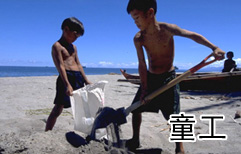
BTW, the photo are of kids playing on the beach. Doesn't CPod have some pics of kids working in the brick factories in Shanxi?
bodaweiMarch 23, 2011
I would say the concept of children having the right to enjoy their childhood is considerably newer than you suggest. It was probably not until about the 1960s or 1970s that people in general interrogated these concerns.
I'm not saying that I did not enjoy my childhood, just that the vast majority of parents did not give it much thought. There was not the focus on children there is today - children were just people waiting to become adults. It is interesting to look at kid's clothing - this is a new invention for the bulk of the population. In my day it was just short pants into long pants, and adult designs made small enough for you to wear.
bodaweiMarch 23, 2011
Incidentally - I was just commenting the other day how children are children in China - for instance there are distinctive 'kid' haircuts (often very cute). When I was a child I had a haircut with my father and it was exactly the same cut (short back and sides.)

ElijahWMarch 23, 2011
这孩子上学的话,还不会有什么童年乐趣!
https://chinesepod.com/lessons/child-parent-fight/dialogue
haraldhaiwenMarch 22, 2011
什么问题呀... 我们瑞士也有小孩子给他们父母亲帮助. 在农场上,在饭店里. 如果他们能上学校我们觉得就没问题. 当然是孩子做工作,不过比玩电子游戏看电视广告这样的活动我觉得简单的工作还好.

bvbeckmanMarch 21, 2011
I do not get to spend much time in small towns in China, only larger cities. Is this more prelevant in rural areas ? It seems to be very rare in Shenyang.
KethMarch 21, 2011
当我小孩儿的时候我进场帮助我的父母。他们有条鱼店和星期六晚上十一点钟爸爸我起床了帮助他们切土豆还是一条鱼。但是这种事儿就是家人活。我总是去学校了。我的爸爸自己开始工作什么时候他十二岁了。我的父母爱了我。我很开心了。



jacksonmdavisMarch 21, 2011
在我这里(河南)这样的事儿好像算蛮普遍的;我最喜欢的饭店很长长会有个小孩儿在那儿干活。我一个中国同事老说就是童工,但我怀疑可能我们几个外国人在他才会这么说。 反正算不算童工我还觉得他们有点儿可怜。。。
kimiikMarch 21, 2011
A tribute to Poem with Pete :
《彤弓》 彤弓弨兮,受言藏兮。我有嘉宾,中心贶之。钟鼓既设,一朝飨之。彤弓弨兮,受言载兮。我有嘉宾,中心喜之。钟鼓既设,一朝右之。彤弓弨兮,受言櫜之。我有嘉宾,中心好之。钟鼓既设,一朝醻之。
What did you notice in this lesson?
You are posting as a guest. Your reply is reviewed before it appears. Log in to post without review.