
karlovacDecember 20, 2011
I'm curious about the air-conditioner expansion example:
空调坏了,冷死了。(The air conditioner is broken. It's freezing.)
Does "空调" mean both air conditioner and heater? The reason I ask is that in the US, if the air conditioner was broken, it would be hot, not cold. (i.e. the A/C was failing to cool the room). This is the second expansion example that I've seen that suggested a "空调" would heat the room. I don't recall which lesson it was, but I think it referred to the air conditioner being turned off (and consequently the room was cold). Just curious if a Chinese "空调" is exactly what we think of as A/C.

RJDecember 20, 2011
Your suspicion is correct. In China "air conditioner" refers to a device that both heats and cools. It conditions the air.

stephenfoxDecember 20, 2011
As RJ said in many parts of China there is no central heating, for example where i live! Its hot here for 8 months of the year anyway. but they have AC units which both heat and cool the air.
karlovacDecember 22, 2011
Thanks RJ and Stephen! So I guess the English for 空调 would be a "reversible heat pump".
meimoya1December 23, 2011
空调 can be a reversible heat pump, but not always. In the extreme south of China, 空调s that both "heat" and cool the air are not nearly so common, in my experience. Straight up ACs are less expensive than the dual-function 空调s. Even the very fancy office building I worked in in Guangzhou didn't have heat pumps.

newbie9July 18, 2012
Hi,
The A/C units I've seen mostly heat and cool the room. The temperature settings are usually from 16-32 degrees C.

darkstar94October 2, 2011
Lately I've been more aware of my English thinking creeping into my Chinese, I was just wanted to ask would I use 请,叫 or 问 in the sentences "Ask them if they want to come" or "I want to ask you to be my teacher" or "I want to ask you to come to my party"

lujiaojieOctober 9, 2011
"Ask them if they want to come" 问问他们想不想来。Wènwen tāmen xiǎngbuxiǎng lái.
"I want to ask you to be my teacher" 我想请你做我的老师。Wǒ xiǎng qǐngnǐ zuò wǒ de lǎoshī.
"I want to ask you to come to my party" 我想请你去参加我的聚会。Wǒ xiǎng qǐng nǐ qù cānjiā wǒ de jùhuì.

arnevanvlietFebruary 27, 2011
In this expansion I wonder if the phrase 晚上不困 should be translated as 'not tired'. It seems a more accurate would be 'I am not sleepy at night / I don't sleep at night'?
Not tired should better be translated as 不累

JasonSchFebruary 27, 2011
This just comes down to how you interpret/use the word 'tired'. In the context of being ready for bed, tired and sleepy are interchangeable in my book. In fact, I rarely use the word sleepy. That being said, there is a difference between 累 and 困, where 累 refers specifically to being out of energy and 困 to being 'sleepy'.
dogrFebruary 27, 2011
It was said in the discussion of the dialog that 白天 bai2tian1 is used for daytime but 黑天 hei1tian1 is not used for night time, yet both are in my dictionary with just those meanings. Is 黑天 hei1tian1 seldom used?

kimiikFebruary 27, 2011
Btw, 黑天 is also the chinese name of Krishna (the hinduist deity) which seems to symbolize something bad in Buddhism.
JasonSchFebruary 27, 2011
Yeah, 黑天 is very seldom used to mean 'night'. The use of of 黑 with 天 is most common as a verb, i.e.: 天快黑了, 'it will be dark out soon'.
kimiikFebruary 28, 2011
In Tibetan Buddhism, 大黑天 or 大黑神 seems to be the name of the big black deity.
https://en.wikipedia.org/wiki/Daheitian
kimiikFebruary 28, 2011
Also, 大白天 could mean "in broard day light" or "open for all eyes" (act in an obscene way) :
大白天在街上

jinkeliFebruary 25, 2011
Wow, funny! This morning I had no hot water in my house! Seems the pilot went out. What a coincidence!
-c
brianhzFebruary 24, 2011
in this expansion sentance
你怎么不给我打电话
why is 不 used and not 没 like 你怎么没给我打电话。
JasonSchFebruary 24, 2011
Hi Brian,
In certain situations 你怎么没打... and 你怎么不打 here are interchangeable, and mean essentially the same thing, and can be translated as either why didn't/haven't you... In certain contexts, however, the 不 can indicate something like, 'Why don't you ever call me'. (i.e. you didn't before, you aren't now, and it's like you won't in the future)
bluediandianFebruary 25, 2011
你怎么不给我打电话=why don't you call me ? (didn't promise)
你怎么没给我打电话=why didn't you call me? (promised)
but alsways, the are the same meaning.
smallvilleFebruary 23, 2011
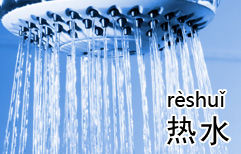
热水只有“hot water”的意思吗?还是它也包含“茶”这个意思?我每次去恩恩(一家在美国的中国饭馆 ),服务员都说“三个热水”也不说“三杯茶”。

jennyzhuFebruary 24, 2011
热水 means hot water, not hot tea. The people in your example gave 热水the meaning of hot tea in their own environment.
RJFebruary 23, 2011
John,
"negative intensifier." Perfect way to describe it. Speaking of intensifiers, are there others in Chinese? "To death" is also used in english, but there are other adjectival intensifiers such as "Mad as hell' or 'cold as hell". Are there such slang expressions in Chinese? Pretzel might also say "that new metallica album is bad as hell", meaning its great. Do similar usages exist in Chinese? Enough for a QW?

JohnFebruary 28, 2011
RJ,
Actually, there are quite a few. Some of the more creative expressions in Chinese involve a non-standard complement.
So, some of the common complements of degree include:
Verb/Adj + 得 + 不得了
Verb/Adj + 得 + 不行
Verb/Adj + 得 + 要死
We'll think about this as a topic for a Qing Wen!

richnirishFebruary 23, 2011
Question...
Is there a Qing Wen on default objects? Does anyone have a list of the most common?

baolinna27February 22, 2011
When I arrive to China, was no use to the cold and the hot water exclusive hours. Because I was slepping very late talking with friend and family, the next day missed the hot water hours.... So I learned to use the hot boiler coffe machine to get hot water and then take a bath.
I was feeling so bad to get water, waiting to boil, put it in a bucket, then do it again like 3 times. Finally I learned to go to sleep on time and get up on time specially when Beijing was around -15°. ^^

bobm112February 22, 2011
How do you say "context" in Chinese.

catherinemFebruary 22, 2011
You can say: 上下文 shang4xia4wen2 or 语境 yu3jing4. ("要看语境" [yao4 kan4 yu3jing4] = "depends on the context").

zhong_bideFebruary 22, 2011
I remember being at a hotel about 7 years ago in Zibo where there was no flask of hot water. I asked the staff for 热水 and they seemed perplexed and sent me around the side of the building. I was then perplexed. Eventaully someone did bring up a flask of hot water though.
Of course I should have asked for 开水。


xiao_ma1119February 22, 2011
When I was in China, I had no problem in the hotels with hot water. But there was this one place where there was never enough toilet paper. It was "free" but we basically had to go to the front desk and ask for something whenever we needed to use the facilities.
Also in some parts of South America, I know they kind of ration water and electricity. They shut both off in different parts of the city for three hours everyday. The kicker is that it isn't the same three hours, and they never tell you when they're going to do it. So you could be in the middle of your shower when....

cinnamonfernFebruary 22, 2011
That's why I bought those mini packs of tissues and carry them with me everywhere. :)
They also ration water use in some parts of the U.S. I was staying at a hostel in Monterrey, CA and you got a coin that you used to start the water, and this was timed to last 5 minutes...so after that time, you'd better be finished or you'd still be soapy.

bababardwanFebruary 22, 2011
In Dilu's out of rice example, instead of 那怎么办?you could get straight to the point with 那什么饭?
mucca88761February 21, 2011
It happens all the time!
Some hotel manager're pinch pennies and make people unconfortable. Even when they're supposed to have hot water they often don't. All what they can say:"中国人太多,没办法 ." It drives me mad!

pretzellogicFebruary 21, 2011
I always thought it was funny to go to Beijing, and you could safely assume that you had 24-hour hot water. You didn't even have to ask. Then we'd go to the village, and get water from 6-10am, and 6-10pm.
What did you notice in this lesson?
You are posting as a guest. Your reply is reviewed before it appears. Log in to post without review.