
wenjongAugust 19, 2011
We probably got scammed in Beijing fresh off the plane from Canada... got "friendly" with a couple guys "studying english at university who wanted to practice with us", and ended up in a tea place. But frankly, though it cost way more than I could have expected, it was probably the least touristy, nicest part of the visit, other than adopting my son. It lasted over an hour, we tried many kinds of tea, it was a whole ceremony and was very interesting and engaging, just the four of us and the tea lady.
We went to a different "tea house" with the whole adoption group a week later, with the tour bus letting all 30 Canadians out, and it was at long tables in a big place with tons of crappy tea and ceramics, all very touristy and gadgety. The woman did a similar "ceremony" but with a lot of gadgets (little peeing boy pot, cup that changes color with hot water etc, that they had for sale there), and it was like a pale fast imitation of where we had been a week earlier, where she took her time, all was explained, the woman seemed very accomplished etc.
We went to other things like a show at Shaolin Temple, tour of Tiananmen and the Forbidden Palace, and it was all rushed, too many people, cheap tourist goods etc.
So, even if we got scammed by these "students" at the "tea place", I don't regret it for one instant. Some of the best tea I've ever tasted, it was relaxing, culturally fascinating, the carved wooden dragon table was amazing... worth the charge on the Visa card. :)

WarszawskiJuniorJuly 30, 2011
About 5 years ago i was with my father in Wenzhou, it was about 9pm and we visited a tea house. The guy who worked there was very friendly and invited us to to take a seat he served us some tea. As we didn´t speak chinese and he didn´t speak english i didn´t know what kind of tea it was, and every time we wanted to leave he stand up and serve us some more tea, until my father said "enough", so we went back to our hotel. He didn´t charge us anything.
The fact is that we couldn´t sleep all night and our body was shaking as if we drank 10 cups of coffee. I never knew what kind of tea it was and since then i went to many tea houses all around China but that was the only time we had such a "stimulating" tea.
whataboutmylifeFebruary 13, 2011
Question: Is the 一(yi) in the third line of the dialogue 1st tone or 4th ? I know there is a pop-up dictionary but there is a tone change rule that may apply in this context and I've been told that it's often not written down in transcripts

toianwFebruary 13, 2011
Yes, 4th tone (I think this was mentioned by John in the lesson). As a convention, it's still written as 1st tone in pinyin.
There's also this lesson:
Elementary - Tone Change Rule: Yi '一'
whataboutmylifeFebruary 14, 2011
oh , was it mentioned in the lesson? I missed it. I'll listen again

martyzcpFebruary 12, 2011
In Suzhou you usually get one cup of free low-grade tea at the beginning. Its not bad tasting, but it's typically "tea" made from grain rather then actual tea leaves. People sometimes wash the dishes with it, sometimes not, depending on their opinion of the cleanliness of the dishes. I've never seen someone clean the shrink-wrapped dishes, but it wouldn't surprise me - everyone has their own habits.
On my last trip I spent two evenings in a teahouse with friends. We ordered a fruit and herbal tea, for which you can get infinite free hot water refills. My friends instructed me to say, 服务员,帮我们加水点 (fuwuyuan, bang women jia shui dian), but I kept stumbling half-way through, with the result that the waitress kept finishing my sentence for me :-). We were there for hours though, so I got lots of practice.

bweedinFebruary 11, 2011
When some "students" invited me to a Chinese minority cultural show, I pretended I didn't speak English, and then I pretended to get angry (major face loss in public) because I couldn't find the Shanghai museum (which was true) and it was pouring rain and I had no umbrella. They led me to the museum, and they didn't get a mao out of me. That's one small victory for all of us who have ever gotten scammed.
user26959February 11, 2011
I use a line which never fails when they try to scam me...
I look at them straight in the eye and say:
Wo shi huai dan he ni yi yang (I am a rotten egg (crook) just like you are!) They usually look at me, very surprised, and leave immediately.

bababardwanFebruary 11, 2011
hehe, very good. 只要 【Just as long as】 it's not 5 guys who are hiding 大刀【machete's] behind their backs.
user10196February 10, 2011
I have a question which is not connected with this lesson, but interests me. We now have the year of the rabbit. In German they say year of the hare. Does the Chinese word mean hare or rabbit. From my dictionary I have the impression it means rabbit. Jennie

bodaweiFebruary 11, 2011
The Chinese are rather vague about these distinctions - hare/rabbit, sheep/goat etc. They just look at the animal and see 'food'.
bababardwanFebruary 11, 2011
yeah, I've noticed the same thing in this and other areas, particularly scientific areas where you would expect accuracy. But there must be Vet students and science students,etc in China where they are more specific about these things [as opposed to the 老百姓。。person on the street]. I wonder how they handle things then?
bodaweiFebruary 11, 2011
The road to specificity in China is always interesting..
Him: 'Would you like to eat lamb tonight?'
Me: 'Yum, yes please..'
[5 minutes later]
Him: 'The goat restaurant has many specialities.'
Me: 'Oh, sounds interesting, I like goat meat.'
[5 minutes later, sitting at a table in the restaurant.]
Him: 'Would you like the goat liver, the goat intestines or the goat blood?'
Me: '随便。Can we get some potato as well?'

tingyunFebruary 11, 2011
I think Baidu encyclopedia is a good place to go if you want to get specific about such things -here's the link for 兔: http://baike.baidu.com/view/27770.htm . Scroll down to the 下属类别 , and you'll have a nice list of 40 or so different types and their technical names. Also, many have their own pages (some of the names are themselves links, which is convenient, but some of the others you can also find by plugging in the name to the encyclopedia search manually). I imagine that's how the vets and such get by - though probably relatively few non professionals would recognize those words. Actually, in English I don't know the difference between a Hare and a Rabbit, much less any more technical distinctions.
As a general note, this is one of the many places where I think Baidu encyclopedia is much better than a normal dictionary - I love it for looking up animal and plant terms. Not because I'm trying to get specific about subtypes, but rather because I usually find the included pictures much more helpful way to get a sense of what the plant or animal is (my english vocab in animals and plants is too limitied for translations to be helpful, and generally reading a detailed chinese dictionary description proves a bit dry). That, or google image search.
bababardwanFebruary 11, 2011
tingyun,
Another great tip with Baidu encyclopedia. Thanks mate. I'll have to remember that one. Yep, I tried google image search for just that purpose the other day, but then backed it up with zhongwen wikipedia [for raccoons/civet cats] . Have you ever compared Baidu encyclopedia and wikipedia?
Yeah, as I suspected, it's not that they can't be more specific, it's more about 老百姓说法 vs more accurate parlance by those in the know.
tingyunFebruary 11, 2011
Hi bababardwan,
Can't say I've done much comparing - as I've pretty much only used Baidu encyclopedia - let me know if you end up finding any particular strengths or weaknesses between the two.
Yah, though I'd guess the people 'in the know' are probably only experts, and even well educated people probably only have a few subtypes of a given animal in their vocab. Then again, there are alot of things that influence what words people are aware of, some of it hard to predict across cultures. A few days ago I was reading some Ming dynasty court opinion on rejection of a marriage contract, and I was confused by what the word 石女 meant (http://www.nciku.com/search/zh/detail/%E7%9F%B3%E5%A5%B3/37579 ) , as the english translation was a completely unknown term to me (and I wasn't even aware there was such a medical condition) - then I was chatting with a friend about the case, and we came across the word, and he was shocked I wouldn't have recognized the english version of it, as he explained he was fairly certain every Chinese person knows of that condition and word. I asked why would this be such a commonly known term, and he thought for awhile, and then said 'oh, its because there is this famous story...(I forgot the name)'. And then there is how often the proper names of, say, famous individual ancient horses get thrown around (纤离xian1li2 (I think lived in the Qin dynasty, though I don't remember what it was involved in), 的卢di4lu2, (刘备's) 赤兔马chi4tu4ma3 (吕布's,then 关羽's)), and famous individual weapons (干将 gan1jiang1, 莫邪mo4ye2 (both swords, and from warring states period), and you wonder why the name of so many particular horses or some scraps of metal survive as well known terms...though I guess in English we have Excalibur...still, there's a difference in quantity. ;)
bababardwanFebruary 11, 2011
"I was reading some Ming dynasty court opinion on rejection of a marriage contract"
..what a coincidence..so was I
"let me know if you end up finding any particular strengths or weaknesses between the two"
shall do mate. Off the top of my head though I spy an advantage with zhongwen wikipedia...a link to the English version so you can toggle back and forth if you're not sure you're on the right track, though they are just links to the same topic and not translations.

zhenlijiangFebruary 12, 2011
Tingyun, just curious. By "fairly certain every Chinese person knows of that condition", does your friend mean he's certain every Chinese person knows 石女 refers to an infertile woman, or that they actually know of that specific anatomical / physiological condition as described there on nciku? I wouldn't be surprised if it were only the former. Apologies if you've already clarified this point and I missed it.
bababardwanFebruary 12, 2011
great question zhen. The same thing crossed my mind and I agree with you, particularly as the word itself [that is going by the individual characters alone ] only seems to suggest "dry woman" ..reminds me of barren, and doesn't seem to have an anatomical reference in there.
zhenlijiangFebruary 12, 2011
Right, stone woman makes me think "unyielding", as in "giving nothing". In Japanese 石女 will be recognized as umazu-me, written also as 産まず女--an outdated, definitely no longer appropriate to use (dehumanizing even in the old days though), term for a woman who cannot have children.
*edit * I guess I'm really wondering esp. about the English definition nciku has there. My C-J dictionary only says of 石女 "a woman unable to bear children". I have no knowledge of the famous story, but the condition would have been referred to in it quite specifically I guess? The Contemporary Standard Chinese Dictionary definition on the same page does allow that the term can include women who have problems with the uterus. But still those are pretty specific. What most surprises me is that such specific medical / anatomical descriptions aside, neither the English nor the Chinese dictionary definition there say anything about 石女 being a general reference to an infertile woman (so my C-J dictionary would be getting it wrong then--which is certainly not inconceivable). Perhaps my familiarity with the Japanese term is interfering here.
(Apologies for going off-topic here!)
tingyunFebruary 12, 2011
Hi guys,
You know, I wasn't even aware of the alternate possibility until Zhenlijiang mentioned it. I skimmed through most of the Baidu encyclopedia entry, and from everything written there I became convinced it generally refers to a condition that prevents intercourse (at least in the standard manner). Here's one of the quotes (which I like because its talking about the meaning 'among the people' 民间'): "石女,也称为石芯子、实女,民间一般用这个词来称呼先天无法进行性生活的女性。原因一般是因为男性无法正常将生殖器官进入女性体内。"
In the case, it was definitely that sense, based on how it was discovered in the case. Haha, bababawarden, I wasn't just reading it for the pleasure (though looking back on my post it reads that way) - my research is on Ming Dynasty criminal law, specifically reasons for punishment (deterrence of future crime, incapacitation, reform, and retribution). I already did the work on the main code, and an example regulation, and now what's left is judges application, which means getting into the case decisions. The only complete colleciton of 判词 (final opinions) that survives is from a late Ming official 李清, the collection is called 折狱新语. Actually, his stuff is some of the most difficult I've ever read, far more difficult than say 史记, 资治通鉴, even budhist texts from Dunhuang don't compare - as he follows the rule of 'never say something directly when you can use a literary or historical allusion', and often doubles or triples up the allusions in a single sentence. Hence, it takes me an absurdly long time just to work through a little paragraph, and sometimes I'm still not understanding a large part of it.
zhenlijiangFebruary 13, 2011
Thanks for the follow-up Tingyun. So I guess technically, with the means in reproductive medicine we have now it could be possible, for a woman with this condition to have a baby (by ceasarean delivery).
We still don't know anything about the famous story I guess.
Guess I'll ask a teacher when I get the chance, if they understand 石女 in the same way we do in Japanese at all, or if my C-J dictionary really needs to be set straight there.
tingyunFebruary 13, 2011
Also, I think in many cases they can actually surgically correct it directly, meaning that they can they can participate in the input process as well as the output.
jaycalFebruary 10, 2011
Count me in as one of those that got "scammed" in SH. The more I learn the more I realize how naive i was at the time (it was my second week in BJ/SK..)
I met three college students that gave me the go-round and we ended up in the tea shop. I was told the price up front "per taste" and ended up (willingly) buying some tea to take home. One of the students bought me the same amount of tea I wanted to purchase myself and then he and I paid for the two girls we were with. Total "take" for them was 700. :-\

waiguorenFebruary 10, 2011
Re: being scammed.
I remember being really angry at the time, but now it seems like such a trivial matter. If being 'scammed' for a relatively small amount of money is the worse thing that happens to you in China, then you're doing okay...

wotingyuFebruary 9, 2011
We need to put the tea scammers in touch with the Nigerian email scammers. They can trade overpriced tea for fake inheritances and endowments.

tonymeadows100February 9, 2011
The tea scam is alive and well in Beijing too. I go to China several times a year on business and when in Beijing I like to go to Wang Fu Jing for window shopping. Usually when I get near the “In time Lotte” Dept store I am approached by a couple of 'twenty something' smiley faced girls who all use the same basic opening script:
“Hello, do you speak English? We are studying English at university and would love to practise our speaking with you :-)”
I’m happy enough to chat with them, provided I can speak to them in my limited Chinese and they use English. This all works fine and is good practise for me, until the inevitable “Do you like Chinese tea? Let’s go and drink tea in that tea house over there …” at which point I claim to have a tea allergy and invite them to Starbucks for coffee. I've not ever had one acceptance ...

pretzellogicFebruary 9, 2011
yikes, does no one at WangFuJing ever fall for the art student scam but me? at least I got some amateurish drawings out of it
kang_jieFebruary 9, 2011
I think I met those same university students! A guy approached me with the same line about practicing English. He told me he was from Heilongjiang Province and had taken line 1 into the city that morning. I think he realized his prospects for pulling off the tea scam weren't very good when I started whipping out some local words I picked up during a summer in Harbin. I said I didn't want to go anywhere, but did agree to walk and talk for a couple minutes. He never mentioned tea, but led me straight to the second floor of a tea house. I didn't even sit down, just turned on my heel and left! I've heard the tea scam story too many times to be comfortable in a situation like that!

wangqiuFebruary 9, 2011
wow i feel stupid....when i first got to beijing near tian an men square two girls approached me and wanted to practice english....i ended up sitting down for a cup of 1000 rmb tea....i was afraid to call the police at the time but i told them that we would split it 3 ways.....almost a year and a half later, i am glad it happened...i learned a lot from the experience, and it made me realize i was too naive and trusting......now i just speak to them in chinese or tell them im russian and dont speak english......

hyzhenhokFebruary 9, 2011
Makes me glad to be out in the boonies (in a city of 2 million). There just aren't that many Westerners out here, and only a small number of us are tourists. We just don't have this sort of predation out here (yet!).
tonymeadows100February 10, 2011
@pretzellogic When I'm on business in China I often go with a member of our staff who is a Beijing girl now living in the UK. She has a Masters in computer science so she's a smart cookie and knows about all the tricks. One time in Beijing we were approached by an "art scam" couple and despite very determined warnings from my colleague, I insisted we went along with it to see what would happen. To be honest, while being 100% aware it was a "scam", the items on offer at the prices being asked seemed very attractive to me. But while I was musing over what to buy, the "scam" couple turned the heat on my colleague telling her in very fast Chinese it was her “duty to China to ensure the foreigner bought at least something”. This attitude made her quite grumpy so she dragged me out before I could make a choice, so quite a narrow escape for me :-)
martyzcpFebruary 12, 2011
I had a similar experience, well 3 or 4 of them, during a visit to Beijing. I was staying near Wanfujing St where the scamming is worst. I did end up buying a small piece of art sold by "students" so pretzellogic isn't the only one.
In another incident a young woman invited me to practice English in a coffeehouse with her later in the evening. I knew that was a total scam, but was bored enough to go along with it (sometimes I find the pitch can be quite entertaining). Before meeting her I left my wallet and most of my cash in the hotel. Sure enough she instead directed me to an empty bar where after a few drinks and interesting conversation I was presented with a bill for over 900 RMB (should have been about 60 RMB). I dug out the 150 RMB that I had on me, shrugged my shoulders and said "sorry, that's all I have". I guessed correctly that the bar employees wouldn't have the guts to beat up a foreigner on Wanfujing Street (besides I was bigger than their "tough guy"). In the end the woman paid the rest of the bill which avoided a scene. I did still get overcharged, but I looked at it as a live theater experience where I had the best seat in the house.
pretzellogicFebruary 12, 2011
Tonymeadows, I feel better!
Martyzcp, I wish I had thought of leaving my wallet elsewhere. Now, I just don't go into the mall (I forget the name) at wangfujing where the art student scammers hang out, and I don't get hassled.

cinnamonfernFebruary 9, 2011
I think you probably have to be careful in any large city in the tourist areas. I almost got scammed in Beijing in October. I took the wrong subway line to the Forbidden City and ended up in this really made-up touristy area where I would never have gone normally. These two 'nice people' came up to me and started talking in decent English (this should have tipped me off). I was okay walking around and talking to them until they wanted to go into a building to 'exchange email addresses'. I knew about the tea scams so I was instantly apprehensive...but I still went inside.
We went upstairs, the girl was acting tired and fake-yawning (I think it takes skill to pull off a convincing yawn). And then they wanted to get tea. I promptly asked the waitress to see the menu. The outrageous price and the bad acting convinced me I was about to be ripped off. So I said I didn't want any tea and quickly took off.
tonymeadows100February 9, 2011
“I knew about the tea scams so I was instantly apprehensive...but I still went inside”.
I totally understand that, I have a sort of “morbid curiosity” when I think I’m being scammed, I have to follow it through until the last-minute get out point just to see how well my scammers have prepared their ‘craft’. My work is mainly in China and S E Asia and I’m often alone so I am a target for all sorts of ingenious scams, generally fronted by suspiciously friendly ladies.

brendaninausFebruary 9, 2011
Yes, I have fallen for the tea. karaoke or whatever else they use to get you into a room for some way overpriced good. Usually I work it out before I have consumed anything but this doesn't always let you off. Last time I tried to push my way out as I didn't do anything that I would have to pay for, but the thugs they have to enforce payments, even when there isn't a reason for them, didn't agree.
I was pushed over and my hand fell on a glass which shattered and sent glass through it.
A visit to the police and hospital ensued. Not a good start to my holiday with my right hand stitched up.
So be careful with your morbid curiosity.
waiguorenFebruary 9, 2011
Yes, always super-important to clarify the price FIRST. I walked into a hole-in-the-wall establishment in Qufu, Shandong (birthplace of Confucious) only to be charged Y30 for a bowl of Yángròutāng (lamb soup) when the going rate was close to Y5.
哎呀
waiguorenFebruary 9, 2011
I got scammed when I visited Shanghai, but it wasn't for tea - it was for an acrobatics show. I met this group of 'really nice' people who were from 'out of town' and they really wanted to see the acrobatics show. Because they seemed really nice, I agreed to join them, so we went to a tea-house (I didn't buy any tea!) to pay for the tickets they all handed over the money (like Y200 a ticket) looked at me and said 'Will you join us?' I hesitated, but bowed into peer pressure, paid Y200 and agreed to join them. They said they would meet me there. Well, they didn't. And that's when the penny dropped. There was an acrobatics show, it was actually okay - it just wasn't worth Y200. If I had of just rocked up at the show, I think the tickets would have been around 20-30 yuan.
I felt so ripped off. Needless to say, I saw them the next day in Renmin Park, pulling the same scheme. I felt so ripped off, I even confronted one of them and said 'Nǐ piàn wǒ!'
Oh well, live and learn. But a completely free trip to ChinesePod head office kind of fixed things.

geiwotangbaFebruary 9, 2011
I got scammed outside a Buddhist Temple. I like to go there to climb/run (Rocky would be proud) the 15 flights of stairs that lead up to the main temple on top of one of the few big hills in my area to keep in shape. One time a lady dressed like a Maoist Nun came up to me and shoved some sort of fortune card or holy card in front of me. Me, not wanting to be impolite stopped to give her some sort of attention, next thing I found myself signing some prayer list and being accosted for some sort of donation. First I put down twenty yuan, but she crossed off my amount and put down 100 yuan. I was laughing a bit when I walked away, but decided to compromise and give the religious shake down artist 50 yuan to leave me alone. I still go to that temple for the exercise but am extra cautious against being the victim of another nun ambush.
waiguorenFebruary 9, 2011
没什么。I took the moral high-ground, and just left it at that. The look on my face said it all: 你骗我。。。
bweedinFebruary 9, 2011
What's everyone's experience with tea in China? I remember most places not having that courtesy tea in China, except in Guangdong. They usually served 开水kāishuǐ (hot water), if they did serve anything.

JohnFebruary 9, 2011
That's small town China, no? Or maybe just really small (hole-in-the-wall) restaurants?
In most 1st, 2nd, or even 3rd tier cities, serving some generic 茶 is pretty customary.

RJFebruary 9, 2011
In Guangdong everyone "washes" their chopsticks and bowls with tea before beginning . A large bowl is usually set on the table into which the used tea is collected and later removed by staff. I find the whole ritual a waste of time and you usually end up with a table cloth soaked with tea. I figured it was free otherwise everyone wouldnt be splashing it about like that. Even bowls that are sealed in plastic get the ritual cleaning.
geiwotangbaFebruary 9, 2011
Yeah, the stuff that comes out of the plastic wrap seems pretty clean to me too. Chinese like to spend time doing stuff I guess, like chewing on bones, the act of eating is much more important than actually eating. I give them great credit for being able to entertain themselves with these tiny rituals. Me, I need to eat something as fast as I can, wash it down with something cool, and get the hell out of there, this is a product of my military training, and something I've had to give up to be sociable to whoever I'm with in China,...sigh...I still need to train myself to appreciate a good bone and chewy grisel.

DorayakiFebruary 9, 2011
I agree with you. First time I have dim sum with my friend in Australia, they are from 广东, before start the meal they are washing their bowl and cup. I was surprise, something new for me, seems this their habit, no question a lot to them.. but i guess waste a lot of time, and table become messy and also give the 服务员麻烦。
personally i only use the paper towel to rub the bowl and cup :)

ejrungeFebruary 9, 2011
In Shanghai, Kunshan, Suzhou, Wuxi, and this general area, any complimentary tea is no better than dirty dishwater. The last time I went to the expensive bar at the Jin Mao Tower Atriumon the 53rd floor, tea was more expensive than a mixed drink. There is no free lunch in China.
JohnFebruary 9, 2011
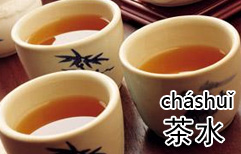
茶水 (cháshuǐ) is definitely tea steeped in boiling water (although it may no longer be so hot).
茶 (chá) can refer to just the tea (leaves), as well as 茶水 (cháshuǐ).
bodaweiFebruary 9, 2011
Tea out my way is usually luke warm, but also some places have 红茶 hóngchá (black tea) on tap rather than 绿茶 lǜchá (green tea).
bweedinFebruary 10, 2011
yep, small town China (十万人口). When I ventured out to Shanghai, I would have Western food, go to hole-in-the-wall restaurants, or street food, so the whole tea situation did not apply.
bweedinFebruary 10, 2011
I was surprised when I saw that in Hong Kong too, but the customers may have been from Guangdong, or that's just something that old Hong Kong people do.
I remember when we sat outdoors in Guangdong and we threw out the dirty 茶水 on the ground. I don't really mind the whole rinsing ritual so much.
bweedinFebruary 10, 2011
I've heard of tea costing 900 yuan a pot at this chain in Wenzhou called 去茶去 (English name: Go Tea Go).
I bought some tea from some monks at a tea farm in Fujian province. The 红茶 was 50 kuai a jin and the 绿茶 was about 100. best tea ever.
cinnamonfernFebruary 10, 2011
People from Hong Kong typically wash the dishes with hot water before using them (even if they come wrapped in plastic). I guess there is no guarantee that they're well cleaned. I was surprised when I visited my friend who is from Hebei and she also washed the restaurant dishes...but then she lives in Xiamen now (Fujian province) so maybe she's been affected by that.
bweedinFebruary 11, 2011
interesting, because the waiter in Hong Kong didn't offer us westerners to wash our bowls and chopsticks! I guess he figured if we don't know any better, then it'll save him the extra work.
cinnamonfernFebruary 11, 2011
Ha - that's definitely possible. Also it's not always obvious that you have the option to wash the dishes because the waiters won't say anything. They will bring a teapot with hot water in it and perhaps an extra dish to pour the waste hot water into - or you just use one of your own dishes and they will replace it. If you don't use the hot water, sometimes they will just silently take it away. So if you weren't paying attention you never even knew it was there. (This has happened to me before.) If you order tea, sometimes they will bring two teapots, one with tea and one with hot water - you can use the hot water to rinse your dishes and also to refresh the tea when it gets cold/bitter.
cheapcheap567February 16, 2011
I hate when they wrap the dishes in plastic. It's just totally pandering to the OCD cleaning fetish. Plus its killing the planet. Mad
cinnamonfernFebruary 21, 2011
Yeah - especially if you wash them yourself anyway. I thought it might have been an issue of practicality. The plastic-wrapped dishes might have been sent out to a company to be cleaned? You'd want to wrap them for transport or they'd probably just get dirty again. It seemed that way to me...but I was just guessing.

matthewrudyJune 15, 2011
If you're eating on the street
they often wont bring you a waste water bowl
you just chuck it on the street.
And, yes.
The shrink wrapped dishes are like that because the restaurant outsources their dish washing.
With hong kong rents so high, do you want to waste space in your restaurant for washing so many dishes?
bababardwanFebruary 8, 2011
Now this is where we need to get our local friendly 警察 【policeperson] on board, on BST as suggested by RJ here:
https://chinesepod.com/lessons/inside-the-baozi-business#comment-205008
..to advise on where one stands and what to do if you find yourself [well hopefully we Poddies are all well informed enough now, but if a mate gives you a tinkle explaining such a pickle] in such a predicament as the tea scam.
What did you notice in this lesson?
You are posting as a guest. Your reply is reviewed before it appears. Log in to post without review.