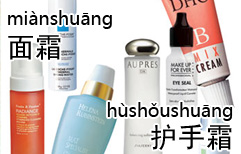

xiaophilDecember 30, 2010
I have a question. If I'm lazy or forget the exact name for the cream I'm using, can I just say 擦店霜?
yangk999December 30, 2010
Hi Xiaophil, I think "擦点霜" doesn't show clearly your meaning, like if you say "take some cream", they may not understand well your meaning. But if you give the cream to the guy and tell him "擦点霜" it will be ok.
Sorry my English is not very good, hope it can help.
tanlien04December 28, 2010
What is the difference between "yi xia" and "yi dian"?
zuo yi xia (sit for a while) and he yi dian (drink a little)

lujiaojieDecember 29, 2010
一下 yīxià means "in a short while in a short while", you can say:
等一下 děng yīxià
看一下 kàn yīxià
一点 yìdiǎn means "a little; a bit; a small amount", you can say:
吃一点 chī yīdiǎn
喝一点 hē yīdiǎn
买一点 mǎi yīdiǎn

calkinsDecember 29, 2010
lujiaojie, 可以麻煩妳幫我一下,我有一樣的問題。我朋友發了簡訊給我,說“我再一下下回去。” 我懂“一下下”的意思跟另外的,但我不懂為什麼她用了“再”。她不會給我解釋。謝謝妳幫我!
calkinsDecember 29, 2010
Sorry sorry! Just realized this is ele. and I should use pinyin or English.
Lujiaojie, I have a similar question, can I trouble you to help me? My friend sent me a text message and said “我再一下下回去。” I understand “一下下” and most of the rest, but I don't understand why she used “再”. She couldn't explain it to me. Thanks for your help!
SF_RachelDecember 13, 2010
I agree with Dilu -- one kind of moisturizing cream is never enough! For some of us gals, anyway.
When I used to live in Wisconsin I had terrible problems with dry skin in the winter -- to the point of tiny but very painful fissures spontaneously opening up in the skin on my hands. My doctor recommended two things: moisurizing after showering with common kitchen vegetable shortening, and applying superglue to the fissures. I insisted on using a real moisurizer rather than shortening, but the superglue turned out to be a fantastic idea.
In Wisconsin -- a big dairy producing state -- I also learned you could buy "udder cream" that was allegedly a non-toxic cream that dairy farmers would 擦 on the cows' milk-making apparatus to keep it soft and supple (and prevent/ minimize the horrendous dryness and cracking of Wisconsin winters: poor cows!). I suppose it's probably just vegetable shortening!
sydcartenDecember 12, 2010
擦 and 皮肤 are both useful words to know, but hand cream and face cream are not topics I can remember discussing in any language.


忠JaronDecember 8, 2010
I like how to say cream in cantonese.
the word "go" with a high tone.
and toothe paste is "ah go" a low falling tone and high tone.
"go" seems so much smoother to say than "shuāng"
PirminDecember 11, 2010
牙膏 yágāo (tooth paste).
Maybe what you hear as "ah go" is the cantonese pronounciation of it?

xiao_liangDecember 8, 2010
The first lady is a new voice actor, right? I've only heard her once before. I really like her voice, it has a great sulky tone to it :)

xiao_liangDecember 8, 2010
Hehe, not depressed! Sulky! It's a really good thing, her voice is full of character, especially when she has the lines where she's complaining about something, or exasperated. She was in the recent "I want an electric scooter" lesson too.
Who is it Cpod?

xiao_liangDecember 9, 2010
Aha, thanks Connie! Please pass on my appreciation to her :)
Wow, 黑龙江 is really far north! She's come a long way to work in Shanghai...

bennyboykDecember 8, 2010
I think it's rained like once in the past two months in Tianjin. We need moisture!!!!

waiguorenDecember 7, 2010
Wow, can really 'hear' the 3rd tone in the word 'leng3' in the sentence ’北京的冬天又干又冷‘。
Must admit, my 3rd tone sounds nothing like that. Wish it did.
Also learnt a new word in 'ca1' 擦。
Good work (as usual).

xiaoma88December 7, 2010
I just use whatever moisturiser I can get my hands on.
It seems to me the smaller the body part the more expensive the cream - eye cream is ridiculously expensive!
So is there a word for general moisturiser?

xiao_ma1119December 7, 2010
So, is it safe to assume that 护脚霜 (hùjiǎoshuāng) is foot cream, as in foot moisturizer? (and not some other kind of foot cream?


geiwotangbaDecember 6, 2010
我对干天气没有意思和不管面霜等等,在南方有好多蚊子所以很爱驱蚊露!I could care less about the dry weather and facial cream and such, down south we've got a lot of mosquitoes and I just love my mosquito repellent! (but it is nice to learn about this kind of vocab though, still love thinking about the 防晒霜lesson too!)
我想起来上级课程1475:南北差导:不过人们常说女人是水做的,南方湿润的气候对女性的皮肤倒是比较好。
This makes me think of advanced lesson #1475, DIFFERENCES BETWEEN NORTH AND SOUTH:But people often say that women are made of water,And the moist climate of the south is better for a woman’s skin.
那,你们上海人和北京人把面霜都扔到垃圾桶,搬家到广州,深圳,佛山吧!

jackfrombelgiumDecember 6, 2010
If you want to use a protection cream for face do you have to say "hùmiànshuāng"?

bodaweiDecember 6, 2010
That's weird, I used the reply to jackfrombelgium link and it replied to dagah.
Ok, that one worked.

jennyzhuDecember 6, 2010
We'd say "防皱霜/fángzhòushuāng" for anti wrinkle cream. 防/fáng means "to guard against" as in 防晒霜/fángshàishuāng/anti sun screen.
light487December 7, 2010
I was talking to my Shanghainese friend at the coffee shop about the different creams and she told me that there is two types of "anti wrinkle" creams. There is the one for young people to "protect against" wrinkles, which is the one that Jenny has kindly told us about but then there is also the cream for older people who already have wrinkles and want them to "go away".. this is called: qùzhòushuāng (the first character there being the character for "to go".. just like when you are going somewhere.. sorry can't write in Chinese from here). :)
The reason this conversation started was due to the word/character cā, which has been used in this lesson to mean "apply or spread something on". It can also be used to mean "rub" and "wipe" and can be used to ask the waitress, or anyone, to "wipe" the table clean etc..
Funny Moment: While discussing this, we talked about other types of creams as well and one of them "eye cream". When she said this she actually called it "eyes cream".. which sounds an awful lot like "ice cream".. :) I asked her if she often used bīngqílín on her face.. and then smiled and said "eyes cream" while making hand gestures to wipe around my eyes.. :) :)
Interesting Factoid about Whitening: ( I know, I know.. I am starting to ramble off topic) my other friend who works at the same coffee shop told me once that when she was a young child/baby, her mother used to wash her with cow's milk to ensure her skin remained pale and beautiful. Not a whole bath of milk, mind you, just some milk on a cloth wiped over her skin.. :)

dagahDecember 5, 2010
Hi,
I have a question (not related to this lesson)
How to say normal for an object? Like "a normal book/bike/movie" etc? for example if you want to go and buy a bike, but they only have tandem bikes.
I tried to use "正常" a few times, but they dont understand my meaning.
hope someone can clear it out for me, i've been wondering about this for a while.
Thanks!
light487December 5, 2010
Hrmm.. well.. not sure what you mean by normal book.. or normal movie.. I can find many example of "normal" in my own dictionary.. such as tōngcháng for example.. but in the example you gave regarding the bikes, I would probably be saying something along the lines of "I don't want a 2 person bike, I want a 1 person bike".. or in the case of a movie, "I don't want to watch a horror movie, I want to watch a comedy".. if you know what I mean..
Or to shorten it, "I want a 1 person bike".. rather than trying to say "I want a normal bike".. be more direct.
Maybe: "wo yao yige ren de zixingche"
abbyabyebyedelayneDecember 5, 2010
Normal is a very subjective word, which maybe what is causing the misunderstanding. Perhaps you could try using other adverbs/adjectives to describe the object you are looking for? Instead of normal movie or book, you could say horror, comedy, action, etc.
I hope this helps out!
kang_jieDecember 6, 2010
Maybe you're looking for the word 普通 (pǔtōng), which is often translated as "common." If you use that word in your question about the bike, it would be like saying you want a common/standard/typical bike, nothing special.
Hope that helps!
dagahDecember 6, 2010
thanks for the answers! maybe 普通 is better to use, yeah.. as for the books example I went in a bookstore to search for a book written using traditional characters, but most of the books are read from right to the left.. That's when i wanted to say written in "a normal way" (I know theres a word for this kind of writing style, but I forgot).. anyway, next time I'll try using 普通 - could you say "普通写的一本"(?).
谢谢 :P
bodaweiDecember 6, 2010
For sunscreen - I know from experience (say 18 months ago) there are a number of dictionary offerings that don't work. After floundering around I have used 防晒油 fángshàiyóu with success. (This is more a description than a translation of sunscreen). And you have to say 不要美白 if that is indeed what you want. Many of the sunscreen products then had whitening included.
I think that this is one of those words that hasn't settled down yet, but there is much more available now on the mainland, just in the last couple of years.
light487December 6, 2010
Hehe.. not like there is a lot of sun penetration in some places anyway. :) I remember my first day "ever" in Shanghai and the sun was this pale, orange smudge in the sky. Visibility was about 100 to 200 metres through the thick air pollution. I quite liked it at first, as it was so surreal and different but that quickly wore off and become anxiety as I thought that it was going to be like that every day!! Luckily that was the worst air pollution I've witnessed in the last 2 trips... far beyond the norms. Certainly wouldn't need sun protection on that day.. but would definitely need some ibuprofen for the headache you get from the pollution though. :)
bodaweiDecember 6, 2010
Well, yes, I sometimes forget; I live under blue skies in the best climate in China. :)
But it doesn't take much sun anywhere in China to bring out the umbrellas etc. The women in particular use umbrellas to cross between buildings at the campus I work at. Very funny, but maybe also very wise.


pretzellogicDecember 5, 2010
I've needed this lesson for a long time. Now just need a lesson requesting Chap Stick.
claudieloDecember 6, 2010
pretzellogic two questions for you (forgive my curiosity):
1) you speak a very good chinese. It surprises me to see in an elementary lesson... you go through all lesson's levels at any new release?
2) if i didn t misunderstand you had an alitalia flight avatar till few days ago... how come? fan of bankruptcy companies (i can tell as italian :-)?
pretzellogicDecember 6, 2010
And I thought I was the only one that knew Alitalia had some financial challenges ;-)
I have daily reminders of how bad my Chinese is. The problem for me with dictionaries is
1) that they do not also usually tell you the measure word for the noun in question
2) the usual temptation when you do know a word (say, lotion), is to ask for it the same way you ask for something in English. This is a receipe for being laughed at, and I am also laughed at enough on a daily basis by my bad tones without adding further humiliation by asking for something the wrong way (like for example, us Americans say, "I have a flat tire". This is not what the Chinese say.
3) I flew Continental yesterday. A pretty darn good airline that hopefully will improve United, instead of United ruining Continental.
pretzellogicDecember 6, 2010
Oh, claudielo, I actually am on a quest for new words that we've never had lessons for before. I don't recall that we actually had a lesson on lotion, which is why you're having to deal with me discussing an elementary level lesson.
And despite Alitalia's difficulties, they have pretty livery ;-)
light487December 6, 2010
Yup.. I am beyond newbie level.. but I still go and listen to the newbie ones.. there's always something to learn from all the different levels :)
claudieloDecember 7, 2010
ah ah i see i see
well pretzellogic
as for alitalia: the livery is surely nice. At least something positive. Al the rest... not to mention
as for continental: i hope they will be capable of keeping such high quality standard even after the huge fine the ll have to pay due to the concorde disaster in charles de gaulle
as for your your studying system i agree with you. I also like to check sometimes through elementary lessons. :-)
as for the lotion one question: i remember a roommate referring to lotion used to use a word with the character 润, "run" in. Which means "moist". but can t find this word anymore
light487December 7, 2010
rùnzé could be what you mean? It can have the meaning "to moisten/to lubricate"
claudieloDecember 8, 2010
ight487 it was a 3 characters word if i good remember and referred to an object (mainly) girls use to moisten hands or part of the body. it was a noun not a verb...
claudieloDecember 8, 2010
a chinese friend just told me
润肤霜 runfushuang, moisturizer (run= moist; fu= skin; shuang=cream)
or
滋润霜 zirunshuang (but actually this i didn t really catch what it s...)
pretzellogicDecember 11, 2010
claudielo, I was curious about the Concorde fine as well. I think United/Continental can easily pay it, but i'm more curious about the liability and exposure to lawsuits by the families that had family members that died on the Concorde.
claudieloDecember 11, 2010
well, yes, you are right... actually i was referring to the fine first, and than also to the outcome of the lawsuits of the family. This latter will be the surely the most burdening for the airways company... no doubt
we will see next
light487December 5, 2010
1. What about the "whitening" cream that I have seen in China? I find this to be a very interesting culturual difference between the east and west when it comes to cosmetics. The whitening cream obviously makes the woman's skin more pale.. whereas in the west, women want the opposite of this to the extent of having tanning creams/lotions/sprays to give them a year-round tan but to a lesser extent creams that create a warm glow to the facial area..
When I first saw it I was a little confused but then I thought about the culturual significance of pale skin being more attractive and thought it was fascinating. This lesson made me think about this and thought I would share it. :)
So how would one call this type of cream? I assume "bai" would be a part of the word..
2. In this lesson we have miàn meaning face but in another lesson, Intermediate - What does she look like?, we had liǎn (actual vocab was yuánliǎn - round face) to mean face. What is the difference here?
3. gān is dry.. what is humid? When I look in my dictionary I come up with many different possibilities... so if we said "Fujian de xia4tian1 .... " (Fujian summer).. how can we say it is humid?
abbyabyebyedelayneDecember 5, 2010
It seems that a good translation for the whitening face cream would be something along the lines of 皮肤美白霜 (Pífū měibái shuāng).
面 refers to the surface rather then facial features. And my Chinese teacher taught us 潮湿 (Cháoshī) for humid. You can also use 闷 (mēn) which means stuffy, if it is hot and humid. :)
light487December 5, 2010
Skin Beautifying (White) Cream? :) hehe.. makes sense :)
Ahh see.. that's the problem with dictionaries.. chaoshi means damp/moist and I wouldn't have immediately thought to use that when there are others that include humid in the translated description.. :) hehe.. I find this happens a lot though.. that the word you are looking for is either more or less abstract than you start out looking for :)
abbyabyebyedelayneDecember 5, 2010
Yes, dictionaries are so difficult because it lists more or less very literal meanings and doesn't take into account the word is culturally used or less literally involved. For instance, our class learned a verb thursday from our text books that means "to want to; to be willing to" and our teacher informed us that we would probably be looked at strangely if we ever used it because in china its usually only used during a marriage proposal. xD


nbmaynDecember 8, 2010
Yes, I have been wondering when to use mian4 vs. lian3 for face. (Sorry, I have yet to figure out how to do tones on my computer.)
What did you notice in this lesson?
You are posting as a guest. Your reply is reviewed before it appears. Log in to post without review.