jbowesJanuary 7, 2011
Can I say "face me" with liǎn?

JasonSchJanuary 9, 2011
Hi jbowes,
If you mean literally, 'face me', it would be most natural to say simply 'kàn wǒ' (看我). To face figuratively, as in face a situation or a problem, you can use miànduì, (面对) which however does include 面, which also means 'face'.

alanelmoreDecember 4, 2010
@font-face { font-family: "宋体"; }@font-face { font-family: "Cambria"; }p.MsoNormal, li.MsoNormal, div.MsoNormal { margin: 0cm 0cm 10pt; font-size: 12pt; font-family: "Times New Roman"; }div.Section1 { page: Section1; }
我的中国朋友说:公共卫生间没有肥皂。这是真的吗?
Wǒ de zhōng guó péngyǒu shuō : gōng gòng wèi shēng jiān méi yǒu féi zào. Zhè shì zhēn de ma ?
My Chinese friend says that there is no soap in public restrooms. Is this true?

bodaweiDecember 4, 2010
I assume that you are talking about the Chinese mainland?
Many public toilets do not have soap.
But it is not a rule. When you arrive at the airport, for example, there will almost certainly be soap in the toilets. And many major tourist sites will have soap dispensers - museums, concert halls, etc. And many restaurants also will have soap dispensers. But only a few will have toilet paper.
The five star hotels, and an increasing number of restaurants, have both soap and toilet paper supplied.
But you always travel prepared - with tissues, and many people also take disinfectant wipes, substituting for soap.

light487December 5, 2010
haha.. I remember I couldn't get out of those Beijing public toilets fast enough, the stench of amonia was just too much for my feeble, Western nose. :) They apply a "liberal" amount of industrial strength amonia to those toilets.. :) Have to admit though, they did seem to have the largest amount per square kilometer of public toilets than all the cities in China I have visited. Following the signage to a public toilet in Shanghai can take you on a long and winding journey.. :) haha
jbowesJanuary 7, 2011
towels, paper or rel, are almost non-existant in toilets, soap is a 50/50 affair in Taiwan. Yes, nice places will certainly have soap, most other places are hit and miss.

pretzellogicNovember 20, 2010
I was flying from San Francisco to Boston, and I was sitting in the window seat, waiting for passengers to board the airplane. After about 10 minutes, a guy gets ready to sit in the middle seat next to me, and he says, "you'll have to excuse me, I just came down from the mountain". I thought that was an unusual thing to say to someone you've never met or talked to. Then he sat down next to me, and I smelled what he meant. I suspect he hadn't taken a shower in about 6 months. Or at least he hadn't seen soap in a while. Not even on his hands.

bababardwanNovember 20, 2010
hehe, wild. A bone fide, in the flesh Beverly Hillbilly. What a privilege ! That wasn't dirt on his hands, it was likely black gold.
pretzellogicNovember 20, 2010
It probably was, but I didn't look too closely at him. Anyway, after the first hour, I got used to the smell. This is a good thing, since it was about a 6 hour flight.

alexlexiluNovember 19, 2010
My theory is that many western women's hair looks terrible in the morning after sleeping on it. The only way to correct that is to wash and dry it again... I think that's why many of my girlfriends prefer washing in the morning, cuz they can fix their hair to look good to go out... I have to say that some Chinese people hair would benefit from that argument as well... I see quite a bit here in America going to work with greasy, unkept or bedmarks hair and that is considered not professionnal at all... then they wonder why they can't find professional jobs here...
Another issue, if you wash at night, you may start smelling by late morning afternoon... and that is also not appropriate in Western societies. I don't know about Chinese here... I don't particularly remember smelling them... but you will with some other cultures...
So I guess it all comes down to how strongly the society you live in values your personnal appearance in public... Here in the Western world, especially in business, it is VERY important... That's why we prefer to fix ourselves all up in the morning, including brushing our teeth after every meal.
Plus, like John said, we are not that dirty after we get home since it's not that polluted...

markNovember 19, 2010
I thought maybe the preference about bathing time was climate related. US culture comes from Europe, which has a climate similar to where I live, on the west coast. It is not very humid here. So, if you wash in the morning, you won't be all sweaty sticky by the time you go to bed. However, China's climate is more like the eastern US where summers are very humid, you'll definitely stick to the bedding by the end of the day.

xiao_liangNovember 19, 2010
It's also a genetics thing. The simple fact is: white and black people sweat more than east asians do. We sweat more, we smell more. We wake up and need a shower more - fact!

nbmaynNovember 19, 2010
I can't really wake up in the morning without a nice shower. Plus, what do you do if it was a warm night and you were sweating? I could not go out in public in the morning unless I was clean. But, if I have been doing work in my yard or some other dirty job, I would definitely shower before bed!
alexlexiluNovember 19, 2010
Totally agreed... plus... I can't wake up until I have a good shower... it just has that effect... I don't know how Chinese can get up, wash their face and be out the door within 10-15 mins... I'm barely waking up by then...
alexlexiluNovember 19, 2010
Yeah totally... our culture makes it inappropriate to go out the door while risking to smell at some point during the day... MUST be avoided... socially not acceptable... It's showing concern for people around us.... I guess xiao liang hit the nail on the head... it must be all genetics... let's accept it...


hugo87November 19, 2010
I have a question about the expansion of this lesson:
你又换女朋友了?
(You have a new girlfriend again?)
Why is there no 吗 at the end of the question, it is a question which can be answered with yes or no so there has to be a question particle at the end right?
alexlexiluNovember 19, 2010
It's not really a question.... that's why. It's a rhetorical question, which mean that no answer is expected. It is more like using a question tone to emphasize an idea.
https://en.wikipedia.org/wiki/Rhetorical_question
It's like saying: You changed girlfriend again?
There are no question words in this question either. Yet it is said with a question intonation.
JasonSchNovember 19, 2010
Hi Hugo,
Good question. Just like in English, you can make something a question using only your tone.
However, if you were to add a 吗 to the end of this sentence, it would be a direct question: 'Did you get a new girlfriend again?"
Without the 吗, and with just a question mark, it's more of a rhetorical question - (likely in response to seeing/hearing something about the new girlfriend.)

kimiikNovember 18, 2010
Welcome Dilu. It's always nice to hear new voices on this Podcasts.
Speaking about 干净 from a foreign perspective, westerners always wonder why most chinese people take a shower in the evening but don't brush they teeth.
Also brushing teeth and washing face BEFORE breakfast seems to be typically chinese. No wonder breakfast taste bad. ;o)

zhenlijiangNovember 18, 2010
Quite a few Japanese apparently do that too--the brushing teeth before breakfast. But nobody in my family does; actually nobody I know does, so I've always found it just as strange as you do.
We take baths at night too, this I feel quite strongly about. Same with the Chinese, as a good Japanese you don't slip into bed 脏. Since the 80s I think showering in the morning--朝シャン asa-shan (morning shampoo)--started becoming de rigueur among teenage girls (you know how oily teenagers are. and very self-conscious. it's also American influence I'm sure). I think most people today still are used to having a proper bath before bed. We love our baths, can't live without them.
user14904November 17, 2010
Just wanted to say that I've been listening for a long time and Dilu has done a good job in this podcast. Thanks

brigraingerNovember 17, 2010
I really love Chinese pod team but how can John say in ENGLISH we say' my hands have gotten' dirty Yo have as much chance of hearing that in English as of hearing the sound of Beau Bells in New York!You might say that ,but in English I think we would just say' my hands are dirty '.. ha ha .! Maybe I am being too 'Chinesepoddy for English speakers' hey John!
in_montrealNovember 17, 2010
Welcome Dilu. Looking forward to many more.
When I was hanging out in Shanghai on a short trip, it was a tiny milestone when I successfully went to a laundry and did my transaction in Chinese. 洗衣服 xǐ yīfu. (It was high time!)

忠JaronNovember 17, 2010
way to go DiLu! you did great!
My wife always thought i was weird when i didn't want to "every" night or wash my face in the morning. I explained to her i was used to showering in the morning, etc. Now i am more chinese. Showered last night, and washed my face this morning before study.
I would much prefer a chinese duck and rice than i would any fast food burger nowadays. But i don't greet people and say excuse me like i used to.
the contrasts in western and chinese culture are quite funny sometimes.
xiao_liangNovember 17, 2010
Great job Dilu! Look forward to hearing you more :-)
One question: the way you pronounce 手 seems quite different to how I've heard it before - is this a regional accent? It almost seemed to rhyme with 小 rather than "show" that I've heard before...
Oh, but at the end when you're talking about nursery, it sounds like "show" again... I dunno :-p
lidiluNovember 17, 2010
Thanks for bringing it up xiao_liang. I didn't notice the difference so i listened to the podcast again. Perhaps i was reading too naturally when doing the translation part. So the 'ou' in 'shou' was a little weak. And when talking about the word at the end, I kinda emphasized it.
Xiexie. Good to know~
xiao_liangNovember 17, 2010
I shouldn't worry about it too much - after all, the reason we have you to listen to is because you are a normal chinese person speaking in a normal chinese way! I just wondered if it was a normal pronunciation, which I guess it is :-) Something for me to watch out for!

walidshaariNovember 17, 2010
Welcome DiLu to the good clean start; hope to hear from you a lot soon.
This question is probably to JasonSCH, In the Expansion:
我喜欢你的衣服,我们换一下吧。 I would translate this to lets swap cloths for a while... while the translation was lets trade, how does yi xia 一下 work here? what is the best translation?
also 我要换工作。 is it OK to translate it to i would like to change my job?
and what is the best negative reply for 你还要买什么吗? would it be, 够了,谢谢。 or something like 我不要。
JasonSchNovember 17, 2010
Hi walidshaari,
When I read this sentence, I feel like it wouldn't be a permanent trade either, but I just asked Jiaojie and apparently it can! So, in this case, although 一下 gets annotated as 'briefly', it's not necessarily about actual time, but rather, softening the tone of the verb. (you could also say 我们换换吧)
It's OK to translate 我要换工作 as 'I would like to/I'm going to change my job', but it sounds a bit unnatural in English to say 'change' jobs. We usually something along the lines of, 'find a new job'.
As for a negative response to 你还要买什么吗? both of your suggestions are good! You could also say, 不要了 or 不买了.

jbaldwi1November 17, 2010
In the southwest desert of the US it can get pretty dusty and a quick shower in the morning helps wake me up.
bababardwanNovember 17, 2010
Well done Dilu. Must feel good to have one under your belt and off to a clean start. Time to exhale. Jiayou!

jennyzhuNovember 17, 2010
Dilu is great! She has the most spark out of the candidates John and I interviewed.

忠JaronNovember 16, 2010
Welcome Dilu! Alright i can use this lesson to teach my daughter how stay clean in mandarin in the future!
How about potty training in chinese?
that would be a good one!
how do you say slit in the pants?

rodsNovember 16, 2010
First of all, great job Dilu!!
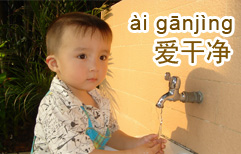
So, does Xiǎobǎo really ài gānjiìng? Or does she just have a new bathtub toy that she wants to play with, like a rubber ducky, or a toy boat or something?
(Now Ernie's Rubber Duckie song is stuck in my head.)
lidiluNovember 17, 2010
xiexie rodswithoutnumber :) I don't think xiaobao is a typical Chinese kid. Well, i know i wasn't like that when i was a kid.
zhenlijiangNovember 16, 2010
John and Dino are hosting--? I don't believe we've been introduced ...
Welcome to ChinesePod Dilu!

catherinemNovember 16, 2010
Zhenlijiang - Dilu is one of our new voices here at CPod. For a more proper introduction, check out last Sunday's News and Features show.
zhenlijiangNovember 16, 2010
Catherine--take a look at the Lesson Information.
You can see I made the comment I did in the latest N&F because I did listen to the show.
zhenlijiangNovember 16, 2010
The first line in the Lesson Information box. You have "Hosts: John, Dino".
I was just pointing that out.
bodaweiNovember 16, 2010
'Dino' brings to mind Dean Martin - 李师 ain't Dino. :) Puzzling, n and o are not easily mistaken for l and u on the keyboard.
zhenlijiangNovember 16, 2010
OK just went back and re-listened to the N&F. You did call her Dino, after her interview with Jenny and John (during which there was no mention that she had an English name). Sorry.
That really didn't register you see, esp as there was discussion in the comments section about her name but nothing about Dino.
bodaweiNovember 16, 2010
My apologies for the '李师 ain't Dino' comment - I had a discussion with her on the N&F board about names and she didn't mention Dino, and I missed the reference in the broadcast.
lidiluNovember 17, 2010
Thank you zhenlijiang for the warm welcome :)
Sorry for the name confusion guys. I should have mentioned it earlier. I do have an English name but the team and i decided to use my Chinese name on Cpod, which is Dilu. I'm sorry for the trouble my name caused :p

geiwotangbaNovember 18, 2010
I like it when a foreign language teacher chooses to keep their given name of the foreign language that they are currently teaching. Not that I dislike Jenny or Connie or whoever that chooses to be identified in some Anglo sort of way, it just seems more intimate to be able to hear and identify with you in a more culturally direct way when you use and share more fully your Chinese identity with us.
geiwotangbaNovember 16, 2010
nice rhyme in the English title, any way that can translate better as far as the sound or expression goes in Chinese? Something more 'catchy' or is that just not part of the Chinese way of writing? Just curious.
bodaweiNovember 16, 2010
That is a great question. Chinese writing is full of puns, they love 'catchy'. However, if ChinesePod tried this in Chinese, they would need a whole lesson to explain the title - wouldn't work at Elementary level.
geiwotangbaNovember 17, 2010
Maybe some sort of snappy chengyu...one of those four character sets...just hate to see the English out shine the Chinese here. Recently, I tried to explain the phrase 'clean as a whistle' to one of my English classes. Yeah, I guess you are right, KISS is entirely appropriate here.
JohnNovember 17, 2010
"Keen on clean" was my translation of 爱干净 (ài gānjìng). The Chinese phrase is a little hard to translate into natural English. Being a "clean freak" is taking it too far.
爱干净 (ài gānjìng), however, is a very common phrase in Mandarin, whereas "keen on clean" isn't in English.
What did you notice in this lesson?
You are posting as a guest. Your reply is reviewed before it appears. Log in to post without review.