
tony.cpodNovember 14, 2014
A couple of questions regarding the dialogue please:
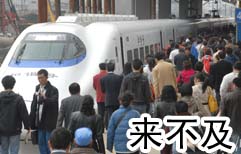
How is 候车室 different from 候车厅 as used in the Intermediate lesson "A Long Bus Ride"? Both seem to mean "waiting room".
Is there any practical difference between 站台 and 月台 to mean "platform"?
Thanks as always for any assistance!
DavidXuzhouNovember 14, 2014
厅 is a hall, has much more bigger space than a 室 room.
月台 is commonly used in Taiwan, and 站台 is more in Mainland.

timothygstoutApril 22, 2011
Couple of quick questions.
1. Is 让一下 really polite, or merely not very rude? My friend said to always use 请 in front of this expression.
2. In the 4th line of the dialogue, someone I assume to be a station attendant says, 哎,有火车票吗?看一下。 My questions is, who is looking? Is this just a reminder to purchase a ticket before proceeding to 安检 and the 检票口?
3. 天啊 is used frequently in dialogues, but is the 啊 here similar to the 对啊 that is more likely to be used in Shanghai than the north? Is there an alternative expression for 天啊 that is used in the north, 天儿?(Half joking)

lujiaojieApril 25, 2011
1 “请让一下” 比较好。
2. 在“进站口”会有工作人员检查车票。
3. 天啊 is commonly used in South and North. 还可以说:我的天!
timothygstoutApril 25, 2011
Love it. 我最喜欢“我的天”!Thanks for this.
I'm still a bit confused about lines 4 and 6. If this person is a station attendant, why would she say "Look at your ticket" in stead of "Show me your ticket"?
Or, should 看一下 here be taken to mean 我看以下?
ruyideSeptember 25, 2010
What is the name for the most basic grade of ticket which just allows you to get on the train and, if you're lucky, find some odd corner on the floor where you can spend the entire journey?
This is what I had to buy on my only (so far) Chinese train journey between Taian and Beijing during the national holiday in October 2007. Great timing on my part but could not be helped.
On this occasion I was resigned to eight hours of exquisite discomfort, wedged into a pocket of space between the carriage toilet and the exit with no room even to swing the proverbial cat.
Fortunately, a lady who was getting off at Jinan, about an hour down the line saw my predicament as a genuine 'lao' laowai (I was well over sixty) and offered me her seat. Needless to say I accepted with alacrity and spent the rest of the journey in relative comfort.
I have to say this was only one of several occasions during my five weeks in China that people showed me similar spontaneous acts of kindness and left me with warm memories of my stay.

calicartelAugust 12, 2010
The topic tags are inefficient, eg "announcement" doesn't throw up any other lesson, although I remember at least one about subway announcements and one about airport announcements. What about letting members attach tags themselves, like on Amazon?

bluesky3064July 20, 2010
I've got a very humourous train story - a few years ago on our first visit to China, my husband and I took an overnight train from Beijing to Xi'an. We shared a compartment with two men, probably in their 50's. I had bought a small mahjong set in one of the markets - more ornamental than practical, but when I took it out to see whether it had any English instructions - which it did - the two guys got seriously animated and set about teaching us how to play! They had zero English and my Mandarin wasn't very good at that stage and I'm not sure I would have been able to work out their dialects or accents anyway. But language was no barrier as the 4 of us huddled over this set of tiny tiles at the minute table in the train compartment. So with loud and enthusiastic shouts of jī (鸡) and chī (吃), we spent a memorable couple of hours. Luckily they did not insist on adding money into the process, because I don't think we would have come away unscathed... At one stage they seemed to become frustrated that we weren't grasping the intricacies of the game quickly enough so they subtly took over our tiles as well and played on our behalf against themselves!
As the evening progressed, the news spread throughout the train about the laowai playing mahjong and we soon had a crowd of interested observers hanging through the compartment doors and windows. Eventually in the early hours of the morning after trying unsuccessfully to hint that we wanted to get some sleep, I had to start packing the tiles away in order to get all the spectators out of our compartment. Every time I look at the mahjong set in our display cabinet it makes me smile to think of this unique train experience - it is definitely one of our treasured China memories.

jen_not_jennyJuly 20, 2010
What a great story!! Trains in China are truly an excellent place to meet people, practice Chinese, and sometimes make real friends!

xiaoxue101July 21, 2010
I totally agree with you Jen! I've had some of my best China travel experiences on trains. So much more exciting than the average uneventful English train!

bababardwanJuly 21, 2010
Great story bluesky..thanks. This is just the sort of experience I'd love to have and I can't help but wonder how long ago this was and whether I'll make it to China before it changes too much and this sort of scenario becomes unlikely.
jen_not_jennyJuly 21, 2010
Hurry! Seriously though, this aspect of Chinese culture (like most fundamental aspects of the culture, IMO) is not likely to change anytime soon. It's mostly the face of China that's changing rapidly. The core is the core is the core.

bababardwanJuly 19, 2010
The above discussion seems to be mainly referring to pushing in line. However in the dialogue it is talking about asking to be let in line. I'm wondering what the most common responses would be to such a request and also what the feeling/reaction of people further back in the line is likely to be.
bababardwanJuly 19, 2010
John's comment that 开往青岛方向 sounded like it almost sounds like they're not going to get there made me notice 开往。。向 has the kwx initials...all a grand joke...just like this grand central joke [where they're going to be 来不及】:
http://improveverywhere.com/2008/01/31/frozen-grand-central/
in_montrealJuly 19, 2010
Hi. Is it OK to use cóng 从 in place of yóu 由 . Do they mean about the same thing?
thanks.
jiangrongfengJuly 19, 2010
the ninth sentence in the expansion section has a mistake in it: the traditional version of 系好 ISN'T the same. It should be 繫好
jiangrongfengJuly 21, 2010
Thank you ,jiangrongfeng, for letting us know of the mistake we made. We'll change it soon so that people learn proper Chinese

eupnea63355July 19, 2010
I was wondering if this practice of stealing a position in the line transfers to other environments, such as the supermarket? How about during traffic while driving? I am in the states, and when I go to the Chinese market the lines are pretty "tight." That is, people crowd themselves, one behind the other. I'm one who likes her space, so this crowding, I do notice.
The potential difficulty of using a train in China is one more thing that I find a scary deterrent to going there to study.
sebireJuly 19, 2010
I had no problems catching trains in China without English assistance, and my Chinese is fairly rudimentary. If you can say "I want to go to x on Thursday", and you know the word for top, middle, bottom and hard sleeper, it's not difficult at all.

bodaweiJuly 19, 2010
Stealing a position in line happens more often than in Australia, and yes it happens in supermarkets if the stakes are high enough (potential 15 - 20 minute wait at the checkout). Yes, on the road - bus beats car, big car beats small car, expensive car beats cheap car, etc. Re train travel, just consider buying your tickets part of your studies.

cwillforJuly 19, 2010
Here's a potential topic: horrible train stories. While travelling from Beijing to Xi'an, we shared a car with a man who snored so loudly that we couldn't sleep! I was tempted to pay the extra money for a private car, but my wife talked me out of it.
By the way, how do you say the different types of tickets (e.g., hard sleeper, soft sleeper, etc.)?
怎么叫不同种的火车票?(Did I ask that correctly?)


starkyJuly 24, 2010
Does "怎么叫不同种的..." translate correctly and/or is it 地道的中文? It seems to be a literal translation of English to Chinese.

bababardwanJuly 19, 2010
Seems to be my day for noticing things I hadn't noticed before. I have noticed that if I play a lesson on my iphone [not done this in a very long time] it will give the lesson dialogue written on the screen as you listen. I've never had this in windows media player before though till this lesson. Is this something new from CPod or have I fluked it somehow and the capability has always been there?
bababardwanJuly 19, 2010
ps. As cool as that is, I prefer to listen first without any cues to see what I can work out by myself. The written dialogue is coming up right over my wmp controls. Is there anyway of turning it off/hiding it for the first run through?
bababardwanJuly 19, 2010
ah, suan le ba...I've just answered my own question...right click...click on lyrics/captions/titles....click off . Great, so that can be toggled on and off.

jennyzhuJuly 19, 2010
A friend's dad once called me "小朱同志"/ziǎozhū tóngzhì. Was probably the only time I was ever called a "comrade".


cwillforJuly 19, 2010
Did I hear correctly that comrade can refer to a gay person? Is it a derogative term?
bodaweiJuly 19, 2010
I was called 同志 once last year, by a stranger, an old guy about my age, who wanted to stop me taking a photo. He certainly caught my attention. :)
bababardwanJuly 19, 2010
xiangqilai "forever laowai" de tiezi ,suoyi di yi ci youren jiao ni tongzhi de shihou ni jiu zhidao ni yihou bushi laowai ...wo jianyi ni gen dropped_chopstick chuqu nage difang
bababardwanJuly 19, 2010
I'd like to know if I, a nianqingren [er laowai],can use tongzhi in the old fashioned way? I'd also like to be called a tongzhi in the original sense.
dropped_chopstickJuly 19, 2010
Tongzhi is not a derogatory term and is mainly used within the gay community. Thankfully, China is largely free of the hateful religious-based homophobia of the west.
bodaweiJuly 21, 2010
Hi Barbs, sorry I missed this. He used the term just as one bloke to another - like 'maaaaate' - I don't really know how common it is. I would guess more in my age group, among men rather than women. I do wonder if it is old Party guys just using it out of habit.



bodaweiJuly 19, 2010
People often push in - security queues, taxi queues, at the bank, the post office, 等等,it takes its toll. After a couple of years experience I believe that there is no point saying anything. The best outcome is you start an argument and I am always going to lose. I watched a queue argument at the supermarket that went for at least 10, maybe 15, minutes. All the way to the check-out. I don't have that many swear words. Those arguments are much more fun to watch than be a party to.
Recently lining up to check in at the airport a guy tried to walk past me in the queue and somehow without thinking (it might have been the big important looking bag I saw out of the corner of my eye, or just the accumulation of resentment from countless similar events) I elbowed him 'no look' right in the ribs as he passed. Without saying a word. He looked quite surprised that a mild-looking foreigner would turn to violence, but he also could not be absolutely sure that it was deliberate. He quickly went and pushed in somewhere else, two or three queues along. I really surprised myself and I'm not advocating this as a general approach.

zhenlijiangJuly 19, 2010
I just hate the whole idea of having to wear a fierce, don't-mess-with-me look ("aura", as we like to say these days in Japanese) in order to preempt people abusing you like that. And the whole idea / stereotype of the loud, spunky Asian girl with lots of attitude has always turned me off. I'm mild-looking--very average I'd say for a Japanese. If that means I can't survive in "ruder" areas of the world then too bad I guess. That's just the way it is.
bababardwanJuly 19, 2010
bodawei,
thanks for sharing your experiences generously as always. I was trying to picture it and what you meant by "no look"....I took this to mean one of two things....the more likely that you meant you were looking the other way to enhance the impression it was accidental [but then if you were looking the other way did you capture the initial reaction or did you look around straight after to capture it?]...the less likely that you were flapping your arm about to point to something like a sign he [or someone you were with] should look at and in this movement you accidentally elbowed him. I guess you could mean that you just weren't looking at his ribs but weren't looking in the other direction either.
ps hehe, I would have loved to have been a fly on the wall and checked out your acting skills ;)
bodaweiJuly 19, 2010
Well, it was a bit of both I think. I remember seeing this guy coming to my queue from some way off - so I marked him as someone who might try to push in (he looked 'important'). I decided to try and head him off (I had already waited quite a while by the rules) by shifting my luggage into his path, which I did without looking at him, and in 'flapping my arm' so to speak in the process of lifting my luggage (with a kind of flourish) it caught him a beauty. You could say he was blind-sided. I think he was unsure about my intent, but my silence probably gave him the cue and he headed straightaway to another queue. The 'no look' is the expression used by Ray Warren in calling the Rugby league - it's when one player passes to another while looking straight ahead (the type of pass that the punters love but coaches hate.)
bababardwanJuly 20, 2010
oh, I don't think Rugby League would be the same without Ray Warren's calling which adds a great flavour, but I haven't watched in some time so didn't pick up the reference...well explained. Maybe he should start a reality tv show where he calls queue behaviour, hehe.

oranginaJuly 20, 2010
I wonder what he would call my move where I shift my weight and put my arms on my hips casually so that I completely accidentally elbow that person that I did not see trying to sneak in beside me.
bababardwanJuly 20, 2010
it just might be your own signature move...perhaps you could call it the oranzhǒuinya 巧计 or 伎俩

socratesinsichuanJuly 21, 2010
I've actually found firmly stating 请排队!can be very effective, especially if there are others around.
bodaweiJuly 22, 2010
@socrates
in limited circumstances I agree. but if you are at the post office and the queue has 12 people all in the number 1 position then it is not effective. also it doesn't work at the bus stop. or fighting for a taxi. if you are ordering kids around it may work.

pretzellogicJuly 18, 2010
at least taking the train, security checks are a lot simpler than at airports.
What did you notice in this lesson?
You are posting as a guest. Your reply is reviewed before it appears. Log in to post without review.