
earlsAugust 11, 2015
You might want to look at this site (en.m.wikipedia.org/wiki/Taiwanese_Mandarin) for more info. I copied the following from their page:
Different preferred usage:
Some terms can be understood by both sides to mean the same thing; however, their preferred usage differs.
TermTaiwanmainland China
tomato
fānqié (番茄), literally "foreign eggplant"
xīhóngshì (西红柿), literally "western red persimmon"(fānqié is the preferred term in southern China)
boxed meal
biàndāng (便當)(loanword from Japanese bentō 弁当)
héfàn (盒饭)
bicycle
jiǎotàchē (腳踏車), literally "pedaling/foot-stamp vehicle"
zìxíngchē (自行车), literally "self-propelled vehicle"(jiǎotàchē is the preferred term in Wu-speaking areas)
kindergarten
yòuzhìyuán (幼稚園),(loanword from Japanese yōchien 幼稚園)
yòu'éryuán (幼儿园)
pineapple
fènglí (鳳梨)
bōluó (菠萝)

consultant2bSeptember 8, 2013
Hi,
Loving chinesepod so far and my first comment here. I have a quick question. What's the difference in usage between tiāntiān & měitiān? Are these interchangeable?

douglasboyleSeptember 8, 2013
你好。欢迎。
Hi. Welcome.
Glad you are enjoying it.
I often hear and use mei3 tian1
for things like everyday I practice mandarin.
我每天都练习普通话。
But maybe because I use mei3 tian1 I'm not listening for
tian4 tian4
In the beginning I didn't want to memorise two different
words for the same meaning.
I'm not 100% sure if they are interchangeable. Ill let the experts answer that.
But I've also learnt that I can't always rely on the dictionary either.
Just because pleco says this is how you say it, no ones using it....
I ask my girlfriend to double check or ask a native.
Hope this helps.
bertson135April 19, 2011
'Expansion' de jùzi shíyī háishì fānyì le "Forget it. I don't want to talk about it."
westguineaFebruary 19, 2010
hi, why in the sentence 好好学习,天天向上。it was pronounced hao3hao1 instead of hao2hao3 as usual two third tones rule?


mnixonJanuary 29, 2010
Was reviewing the supplementary vocabulary, and was looking for confirmation on how to say this sentence.
I'm going to heat up the food in the microwave.
微波炉里我要加热饭
Is this right?
AY

WeiAiLiJanuary 23, 2010
A question about 'tian tian dou' for everyday, how is that used differently from 'meitian'?

changyeJanuary 23, 2010
Hi keaili
They basically have the same meaning, although "天天"(tian1ian1) is more colloquial than "每天" (mei3tian1).
darkstar94January 21, 2010
hello, I was just wondering if when you say “算了” does it come across slightly rude like it might in English?

ousijiaJanuary 21, 2010
Hi darkstar94, no it does not come off as rude to say 算了 - then again, I am sure it would depend on the tone you say it in!
kaixin_in_tampaJanuary 19, 2010
In this video you can see what a typical 回民 (Huí mín Chinese Muslim minority) food joint looks like. 兰州牛肉拉面这么好吃! (Lánzhōu niúròu lāmiàn zhème hǎochī! - Lanzhou pulled beef noodles are so tasty!). If you visit China, you really owe it to wourself to check out one of these places. First, the food is delicious, specially the noodles. Second, they are the only quick, inexpensive places (AFAIK) that have pictures of the entrees (on the wall), for those of us 汉字-challenged. Lastly, they are dirt cheap: a full meal can be easily had for < $2.
http://www.56.com/u70/v_NDAwOTQ3MDc.html
I can't get the video-embedding thing to work anymore.

kimiikJanuary 19, 2010
Is the size of a chinese lunch box standard enough to associate it with the notion of food portion/serving per person (and per meal) ?
盒饭的大小是一个人食物的标准一部分。
Then 盒饭相等 would be an useful unit of measurement for chinese food.

wenjongJanuary 18, 2010
OMG, this brings back memories... finding lunch at the Forbidden City, with my newly adopted 22 month old... we got a self-heating boxed chicken lunch... I took photos of the steam coming out the sides. It was sooo hot, but not only that, the jirou was interspersed with sharp shards of bone... pretty much impossible to feed to a toddler if you want the child to live. Definitely an experience! And fortunately I work at home, so I don't have to dai fan! Thanks for the great lesson!

alexyzyeJanuary 18, 2010
我发现了在上海,一碗盖浇饭比一杯星巴克咖啡还便宜。
(I discovered that in Shanghai, a bowl of rice is cheaper than a cup of Starbucks coffee.)
eupnea63355January 18, 2010
I'm making my study materials for this lesson, and the word for umbrella (in an expansion sentence) is new to me. So, that brings up a question I've had for a long time about measure words. Starting today I am going to learn new nouns with their measure words. For example, on the back of the flashcard I will put
yī bǎ sǎn
一把伞
rather than just 伞.
I found what I assume to be the measure word by looking at example sentences on nciku, but if not for that site, what would one do to find the measure word? My dictionaries do not always have them listed.
Lanzhou is new to me! I look forward to doing a little research, adding it to my "Geography Flashcards" and to my map. Sometimes I feel like a kid in a candy store when studying about China.

francesJanuary 18, 2010
If you find a dictionary that is good about providing measure words, and a particular word has no mw given, then you can probably be safe using 个 gè with that word. 把 bǎ in this case is a general classifier for all kinds of things that you grip (often things with handles), but you'd get by using 个 gè if you didn't know it.
wenjongJanuary 18, 2010
To eupnea63355, you can get a measurewords dictionary... they are usually slim books with lots of measurewords, explanations of them, and a list of nouns they can be used with. Many nouns can have multiple measurewords depending on what you mean. A bowl of water yi wan shui, a cup of water yi bei shui, a drop of water yi dian shui etc... Once you understand what a measureword means or indicates (a lump (kuai), a long thing (tiao)) it helps a lot to remember them! :D
eupnea63355January 18, 2010
I will have to get one of those I suppose. I hope the text is not too tiny.
kaixin_in_tampaJanuary 19, 2010
MDBG shows the classifier for a given noun but it lists multiple ones in some cases, e.g.,
http://us1.mdbg.net/chindict/chindict.php?page=worddict&wdrst=0&wdqb=gou3
lists 只 and 条 as classifiers (measure words) for 狗 (dog). You can then use ChinesePod's Glossary to see which one is most often used in daily speak.
https://chinesepod.com/resources/glossary/entry/狗
Seems like 只 is more common.
bodaweiJanuary 19, 2010
Perhaps because small dogs are more common here? I use 只 for a small dog (because with 只 I think of something the size of a stick) and 条 for a large dog (because 条 can be as large as a river.)
eupnea63355January 23, 2010
shanghai_rocks, I've never used that site before. Looks like a keeper! 谢谢。
By the way, that 56.com site is addictive. I watched http://www.56.com/u76/v_MTk3OTY3MjE.html and really enjoyed it! In my very, very limited understanding of Chinese, that is.
bodaweiJanuary 18, 2010
Ha ha. I could probably eat noodles every day but I've never tested that proposition. 拉面 làmiàn (pulled noodles) is the best known product of 兰州 Lanzhou restaurants but they do also make 米线 míxiàn (rice noodles), useful for people like me who do not eat gluten.
A reality check on prices (our hosts live in Shanghai, the most expensive city in China). The dishes are often served with 小 xiǎo (small) and 大 dà (large) options. Sit down or takeaway are normally the same prices. But note that it is common (where I live) to have soup and 泡菜 (pickled vegetables) available free, to drink and eat respectively while you wait for your ordered meal. The free stuff is self-serve.
拉面 làmiàn or 米线 míxiàn costs 4 - 5 RMB, 5 RMB would be a large bowl. These come with meat and vegetables, but less than in a 盖浇饭.
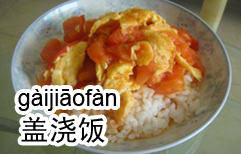
盖浇饭 (meat, vegetables on rice) costs about 5 - 10, even 20, RMB depending on quantity, ingredients and the restaurant. 盖浇饭 is, where I live, usually a very large serve (much larger than in the photo.) My local serves 三鲜盖饭 for 7 RMB and there is always fried egg in our 盖饭.
盒饭 héfàn (a boxed lunch) - I have never seen one!
Another common lunch dish here is 三鲜汤饭 tāngfàn (soup and rice) - this is as the name suggests a bowl of meat and vegetable soup plus a separate plate of steamed rice. Price 5 RMB.
Some abbreviations:
盖浇饭 is always 盖饭 here
便利店 is often 便利
One final thing, Jenny referred to 兰州 as north-west China, but if you look on a map you'll see that it is near the centre of the country (I believe that it possibly east of the geographic centre.) It seems to me that if you live in Shanghai anything west of Nanjing is considered 'west'. Not that we mind. :-)
bodaweiJanuary 18, 2010
I have just checked a map myself - 兰州 Lanzhou is actually east of where I live! Holy cow - I do live in the sticks! I feel quite exotic now.

pauleyJanuary 18, 2010
west of lanzhou..you are definetely out in the sticks.....must be cold too....i have only been as far west as xining in qinghai...or maybe zhonglei in ningxia...but i loved it out that way..beautiful country and people were great...
bodaweiJanuary 18, 2010
Pauley
Yeh, I agree. Well I'm just off to have my daily Illy coffee. The sky is blue and its about 20 degrees. Life's not too bad in the sticks.
bodaweiJanuary 20, 2010
I've had an error pointed out to me.
It is always 盖饭 here but 盖浇饭 and 盖饭 are different things. 盖浇饭 has a thickened 浇 (as the name suggests.) In some places the dishes appear separately on the menu.
jjinfranceJanuary 21, 2010
兰州in the north-west of China, is just as Indian and Ohio are in the "Middle West" of the US--but they are actually in the North East, aren't they?

xuenyJanuary 22, 2010
In the US, 'Northeast' would be New York and Boston. Indiana and Ohio are in what is called the Midwest. A more accurate name would be Mideast...but that name's already taken elsewhere

bababardwanJanuary 18, 2010
ok,no takers for:whaddya get when ya try and stuff a 盒饭 into an already full Bento box?..well for the answer you can highlight over this section:
a bento Bento box,boom boom !! ©bababardwan 2010
..I'd just like to thank John laoshi for his inspiration and teaching me everything I know about making jokes. :)

bababardwanJanuary 17, 2010
Sorry,that's on youtube.It seems much easier to find videos of pulling lanzhou noodles on youtube than it is on baidu video,perhaps because it is of more interest to foreigners and everyday mundane stuff to locals?
Who knows anything about this?:
http://www.tudou.com/programs/view/DifuMEiid1M
labelled as 拦着拉面式格斗。。lanzhou pulled noodles style wresting.
matthiaskJanuary 18, 2010
I seriously wonder how they do it. Is there a trick in the preparation of the dough? Such dough is normally just water and flour, thus how to make it so stretchable?

daofeishiJanuary 18, 2010
They apparently use high gluten flour which makes the dough really stretchy
daofeishiJanuary 18, 2010
Google and ye shall find ;)
http://www.wisegeek.com/what-is-gluten-flour.htm
egretJanuary 30, 2010
Impressive skills, these always get featured on documentaries but I hadn't known what they were called until now.
bababardwanJanuary 17, 2010
Is there any similarity/link between these 盒饭 and Japanese Bento boxes? [hey,maybe I could turn this into another box based joke somehow]
..ok,whaddya get when ya try and stuff a 盒饭 into an already full Bento box?
changyeJanuary 18, 2010
Hi bababardwan
In general Chinese people don't like to eat cold food, so they are not pariticular about bento (box lunch, 盒饭). On the other hand, Japanese love bento very much, and bento has already become a kind of "art/tradition" in Japanese society.
You can find countless kinds of tasty and colourful bento sold at railway stations, convenience stores and department houses. Of course, a lot of Japanese mothers put great energy into making bento for their children. Please look at this photo.
https://images.google.com/images?hl=en&source=hp&q=bento&btnG=Search+Images&gbv=2&aq=f&oq=&aqi=
bababardwanJanuary 18, 2010
thanks changye..amazing photos..the Japanese mums have raised the bar really high.I've seen these bento before but not seen the Chinese 盒饭 but I gather from what you're saying that two significant differences are that bento are generally cold whereas Chinese 盒饭 are generally hot and the artistic presentation of the Japanese bento.Yeah,I should have thought of that.
chrisheilong79January 25, 2010
@changye, altough there is truth to what you say. I have found that people of the north do love cold dishes, from the cold meats and sausages like you may find in one of the many 一手点 shops to the Sushi, cold Korean style Noodles and salades they love to eat in Summer. That said I do know some Shanghai people that wont touch anything unless its at least warm.

helencao_counselorJanuary 17, 2010
Wow, 我最喜欢的番茄炒蛋盖浇饭!
wo3 zui4 xi3huan de fan1qie2chao3dan4 gai4 jiao1 fan4! --- My favorite scrambled eggs with tomato over rice.

jennyzhuJanuary 17, 2010
And most foreigners love 番茄炒蛋/fan1 qie2 chao3 dan4/scrambled egg with tomato. It should be featured more prominently in Chinese restaurants overseas.

chanelle77January 17, 2010
This is my husband's favorite. He even makes it himself sometimes!
我们 / 老外也喜欢扬州炒饭, wo3men / lao3wai4 ye3 xi3huan1 Yang2zhou1 chao3fan4, We / foreigners also like Yangzhou fried rice.
jennyzhuJanuary 18, 2010
扬州炒饭/Yang2zhou1 chao3fan4/Yangzhou fried rice is yum. 中国人也喜欢。/Zhong1guo2ren2 ye3 xi3huan1. /Chinese like it too.

helenshen_counselorJanuary 18, 2010
I love 番茄炒蛋盖浇面,fan1qie2 chao3dan4 gai4jiao1 mian4, over noodles not rice! haha!

waiguorenJanuary 18, 2010
I'm quite partial to the 孜然土豆鸡丁盖浇饭 (zi1ran2tu3dou4ji1ding1gai4jiao1fan4) you can sometimes find in those Lanzhou hand pulled noodle places.

matt_cJanuary 18, 2010
番茄炒鸡蛋 fānqié chǎo jīdàn or 西红柿炒鸡蛋 xīhóngshì chǎojīdan was the first dish I learned to cook in China. Pure gold!
bababardwanJanuary 18, 2010
hehe,the mention of food and matt suddenly materialises.Good to see ya mate. :)
matt_cJanuary 18, 2010
@babs hehe well of course :D I'm learning how to make a 骨头汤 gǔtóu tāng bone stock soup at the moment - yummy stuff for winter
ousijiaJanuary 19, 2010
我喜欢吃牛肉泡馍!wǒ xǐhuan chī niúròu pàomó. I like to eat steamed bread dipped into beef soup (ok, the English description doesn't sound very appetizing...but trust me, it's 好吃!)


pretzellogicJanuary 17, 2010
First time i've seen poor old Lanzhou mentioned in a lesson.
pretzellogicJanuary 19, 2010
Most Americans have never heard of Lanzhou at all. You're perpetually telling them its in central China. I used to call Lanzhou the "Oklahoma City" of China.
What did you notice in this lesson?
You are posting as a guest. Your reply is reviewed before it appears. Log in to post without review.