
yuikocMay 15, 2009
Hello! I'm a college student studied in Shanghai . I'm now looking for a partner to help me improve my poor english . Of course , at the same time I can teach you the pure chinese as well.We can have a free talk once a week .Anything can be the topic.I believe it will be a good time.
If you are interested in my suggestion,please send me message and we can have a try.
I'm waiting for you .Sincerely!

tvanApril 23, 2009
@demee, I think that 小心/xiao3xin1 usually means "be careful", not "take care." I sometimes hear it preceded by 要 as in 要小心/yao4xiao3xin1.
I see you're not a native speaker; "take care" and "be careful" have very different meanings.
xiaoling1016April 23, 2009
hi,i am a chinese.in my opinion.for the character"喂",you can prounce it wei2 or wei4. wei2 is usually used when you answer the phone,for example,"wei2,who is that?"means"hello,who is that?".wei4 is usually when you give a warning,not associated with impolite words.but when you meet a person you do not know,you call him "wei4,who are you?".it maybe a little impolite
demeeApril 23, 2009
urcto
你好! i checked englishpod.com and i couldn't understand a thing.. does it offer the same services like that of phone english class? how much is it? please answer me :)
thank you ^_^
demeeApril 23, 2009
hi everyone!
i have a question about 小心
can i use it as take care? i'm a newbie :)
one more thing, my chinese friend wants to learn english by phone so she wants to know how much is it to enroll in a phone english class and where can she find one.. i am in shandong
please please please help me with these 2 questions

irmapicoMarch 14, 2009
In Mexico in Spanish we have something similar.
People in the street helping drivers say,
VIENE, VIENE, VIENE so drivers don´t hit the car on the back.
It means the verb " to come"
This people find a way of living in this city with the tips.
They are really something.


pearltowerpeteMarch 12, 2009
Hi urcto
Of course you're welcome to join our community! We look forward to your comments on the message boards.
If you are interested in learning English, you may also want to check out our sister site.
urctoMarch 12, 2009
azzote says 3 days ago
Changye,
your comment reminds me : I have a Qing Wen request !
well, I never know how to say plus, minus, equals, etc (well, that's also a weak point in English !) and that's pretty useful in my job, as in many...
there's a Saved by the Gong on the subject but it's an Upper and something easier on the basics (*+-=/) would be welcome...
A bon entendeur.
===============
plus:+;加(jia 1)
minus:-;减(jian 3)
equal:=;等于(deng 3 yu 2)
×;乘(以)【cheng2(yi3)】
Ep.2×3:二 乘以三 或者 三乘二
/;除(以)【chu2(yi3)】
9/3:九除以三 或者 三除九。But usually,we would like to leave out "以" ,so you will hear “九除三等于三”or “二乘三等于六”(when they want to express 2×3=6)here and there,it is ok.Chinese seldom use a passive tense,quotidianly,除以 is the same as 除,and 乘以 is the same as 乘,too.
urctoMarch 11, 2009
changye says 3 days ago
Hi cassie
Thanks to the mistake, I've learned the chengyu "举一三反" (ju3yi1san1fan3) today, for which thank you. There is a good Japanese saying I like: "転んでもただでは起きない", and this literally means "跌倒也不白起来还要随手捞一把" in Chinese. I don't know how to say it English, but its free translation should be something like "turn everything into profit".
============
I thingk the Japanese saying in Chinese should be 吃一垫,长一智.
As to举一反三,there is a section in Sayings of confucious:If he is shown one corner of a square and cannot infer the other three,the teaching will not be repeated,that 举一隅不以三隅反,则不复也,here 举一反三 comes I thingk.
============To all below:
I wonder something about the group of chinesepod, could I join the group?I am interested in the propagation of Chinese,I am in guangdong,I can speak Mandarin and Cantonese well.And I am learning English now,I think explaning Chinese in English woild be a good way to practise my English.I will try my best to explan Chinese,and you teach me English at the same time:point out all my mistakes.
pearltowerpeteMarch 11, 2009
Hi baha17
注意 emphasizes that you are focusing your attention on something-- 注意听课! "Pay attention in class!"
“小心” is more of a reminder. For example, 小心点儿,别摔倒! Be careful, don't fall!
‘注意’ is usually used to make sure people do something. ‘小心’ is usually used to make sure someone doesn't do something.小心着凉(别着凉)-- careful, don't catch cold. 注意安静(要安静)-- Keep quiet.小心中毒(别中毒) -- Be careful, don't get poisoned!注意卫生(要卫生)-- Pay attention to hygiene.
Thanks, Jiaojie, providing examples and explanation.

changyeMarch 11, 2009
Hi tarcy
Come to think of it, "我中文学了三年" is a shortened form of "我学中文学了三年", just like "他说汉语说得很流利" is often simplified into 他汉语说得很流利 (He can speak Chinese fluently). As you know, 他说汉语很流利 is grammatically incorrect.
Furthermore, you can also say "他会说流利的汉语" (He can speak Chinese fluently), and this is grammatically similar to 他学了三年的汉语, where the modifier is placed before the object. Anyway, modifying a Chinese "V+O" phrase is not so easy!
baha17March 11, 2009
Hi,
Is anyone knowthe difference btween,小心 and
注意?
thanks for the help and have a nice day
changyeMarch 11, 2009
Hi tarcy
That's a clever way to (grammatically correctly) say "I've studied Chinese for three years" in Chinese. Maybe "中文我学了三年了" would be OK, too.
As for "我学中文三年了", I guess that it might be a shortened form of "我学中文已经有三年了", in which the phrase "我学中文" functions as a subject.

shanghaichangesMarch 11, 2009
A good lesson, but I found it more simple than the other elementarys.
Not complaining, just my opinion

tarcyMarch 10, 2009
Hi,
As changye said, the following sentences are correct.・我学了三年(的)中文。 I studied Chinese for three years.・我学了三年(的)中文了。 I've studied Chinese for three years.In Chinese, measure words are generally placed before objects, for example:・我买了一本书。 I bought a book.・我每天吃三顿饭。 I have meals three times everyday.(I afraid that my English translations have some problems...)For the same reason, we here must put the measure word “三年” before the object “中文”.And these following sentences are not correct, because "中文三年" this word order is agaist the general rule. ・我学中文三年了。・我学了中文三年了。But I also think that native Chinese speakers would understand the meanings of these sentences, isn't it right?
winkey51March 10, 2009
evasiege says 1 day ago
Hi, I'm retarded and still don't understand the grammer difference between these two sentences. Can someone please explain.
我学了中文三年了
this one accentuate 三年
我学了三年的中文了
this one accentuate 中文

azzoteMarch 10, 2009
It's not gonna ever change your lives, but according to my dear other half, the beijing bus says :
"che1liang4 jin4zhan4
qing3 zhu4yi4 an1quan2"
车辆进站,请注意安全
che1liang4 stands for "vehicle". jin4zhan4 means "approaching station".
"vehicle approching, please watch out"
changyeMarch 10, 2009
Hi evasiege
The grammar book I mentioned in my posting devotes 30 pages for explaining the usage of 了, and I've read them a few times so far. BUT, honestly speaking, I still don't understand well how to use 了 properly, haha.
As is often the case, actual conversations made by native speakers are more flexible grammatically than examples in textbooks, and grammatical "tolerance" varies from person to person, which makes things more confusing!
As for the phrase 我学了三年(的)中文, maybe it's the most "precise" way to say "I studied Chinese for three years" in Chinese. In this case, 三年 works as a modifier (adjective?), so it's placed before a noun "中文", just like 五年的工作.

cjhawk7March 10, 2009
Thanks for the definitions, though still confusing in some cases. So does it really matter where the verb and the time duration is placed in this particular sentence? I'm more prone to say 我学了中文... rather than 我学了三年...
changyeMarch 10, 2009
Hi evasiege
Native guys naturally understand what these five sentences (A~E) mean, however I'm not sure if they are all grammatically correct.
I think (C)~(E) are probably OK, and confusingly, one of my grammar books (written by a native author) says (A)/(B) are incorrect (and (C)/(D) are correct)......wow.
I agree (B) is a little unnatural, but I often see (A) type sentences on the Internet. I would appreciate other people's opinions.
(A) 我学中文三年了。I've studied Chinese for three years.
(B) 我学了中文三年了。I've studied Chinese for three years.
(C) 我学了三年(的)中文。I studied Chinese for three years.
(D) 我学了三年(的)中文了。I've studied Chinese for three years.
(E) 我学中文已经(有)三年了。I've already studied Chinese for three years.

paulinurusMarch 10, 2009
hi evasiege,
until changye or CPod comes to your rescue, here's my understanding of the grammar when two 了s are found in a sentence.
the first 了is an 'aspect marker' indicating the completion of an action. .
the second 了 is a 'modal particle' to express meanings such as exclamations or intentions.
So, I would interpret 我学了中文三年了 as "I've studied Chinese for three years la " indicating that I've studied for three years and still studying.
And, 我学了三年的中文了, as " I've studied three years of Chinese". We don't know whether the person is still studying presently, but we do know she/he has studied three years of Chinese to the present time.

pearltowerpeteMarch 10, 2009
Hi zhonge
You can click on the small gear at the top right, and then select "Hide English translations by default."
Please let us know if there's anything else we can do.
zhongeMarch 10, 2009
Hi Chinesepod team -
Would you consider translations of the excerpts on the dialogue page defaulting to the "Show Translation" state, rather than showing the translations by default?
If, like me, you enjoy reviewing the lesson by attempting to read or understand the dialogue line by line this would be really helpful (otherwise you cheat by mistake). If you are a user who likes it the way it is, you can just click "show translation" and no harm has been done!
If this is just a preferenced option that i've overlooked please forgive me!
tvanMarch 9, 2009
evasiege, I can't authoritatively answer your question, but I can keep your thread alive by posting here. Both sentences seem to mean the same thing, just different word order.
I don't know what adding the second 了 accomplishes here though. It usually implies completion of the activity, but I'm not sure if that's the case here.
cjhawk7March 9, 2009
Hi, I'm retarded and still don't understand the grammer difference between these two sentences. Can someone please explain.
我学了中文三年了
我学了三年的中文了

bostonphilMarch 9, 2009
Changye,
Are you familiar with the saying "If all you have is lemons, make lemonade"? If you have misfortunes, try to find a way to turn them to a more positive outcome.
This might be close to the sentiment you are looking for.

bababardwanMarch 9, 2009
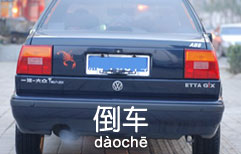
倒 ....to reverse
到.....to arrive.[Also looks like it forms part of (?the radical of ) 倒]
Yeah,I'd like lessons on the above suggestions as well as announcements at airports etc.Any other announcements.They're always harder to make it.Great to have the announcement authentic as in this lesson,but would like it if the sound level on the announcement was a bit louder.
paulinurusMarch 9, 2009
I notice only 2 people rated this lesson (one of whom is me :) Does Cpod use the rating as a feedback? And how is the popularity index determined? Recent poddies may be interested to know.

henningMarch 9, 2009
chiongzibide,here the classic Beijing bus announcement:我们马上儿儿儿儿儿儿儿儿请儿儿儿儿儿。 (Pinyin: wo3men5 ma3shangr5 er2er2er2er2er2er2qingr3r2r2r2. Don't ask me for the English)
To be fair, there are new busses now with better sound quality, and pre-recorded standard Mandarin messages. Since Olympia they even provide English versions.

zhong_bideMarch 9, 2009
I can't say I ever heard trucks talking while in China - just wasn't in the position at the right time.
However a lesson which includes the message on the trains - long distance when nearing destination, as well as the subway trains, would be good. Oh, and the buses - what is the recorded message they use? I realise it might be different in different places.
azzoteMarch 9, 2009
Changye,
your comment reminds me : I have a Qing Wen request !
well, I never know how to say plus, minus, equals, etc (well, that's also a weak point in English !) and that's pretty useful in my job, as in many...
there's a Saved by the Gong on the subject but it's an Upper and something easier on the basics (*+-=/) would be welcome...
A bon entendeur.
azzoteMarch 9, 2009
Yep. The record doesn't match the pdf.
Whatever !
Nice lesson but a little too short... I'm frustrated !
In Beijing the bus are saying something like "zhu4yi4an1quan2 注意安全" (and something before that I forgot)
"take care about safety" or something : can someone confirm/infirm ?

RJMarch 9, 2009
It is noisy in China. Everthing talks or makes noise. When I call China I can hear the car horns in the background. The Chinese use their horns for much more than we do. When you use your horn in the US you are pretty much flipping someone off unless its just a very quick tap for attention. Chinese horn practice would likely get you shot in the US. I also like the cabs, as soon as you get in it starts talking. It always reminded me of the movie total recall - the automated cabs they had on Mars - "welcome to johnny cab, what is your destination" Very sureal. I can close my eyes and know just where I am. I miss it actually. Time to go back I think.
bababardwanMarch 9, 2009
RJ,
"hello2/yeah4"
..哈哈。Do you have caller ID,or is there another way to induce a hello2?
changyeMarch 9, 2009
Hi cassie
Thanks to the mistake, I've learned the chengyu "举一三反" (ju3yi1san1fan3) today, for which thank you. There is a good Japanese saying I like: "転んでもただでは起きない", and this literally means "跌倒也不白起来还要随手捞一把" in Chinese. I don't know how to say it English, but its free translation should be something like "turn everything into profit".
changyeMarch 9, 2009
Hi rjberki
In China, trucks talk, and even desk calculators (if not all) talk, like "san1 jia1 wu3 deng3yu2 ba1 (3 + 5 = 8/三加五等于八)", probably in order to prevent sellers from cheating buyers. I think it makes a good souvenir from China. I would recommend light487 to get one during his travel in China, haha.

everettMarch 9, 2009
That recorded message really gives the lesson atmosphere. On the street I thought that noise was a recorded sales pitch or a police command. Nice to find out what it really meant.
On the subject of the noises appliances make, a friend bought a soy-milk maker – pour the beans in with water and it does the rest – and when it was finished it played jingle-bells (in sine-wave beeps, sounding like a greeting card)
I sometimes get the feeling that in China, and especially on the streets, people like noise and they like it loud. Loud is good.

changyeMarch 9, 2009
Hi Jenny
Thanks for the correction! I agree that 注意别感冒/注意不要感冒/小心感冒 are commonly used but not "注意感冒". 写中文要注意语法!

jennyzhuMarch 9, 2009
To add to Changye's explanation, 小心 implies a potential danger where as 注意 doesn't necessarily imply that. Changye, we would say 注意别感冒.
changyeMarch 9, 2009
注意 (pay attention) can be followed by more nouns than 小心 (be careful) can. For example, you can say both 注意感冒 (flu) and 小心感冒, however you can't say 小心发音/语法, while 注意发音/语法 (pay attention to pronunciation/grammar) is OK.
Nouns placed after 小心 must be something negative, or something that can possibly cause a trouble, such as 感冒 (flu),火灾 (fire),汽车 (car),and 玻璃 (glass). That said, a bad pronounciation (发音) also might cause a trouble in communication, haha.
RJMarch 8, 2009
Thanks Matt,
I get it. Sometimes I answer the phone hello2 and other days its yea4. ;-)

matt_cMarch 8, 2009
@rjberki Wei2 is the more polite way to say wei, wei4 is less polite - although some people do answer their phones with wei4. Wei can be used to get someone's attention as well as answering a phone (or door - but in this case it's usually followed by a shei2 a?)
RJMarch 8, 2009
inland was asking about wei2. Is there any other use for that beside the telephone greeting?
pearltowerpeteMarch 8, 2009
Hi rjberki
It's the same character, but when you want people to get out of the way, it's fourth tone, not second.
pearltowerpeteMarch 8, 2009
Hi inland
Oh, yes! People will shout 喂喂喂!as they come up behind you on a scooter loaded with wife, kid, bag of rice and three potted plants.
It's a good attention-getter.

inlandMarch 8, 2009
on the website I don't hear the woman say "喂,注意" (wei4, zhu4yi). Is my understanding so bad or the recording wrong?

bodaweiMarch 8, 2009
@richnirish
Part B is there as a recorded message on the podcast - a tinny but AUTHENTIC sound. Reminds me of the recordings as you approach each bus stop (eg. name of stop, take care, use the pedestrian crossing, etc.)
However, I cannot hear A saying 喂,注意 (wei, zhu yi)! Sounds like just '这里在倒车'..

richnirishMarch 8, 2009
is it just me or is part B of the audio dialogue missing from the CD download ?
earlybird99March 8, 2009
haha , rjberki, that would drive me freakin' nuts! Somehow that kind of stuff doesn't seem to bother Chinese people. I remember whenever I used to go grocery shopping in Taiwan, there would be these rediculous pre-recorded load-speakers that would advertise specials to shoppers. They would just repeat over and over again, in very poor quality sound. I truely hated that.
RJMarch 8, 2009
In the US trucks dont talk. There is a very recognizable continuous beep that occurs when a truck is backing but I have never heard one talk.
I remember a friend of mine bought a new car in China and whenever she started the car it would remind you to drive safely and have a nice day. I think I may find that very irritating after a while.
What did you notice in this lesson?
You are posting as a guest. Your reply is reviewed before it appears. Log in to post without review.