pretzelllogic36July 14, 2011
Yes, I noticed this, too. Guess they just haven't had a chance to get around to it.
bertson144June 29, 2011
Expansion sentence no. 12 needs to put in an agreement between "...qǐng wǒ..." and "...treat us..." in the translation. I suppose 'qǐng wǒmen' was intended in the Mandarin, or else it's 'treat me' in the English, but I can't be sure which it is.

go_manlyMarch 11, 2010
One of the expansion sentences is 急死我了。(Jí sĭ wŏ le.) I'm in a real hurry.
I'm wondering
1. whether 我 is considered to be the subject of this sentence, as it is in the English translation. If so, it seems to be in a strange place.
2. could we have said instead 我急死了。?
3. or is there an unspecified subject which is acting on 我 ?

bababardwanMarch 12, 2010
Good question mate.I've no idea but it's a different structure to the usual 累死了,饿死了 type pattern as you've noted so it'd be very interesting to find out [as I suspect the answer will give an even wider grammar insight] and at least this'll bump this important question again.

lujiaojieMarch 15, 2010
You can say 我急死了,我累死了,我饿死了, but 急死我了 ,累死我了,饿死我了 is more common.
急死我了 means "something let me in a real hurry", here 我 is object.
bababardwanMarch 11, 2009
2shanghai,
I don't really know why.I just note that the vocab tab has ke3 and ai4 separated by a gap and that exercise 3 is very senstive to things like gaps and neutral tones being represented by a 5.I think of ke3 as being akin to the english "...able" so in this case loveable..cute.While ke3 and ai4 [love] go together to make loveable/cute,maybe it's like our hyphenated words except that Chinese/pinyin doesn't have hyphens ,so instead a gap.I'm very happy to try and help,but best ask CPod or someone more advanced for clarification.Cheers :)

2shanghaiMarch 10, 2009
@bababardwan
Any idea why we need to put in "ke3 ai4" instead of "ke3ai4"? I'm not doing the greatest on the pinyin exercises.

bluedaisyJanuary 31, 2009
Oops...turns out he just didn't understand what I was trying to say! ;-) they do have xitang at Taiwanese weddings
bluedaisyJanuary 30, 2009
I really confused my boyfriend with this one...I asked him if we could give out xitang at our wedding and he didn't know what I was talking about. It turns out that in Taiwan people only give out xitang *before* the wedding, when you're inviting people. He'd never even heard of giving it out during/after. Too bad, because that would be a really cute favor!

pearltowerpeteJanuary 25, 2009
Hi billgloveruk
The 啊 at the end of those sentences adds a little emphasis, or surprise, or even chastising. It affects tone, not meaning.
Generally, women are a little more likely to use those.

billgloverJanuary 25, 2009
I'm wondering if anyone can explain why there is an 啊 at the end of many of the expansion sentences. I was trying to pronounce them out loud only to be asked why I was putting an 啊 at the end of the sentences.
The explanation we could come up with was 啊 = !
bababardwanJanuary 23, 2009
kenm,
hao3 works for me.I think make sure there are no spaces.ke3ai4 will not work as it needs to be ke3 ai4 with a gap.Neutral tones need to have a 5 after them.


kenmJanuary 23, 2009
I have trouble with the third part of the exercises (where you type in the pinyin). Even when I think I'm doing it correctly, I get a mark that I don't understand (e.g. in this exercise, I got 2/6). I assume it's because I'm not handling some of the conventions properly (e.g. neutral tone, or spacing, etc.), but the test doesn't tell me how the correct answer should be entered. For example, I tried "hao3" for question 2, and "ke3ai4" for 3 (both with and without the space), and neither were marked correct. Suggestions? ...

vikramJanuary 20, 2009
The audio clip for the expansion sentence "盒子里是什么?好重啊!" is not working. fix that please.
and...
can "hao3" and "hen3" be interchangeably used depending on the context?
bababardwanJanuary 16, 2009
Just to clarify about 8 八 being lucky because it sounds like fa1...I presume that is 发 as in 发家 ?
btw 恭喜,恭喜。我喜欢喜糖 was my weak attempt at something akin to the English alliteration.Does Chinese have similar literary devices to English? Is there a name for repeating a single character that is found in different words within a sentence?
alexyu_yxjJanuary 15, 2009
To jackfrombelgiu
Every Chinese character like a small picture, we rarely make the mistake to writte "爱" as "爰", but the other characters might be, such as "充值卡" and "冲值卡", the most important I try to explain is when a word like "安静" postfixes with "的", it is an adj. mesns "tranquil", but if it postfixes with "地", it is an adv. means "tranquilly". People in today's China rarely to distinguish these to characters, but their very different, especially in English.
kesiruiJanuary 15, 2009
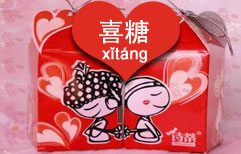
I just found the perfect picture for this topic on my laptop. It's from when we went to get things for the wedding, This is the little shop that sells wedding candies, the boxes and more.

GabeKzooJanuary 14, 2009
Does xi3 tang2 have to be a particular texture like hard candy opposed to soft candy? I don't know if it was mentioned in the podcast, but I was just curious. :)
jaylefJanuary 14, 2009
Kesirui,
Thank you for sharing the pictures of your xi3 tang2. It added a little extra visualization to the lesson for a newbie like me. And please allow me to say 恭喜
jiantingJanuary 14, 2009
I don't want to dampen the mood, but...
I just attended a Chinese-American funeral yesterday in California, USA. Candy was handed out after the service. Is this also called 喜糖 ?
kesiruiJanuary 14, 2009
pearltowerpete,
Haha, that's exactly what I did, (I regretted it after making about boxes 250 though...)

chrisJanuary 14, 2009
Pete,
Yes, I think we were slightly done-over by the specialist wedding shop we used - a keen eye for a profit opportunity the Quanzhounese businesspeople have! However, to put in context, I think we ended up giving candy bags to over 500 people in the end, so it's easy to see how quickly the cost can add up. It was definitely a cultural eye-opener for me since we were giving bags to people with only the most tenuous links to us!
What was also interesting was the relationship between family hierarchy and the amount of candy we gave. For example, my wife's maternal grandmother (god bless her - never learnt Putonghua and only speaks the local min nan hua dialect!) received what seemed like several kilos of candy!
All part of the fantastic China experience I've had over the past several years!
Chris
pearltowerpeteJanuary 14, 2009
Hi chris,
Thanks for sharing your story. I'm really surprised to hear that the candy was more expensive than a banquet for 200 people!
At those prices, it would make sense to buy your candy in bulk and get some 双喜 boxes printed, and package it yourself.

kimiikJanuary 14, 2009
Honestly, the European dragées and the 喜糖 are very similar in aspect, packaging and uses. However, the traditional sugar shell of the dragées could be very hard.
chrisJanuary 14, 2009
I can totally relate to this, having got married in Quanzhou, Fujian a few months ago. I know the wedding candy thing is slightly different between regions in China, but what I found amazing was (a) quite how many people we were expected to give candy too and (b) the mark-up that wedding candy stores make! I'm too polite to mention the amounts, but let's just say that the candy was more expensive than a full banquet for 200 people.
Also, regarding Jenny's comment about dishing out ciggies - yes, this happened at our wedding too. The most bizarre thing I've experienced in a while.
I won't go into the fact that yours truly was made to try and dip chopsticks into bowls of chicken soup at each table - at the same time as the guests at the table tried to stop me from doing so. The only way they'd let me do the dipping was if I drank a shot of baijiu. Let's just say after 18 tables I was somewhat inebriated. All part of the wedding ritual apparently.........
Chris


fangailiJanuary 13, 2009
This is a great lesson. I've been wondering how to say a lot of marriage-related things, since I'm a newlywed! We didn't have xi3tang2 though.
And John -- the pinyin guide is excellent! Thank you!
kesiruiJanuary 13, 2009
I have the perfect example to show everyone!
In this picture you can see on the middle of the table the 喜糖 (xi3tang2) that was given out at my very recent Chinese wedding! Mine were little boxes with chocolate in them that were put on all the plates before people arrived.
We must have looked at 100 different kinds of boxes and candies to choose from.
(my new avatar is also from the wedding ^_^)

matt_cJanuary 13, 2009
@light487@Bababardwan --D-- is otherwise known as Sunix (he's the handsome fellow on the left in this lesson picture), he is truly a legend. You'll be hearing him more often over January and February. My all time favorite line of his was --I like Liu De Hua's songs-- from the karaoke lesson (the first dialogue with Sunix that I had the pleasure of directing). He has also dropped in a few times to take part in the discussions.
matt_cJanuary 13, 2009
@jackfrombelgium I think when fingers slip on the keyboard the brain is still reading how the words should be spelt rather than how they were actually misspelled. Have you ever read that email floating around with all the misspelled words that reads perfectly fine to everyone despite every single word being misspelled? Weird. I guess with Chinese characters it is also easy to make mistakes when there are two characters that appear similar to the untrained eye. I believe I used to get 找 & 我 / 干 & 千 mixed up quite regularly (only with reading but not when writing them). Carelessness could also be a factor ;-)
xueqiuJanuary 13, 2009
jenny,
I got to admit - l already smoked them.... but I'm clean now. That were the wild times of my youth I guess :)
Being a sportsman 对健康更有利!!
suxiaoyaJanuary 13, 2009
I remember hearing once a male Chinese colleague, who had recently started seeing a girl, being gently teased with the question:
我们什麼时候能吃你的喜糖
women shenme shihou neng chi nide xitang?
I thought it was quite a sweet way to ask how well it was going between them. Of course, he insisted that he'd not be handing out wedding candy for a long time!

jennyzhuJanuary 13, 2009
xueqiu,
There's a popular brand of cigarettes called 红双喜/hong2 shuang1 xi3. No surprise that it's the choice of cigarettes given out at Chinese weddings. Oh, yes, besides candies, we also offer ciggies at weddings. Unhealthy but practical. However, many young people have stopped doing it.
xueqiuJanuary 13, 2009
The 喜糖 and 喜蛋 hopefully add up to 双喜 / 囍 (double happiness) for the married couple
那么多的喜 :D
bababardwanJanuary 13, 2009
light,
We're on the same wavelength here.I was going to make exactly the same comment about voice D.Noticed his voice before usually in a similar role and always makes me laugh.Loved the enthusiasm for the xitang in this one.hehe

calkinsJanuary 13, 2009
John's Pinyin Chart is really useful (it's also great that you can download it)... here's another one that I really like to use....it has some detailed info. like you're talking about Light, but what I love is that you also get:
- an animated sketch with the audio pronunciation
- a step-by-step description showing what the mouth, lips, tongue, etc. should be doing
- a video of a Chinese person's mouth producing the sound
I know it'd be a lot of work, but it'd be great if Cpod incorporated something similar in the future.

jackfrombelgiumJanuary 13, 2009
Hi,
@matt_c
When you write "beleive" my brain reads "believe".
This is so with all other mistyped or miswrited words.
Is this the same with Chinese people when they write for exemple
我爱你 我爰你 meaning to say I love you.
Ai4 and yuan2 are very identical for me.
More specific in handwriting text.
Jack
matt_cJanuary 13, 2009
@light487 If you check out the Resources there's a whole 16 section pronunciation guide. I believe section 12 refers to the un/hun pronunciation. John has worked hard on this - pls give him any feedback or suggestions you may have. ps. I accidentally used the wrong symbols in this message with the un/hun (I used pointy brackets - used in html coding) hence it got all messed up...since been fixed.

light487January 13, 2009
Haha.. I love this male actor (Voice of D).. I have heard him in other lessons and he always makes me laugh with his surprised reactions. :) Is it possible to list the actors in the credits somewhere? I think they definitely deserve mention because they are so good! :)
On the subject of Pinyin.. it's one thing to listen to the actual sounds, like in the pronunciation guide, and it's another to understand how those sounds are derived. For example we hear jiéhūn used in the dialogue to mean "to marry". As an English speaker I see "hun" and automatically think of the sound as in the English word "nun". However, if we look at how the "un" final is derived we can understand why it is actually pronounced differently. When the compound final "uen" is combined with an initial, such as "h", it is simplified and written as "hun". So if you know that it is actually "huen", then you can pronounce it more correctly. It is the same with the compound final "uei" as when it is combined with an initial such as "d" it gets simplified and written as "dui" but because we know how it is derived we can think of it as "duei" and pronounce it more correctly.
I am wondering why there is nothing on this important topic on ChinesePOD, such as in the pronunciation guide? May be a more advanced "section" of the pronunciation guide could be created to elaborate on this principle and foundation ideas?

pearltowerpeteJanuary 13, 2009
Hi changye
Some Chinese will also ask 我什么时候能喝你的喜酒?
I wonder what the reaction would be if my 喜酒 were gin-and-tonic?
changyeJanuary 13, 2009
According to 百度百科, in the past, Chinese people threw 喜糖 when a wedding couple got into a carriage or entered a bedroom, just like "rice shower" at some western wedding ceremonies.
Incidentally, the phrase "吃喜糖" naturally connotes "to get married", so some worried Chinese parents say, "孩子呀,我们什么时候能吃你的喜糖?" (My son/daughter, when will you get married?)

azzoteJanuary 12, 2009
Ok, I know, but still... I think a little help in the transcript would greatly help us to memorize those rules and not get mixed with them. At least for newbies and Elementaries. It's not always that clear in the dialogue... and specially the 一 changes are tricky. I don't no, maybe just underline the pinyin when there's a change ?
JohnJanuary 12, 2009
I got married in China, so I did the whole 喜糖 (xǐtáng) thing. I remember finding it a little tricky to figure out exactly who I needed to give it to. Co-workers? Classmates (I was a graduate student at the time)? Friends? Neighbors?
JohnJanuary 12, 2009
azzote,
I see your point, but the way we write the tones follows the rules for pinyin, which we did not create. Once you learn the three basic rules, it's quite a regular system.
You can find those rules in the Tones section of our Pronunciation Guide (scroll to the bottom).
azzoteJanuary 12, 2009
By the way, the subject has been touched before, but I insist : it would be very good if you guys could find a way to show us both the "normal" tone and the "spoken" one.
Maybe write the spoken tone but put it in blue so we know it's been changed. Or let it like this but find any way to remind us to change it.
For instance, I saw 这是 zhe4 shi4 and I suddenly panicked : should I say zhe2 shi4 ??? Does this apply here ???? My heart's still racing.
I mean, some of us have only CPod !!!
xuchenJanuary 12, 2009
喜糖是好吃的,但我觉得婚姻的晚饭是最好吃的!不要错过参加婚姻的机会!
Wedding candy is good, but the wedding dinner is by far the best! Don't miss an opportunity to join!!
-许尘
mukdenJanuary 12, 2009
TONS of good little phrases in this lesson.
Very practical stuff here good for quite a number of situations.
pearltowerpeteJanuary 12, 2009
Hi bababardwan
So do I! The Hershey's kiss seems like a perfectly symbolic 喜糖.
What did you notice in this lesson?
You are posting as a guest. Your reply is reviewed before it appears. Log in to post without review.